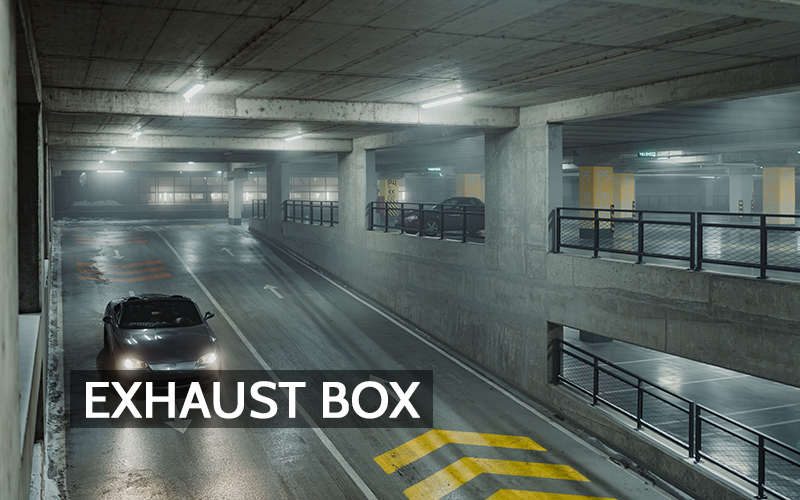
Parking garages are unusual indoor environments. They may contain hundreds or thousands of vehicles, yet many people give little thought to the air they breathe while walking from their car to an elevator.
Every gasoline- or diesel-powered vehicle entering a garage releases exhaust. In an open parking lot, wind quickly dilutes most of those emissions. Inside an enclosed or underground garage, however, pollutants can accumulate if the space is not properly ventilated.
Modern parking garages are therefore designed around an important air-quality problem: allowing cars to operate inside a structure without allowing their exhaust to build to dangerous concentrations.
What Is in Vehicle Exhaust?
Carbon monoxide, or CO, has traditionally been one of the most important pollutants considered in parking-garage design.
Carbon monoxide is a colorless and odorless gas produced by incomplete combustion. Gasoline engines can release CO while starting, idling, accelerating, or operating improperly. Because people cannot smell or see it, dangerous concentrations can develop without an obvious warning.
Exposure can cause headache, dizziness, nausea, confusion, and weakness. At sufficiently high concentrations, carbon monoxide interferes with the blood’s ability to transport oxygen and can become life-threatening.
Vehicle exhaust can also contain nitrogen oxides, particularly nitrogen dioxide, or NO2. Diesel engines have historically been an important concern for NO2 as well as fine particulate matter.
Garages may additionally contain volatile organic compounds, soot, brake particles, tire debris, and road dust disturbed by moving vehicles.
Modern vehicles generally produce far less exhaust pollution than older cars because of improved engines, catalytic converters, and emission controls. The basic problem remains, however: many small emission sources operating simultaneously inside a confined space can still create unhealthy air.
Open Garages Use the Wind
Not every parking structure requires the same ventilation system.
Many aboveground garages are intentionally built with large openings along their exterior walls. These openings allow outdoor wind to pass through the structure and dilute vehicle exhaust naturally.
To qualify as an open parking garage under building codes, a structure must meet specific requirements for the amount and arrangement of its exterior openings.
Designers must consider more than simply cutting holes into the walls. Nearby buildings, architectural panels, interior walls, ramps, and the direction of prevailing winds can all affect whether air actually reaches the center of the garage.
A garage may look open while still developing poorly ventilated corners if air cannot move freely through the structure.
Enclosed Garages Need Mechanical Ventilation
Underground garages and enclosed parking structures cannot depend entirely on natural wind.
These facilities use mechanical exhaust systems. Large fans remove contaminated garage air and discharge it outdoors while replacement air enters from outside.
The goal is continuous dilution. Rather than allowing pollutants to collect and then clearing them periodically, ventilation keeps exhaust concentrations from reaching unacceptable levels.
The placement of exhaust openings matters. Engineers try to move air throughout the garage rather than allowing it to travel directly from an outdoor-air opening to an exhaust fan while bypassing other areas.
Some modern garages use jet fans mounted to ceilings. Instead of relying entirely on large networks of ducts, these fans push air horizontally across the garage toward major exhaust points. They can help eliminate stagnant areas and may also play a role in smoke management during a fire.
Sensors Tell the Fans When to Work Harder
Running large ventilation fans continuously at full speed consumes considerable electricity. Modern garages can instead use gas detectors to control ventilation according to actual conditions.
Carbon monoxide sensors are commonly installed throughout enclosed parking areas. Depending on applicable codes and the types of vehicles expected, nitrogen dioxide sensors may also be used.
When pollutant concentrations are low, the ventilation system can operate at a reduced level. As more vehicles enter and pollutant readings rise, controls increase fan speed or activate additional ventilation.
This is known as demand-controlled ventilation.
A busy garage after a sporting event may suddenly contain hundreds of vehicles starting and leaving within a short period. Sensors allow the ventilation system to respond to that temporary increase. Several hours later, when the garage is almost empty, the system does not need to move the same enormous volume of air.
Sensors require regular inspection and calibration. A detector that has drifted out of specification may incorrectly report safe conditions or cause fans to operate unnecessarily.
Exhaust Must Stay Out of the Building
A parking garage beneath an apartment, hotel, office, or shopping center creates another challenge: keeping garage air from entering occupied spaces.
Doors, elevator shafts, stairwells, utility penetrations, and ventilation ducts can all provide pathways for air movement.
Building designers use pressure differences and physical separation to limit this transfer. Garage exhaust outlets should also be positioned away from building air intakes, doors, windows, and pedestrian areas so discharged pollution is not simply pulled back inside.
Problems can develop when building ventilation systems become unbalanced. If an occupied building operates at strongly negative pressure relative to the garage, it may actually draw contaminated garage air through gaps and openings.
Electric Vehicles Change the Problem, but Do Not Eliminate It
The growing number of electric vehicles will gradually reduce routine exhaust emissions inside parking garages.
An electric vehicle produces no tailpipe carbon monoxide or nitrogen dioxide while driving through the garage. A garage filled primarily with electric vehicles therefore presents a very different ventilation load than one filled with gasoline and diesel vehicles.
Other sources remain. Tire wear, brake wear, road dust, maintenance vehicles, and occasional combustion engines still produce particles.
Electric vehicles also create new design considerations involving charging equipment and fire safety. These concerns are different from conventional exhaust pollution and require their own engineering controls.
Drivers Still Have a Role
Garage ventilation is designed to protect occupants during normal vehicle operation, not to make unnecessary idling harmless.
Drivers should avoid leaving engines running longer than necessary. Maintenance crews should never operate gasoline-powered generators, pressure washers, saws, or similar equipment inside enclosed garages without specifically engineered ventilation and safety controls.
Workers who spend entire shifts inside parking facilities face greater exposure than someone walking to a parked car. Facility operators may therefore inspect ventilation systems, monitor pollutant concentrations, maintain vehicle restrictions, and investigate complaints involving headaches, dizziness, exhaust odors, or visibly smoky vehicles.
Parking garages demonstrate an important principle of indoor air-quality engineering: pollution cannot always be eliminated at its source. Sometimes the environment must instead be designed to recognize, dilute, capture, and remove it before people are exposed.
References
- https://codes.iccsafe.org/content/IMC2024P1/chapter-4-ventilation
- https://codes.iccsafe.org/content/IMC2024P1/chapter-5-exhaust-systems
- https://www.ashrae.org/technical-resources/bookstore/standards-62-1-62-2
- https://www.osha.gov/sites/default/files/publications/CARBONMONOXIDE-FACTSHEET.pdf
- https://www.osha.gov/sites/default/files/publications/3430INDOOR-AIR-QUALITY-SM.pdf
- https://www.osha.gov/otm/section-3-health-hazards/chapter-3
- https://www.epa.gov/indoor-air-quality-iaq/carbon-monoxides-impact-indoor-air-quality
- https://www.epa.gov/indoor-air-quality-iaq/what-carbon-monoxide