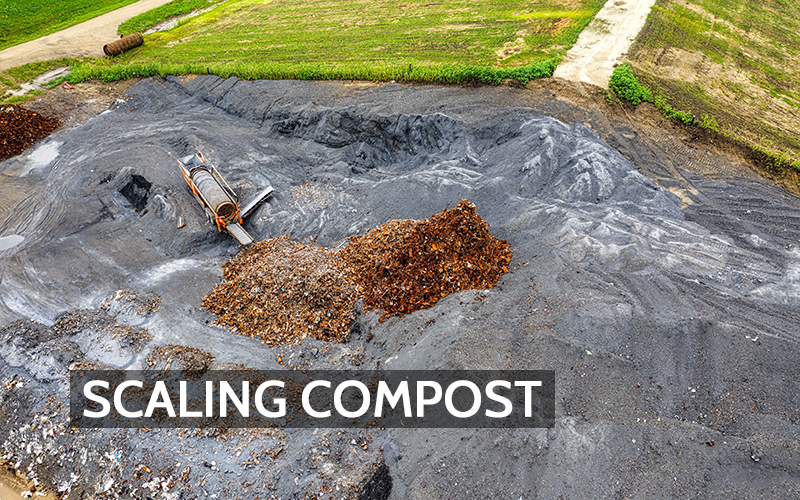
On a forest floor, decomposition happens gradually across a wide landscape. Leaves fall, microorganisms consume organic matter, nutrients return to the soil, and the gases produced by decay disperse into the atmosphere.
An industrial composting facility compresses that same biological process into enormous piles containing food scraps, yard waste, manure, biosolids, or other organic materials. By managing oxygen, moisture, temperature, and microbial activity, operators can transform tons of waste into useful compost within months.
But concentrating decomposition also concentrates its emissions. A compost facility must therefore manage not only organic waste, but an actively changing atmosphere of gases, odors, dust, microorganisms, and biological particles.
Composting Is Supposed to Be Aerobic
Industrial composting depends primarily on aerobic microorganisms—organisms that use oxygen while breaking down organic matter.
Their metabolism produces heat, water vapor, carbon dioxide, and new microbial biomass. Temperatures inside an active compost pile can climb above 55°C, or 131°F, as microbial activity accelerates.
Maintaining oxygen is critical. If portions of a pile become compacted or saturated with water, oxygen cannot penetrate effectively. Anaerobic microorganisms can then become active, producing methane and strongly odorous compounds.
Ironically, one of the greatest air-quality problems at a compost facility can begin when too little air reaches the material.
A Compost Pile Is Also a Gas Source
Carbon dioxide is produced naturally as microorganisms metabolize organic carbon. Because much of that carbon came relatively recently from plants and other biological materials, composting CO₂ is generally treated differently from fossil-fuel carbon in greenhouse-gas accounting.
Methane is more problematic. Although composting is designed to remain aerobic, oxygen-poor pockets can develop deep within dense or excessively wet material. Methane-producing microorganisms can thrive in these zones.
Nitrogen-rich materials create another challenge: ammonia. Food waste, manure, biosolids, grass clippings, and similar materials can contain substantial amounts of nitrogen. As decomposition proceeds, some of that nitrogen may be released as ammonia gas.
Ammonia is both an odor problem and an atmospheric pollutant capable of contributing to secondary particulate matter after reacting with other compounds in the atmosphere.
The Smell of Decomposition Is Chemically Complicated
Compost odors rarely come from a single chemical.
Ammonia, reduced sulfur compounds, organic acids, alcohols, ketones, terpenes, and many other volatile organic compounds can emerge as materials decompose. Some have extremely low odor thresholds, meaning people may detect them even when atmospheric concentrations are small.
Feedstock matters considerably. Composting woody yard waste produces a different chemical mixture than processing food waste, manure, or wastewater biosolids.
Poor aeration can make the problem worse by encouraging compounds associated with anaerobic decay.
For facilities near neighborhoods, odor can become the most visible—or rather, smellable—evidence of an otherwise invisible air-emissions problem.
Turning Compost Can Send Biology Airborne
Keeping a pile aerobic often requires physically moving it.
Windrow composting arranges material into long rows that are periodically turned by specialized machinery. Turning introduces oxygen, redistributes moisture, and prevents portions of the pile from remaining stagnant.
It also disturbs enormous quantities of biological material.
Dust, fragments of plant matter, bacteria, fungal spores, and other bioaerosols can become airborne during turning, grinding, loading, and screening operations. Finished compost can generate additional dust when it is screened into different particle sizes.
Workers operating equipment near these processes may experience much higher exposures than someone standing well away from the facility.
Moisture Has to Be Carefully Balanced
Microorganisms require water, so compost cannot simply be kept dry to reduce emissions.
Too little moisture slows biological decomposition and encourages dust generation. Too much moisture fills the pore spaces that would normally contain air, restricting oxygen movement and encouraging anaerobic conditions.
Temperature, moisture, oxygen, particle size, feedstock composition, and pile structure therefore interact continuously.
Even aeration requires balance. Supplying additional air can improve oxygen availability, but excessive airflow may cool the pile or remove moisture too rapidly.
Industrial composting is less like leaving leaves in a pile and more like operating a biological reactor.
Aerated Piles Give Operators More Control
Aerated static pile systems use perforated pipes and blowers to move air through compost without frequent mechanical turning.
Air can be pushed upward through the pile or pulled downward under negative pressure. Negative aeration has an important air-quality advantage: exhaust can be collected rather than simply escaping from every surface.
A layer of finished compost may also be placed over an active pile. Besides conserving heat and moisture, this cover can help capture some odors and emissions before they reach the surrounding air.
More sophisticated facilities continuously monitor temperature and adjust blower operation accordingly.
Biofilters Let Microbes Clean Up After Microbes
Collected compost exhaust can be directed through a biofilter.
Biofilters typically contain porous organic material such as finished compost, wood chips, or similar media. As contaminated air passes through the moist filter, gases are absorbed onto surfaces or dissolved into thin layers of water.
Microorganisms living within the filter then metabolize many of the captured compounds.
Biofilters can reduce VOCs and odors and are particularly well suited to composting because the process already depends on managing microbial communities.
They are not maintenance-free. Moisture, airflow, temperature, compaction, and microbial activity must themselves be controlled for the filter to remain effective.
Some Facilities Put Decomposition Indoors
In-vessel and enclosed composting systems move the most active stages of decomposition inside buildings, tunnels, drums, or enclosed reactors.
This increases construction and operating costs but gives facilities much greater control over temperature, moisture, aeration, and exhaust.
Buildings can be maintained under negative pressure so that air flows inward rather than allowing odors to escape through doors and openings. Exhaust can then be routed through biofilters, scrubbers, or other treatment systems.
Enclosure is particularly valuable where large composting operations must coexist with densely populated communities.
Managing Decomposition Without Exporting It
Composting can prevent organic waste from entering landfills, where decomposition frequently occurs under methane-producing anaerobic conditions. The finished compost can also return organic matter and nutrients to soil.
Yet composting does not make decomposition disappear. It relocates and manages it.
Every truckload of food scraps, leaves, manure, or other organic material entering a facility becomes part of a massive microbial ecosystem producing heat, gases, particles, and biological material.
Successful industrial composting therefore depends on keeping that ecosystem aerobic while controlling what leaves it.
The objective is not simply to make compost. It is to accelerate one of nature’s oldest recycling processes without turning the surrounding atmosphere into part of the waste stream.
References
- U.S. EPA — Composting
- U.S. EPA — Approaches to Composting
- CalRecycle — Composting Emissions and Air Permits
- Bioresource Technology Reports — Mitigating Greenhouse Gas Emissions From Composting Systems
- Environmental Pollution — Malodorous Gaseous Emissions During Composting
- Science of the Total Environment — VOC Emissions From Composting