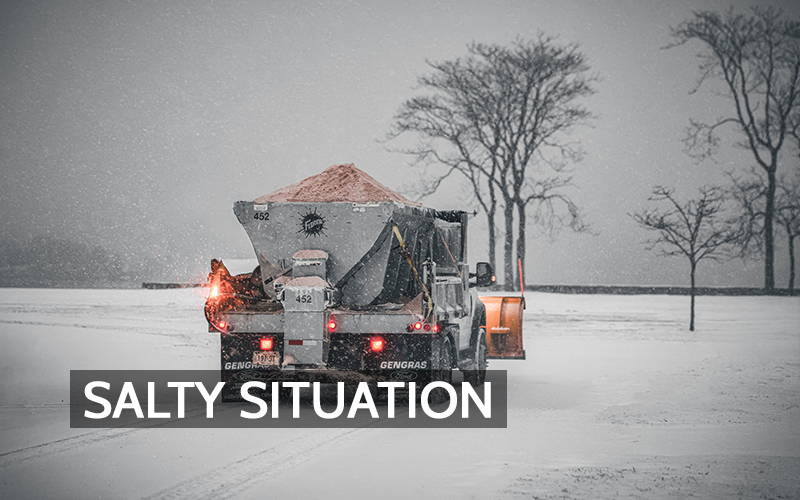
When snow begins falling, road salt becomes one of the most important tools for keeping highways, sidewalks, parking lots, and neighborhood streets safe. Sodium chloride lowers the freezing point of water and helps prevent ice from bonding tightly to pavement, allowing plows and traffic to clear roads more effectively.
Most environmental discussions about road salt focus on runoff into streams, lakes, groundwater, and roadside vegetation. However, not all of the material stays dissolved in water. Some remains on pavement, dries, is crushed by vehicles, and eventually becomes airborne.
This means winter road maintenance can also influence the air immediately surrounding busy roads.
How Road Salt Becomes Airborne
Rock salt spread onto pavement begins as relatively large crystals. Traffic quickly changes that.
Vehicle tires crush salt, sand, pieces of pavement, brake debris, and ordinary road dust into smaller particles. As cars and trucks pass over the road, their tires and turbulent wakes can lift this material back into the atmosphere.
Dry conditions after a winter storm can make this process particularly noticeable. Roads may appear clear, but a layer of dried salt and sediment remains on the surface. Each passing vehicle provides another opportunity for that material to become airborne.
The resulting particles may contain sodium chloride, calcium chloride, magnesium chloride, sand, soil minerals, tire material, brake wear, and fragments of pavement.
Much of this material falls into the coarse-particle range associated with PM10, although smaller particles can also be produced and contribute to PM2.5.
Winter Road Dust Is Chemically Different
Road dust exists throughout the year, but winter changes its chemistry.
During warmer months, resuspended road material may consist largely of soil, pavement, brake wear, tire debris, and other urban dust. During winter, large amounts of chloride-containing deicing material are added to that mixture.
Research in inland cities has found road salt particles in winter air and demonstrated that traffic can mechanically aerosolize salt from treated pavement.
Once airborne, salt does more than behave as an inert grain of dust. Chloride-containing particles can participate in atmospheric chemical reactions involving nitrogen oxides.
One particularly interesting product is nitryl chloride, or ClNO2. It can form at night when nitrogen-containing pollutants interact with chloride particles. After sunrise, nitryl chloride can break apart and release reactive chlorine atoms that influence ozone formation and the chemical transformation of other pollutants.
Road salt therefore provides an unusual example of how a material applied for transportation safety can become part of urban atmospheric chemistry.
Sand Can Create a Different Particle Problem
Salt is not the only material used during winter maintenance.
Sand and other abrasives may be applied when temperatures are too low for salt to work efficiently or when additional traction is needed. Abrasives do not melt ice. Instead, they create a rougher surface for vehicle tires.
Once snow disappears and roads dry, however, that sand remains.
Traffic can grind abrasive material into smaller particles and repeatedly resuspend it. This may contribute to high concentrations of coarse road dust during late winter and early spring.
Street sweeping can help remove this accumulated material before it is repeatedly dispersed by traffic, although sweeping equipment itself must be designed and operated so it does not simply create another dust cloud.
Brine Can Help Keep Salt on the Road
One way transportation departments reduce salt loss is by using liquid brine or by prewetting dry salt before application.
Prewetting helps salt stick to the pavement rather than bouncing away when it leaves the spreader or being immediately pushed aside by traffic. Moist salt also begins dissolving more quickly, allowing it to start working sooner.
Some agencies apply salt brine before a storm begins. This practice, known as anti-icing, attempts to prevent snow and ice from bonding strongly to the road in the first place.
These methods can reduce wasted material when conditions are appropriate. Less salt scattered onto shoulders or left as loose dry crystals also means less material available to become dust later.
Modern spreader trucks can further control application according to vehicle speed, road temperature, precipitation, and treatment needs instead of releasing material at one constant rate.
Different Deicers Have Different Tradeoffs
Sodium chloride is the most familiar road salt, but it is not the only deicing chemical.
Calcium chloride and magnesium chloride can work at lower temperatures and readily attract moisture from the atmosphere. Potassium acetate and calcium magnesium acetate are alternatives used in some specialized applications.
Each material has different costs, temperature ranges, corrosive properties, and environmental effects.
A chemical that reduces one problem does not automatically eliminate every environmental concern. Some alternatives still contain chloride, while others may affect water chemistry or require more energy and resources to produce.
Selecting a deicer therefore involves balancing road safety, temperature, cost, infrastructure corrosion, water quality, and the amount of material likely to leave the roadway.
Managing Winter Road Air Quality
The most effective strategy is often using only as much material as necessary.
Transportation agencies can calibrate spreaders, monitor pavement temperatures, improve storm forecasting, prewet salt, use liquid anti-icing treatments, and train operators to match application rates to actual conditions.
Snowplows remain important because mechanically removing snow reduces how much chemical treatment is required.
After storms, street cleaning can remove accumulated sand and road residue before long dry periods allow repeated resuspension. Communities can also pay particular attention to heavily traveled roads near homes, schools, sidewalks, and other places where people spend time close to traffic.
Drivers contribute as well. Slower speeds on treated roads not only improve winter safety but may reduce the turbulence and mechanical disturbance that lifts loose material into the air.
Road salt remains an important tool for preventing winter crashes, and completely eliminating deicing would create serious safety problems. The challenge is using it efficiently.
A handful of salt thrown onto an icy road may seem entirely different from traditional air pollution. But after being crushed, dried, lifted by traffic, and mixed with urban exhaust, some of that material becomes part of the atmosphere.
Winter air quality is shaped not only by what comes from a tailpipe, but also by what lies beneath the tires.
References
- https://pubs.acs.org/doi/10.1021/acscentsci.9b00994
- https://hero.epa.gov/reference/6715813/
- https://www.epa.gov/snep/winter-coming-and-it-tons-salt-our-roads
- https://www.usgs.gov/centers/new-england-water-science-center/news/deicing-new-englands-roads-parking-areas-and-walkways
- https://www.usgs.gov/publications/methods-evaluating-potential-sources-chloride-surface-waters-and-groundwaters
- https://www.fhwa.dot.gov/publications/research/safety/95202/
- https://www.fhwa.dot.gov/publications/research/safety/95202/002.cfm
- https://www.fhwa.dot.gov/publications/research/safety/95202/005.cfm
- https://environment.transportation.org/teri-idea/direct-liquid-applications-a-winter-maintenance-best-practice-for-improved-road-salt-efficiency/