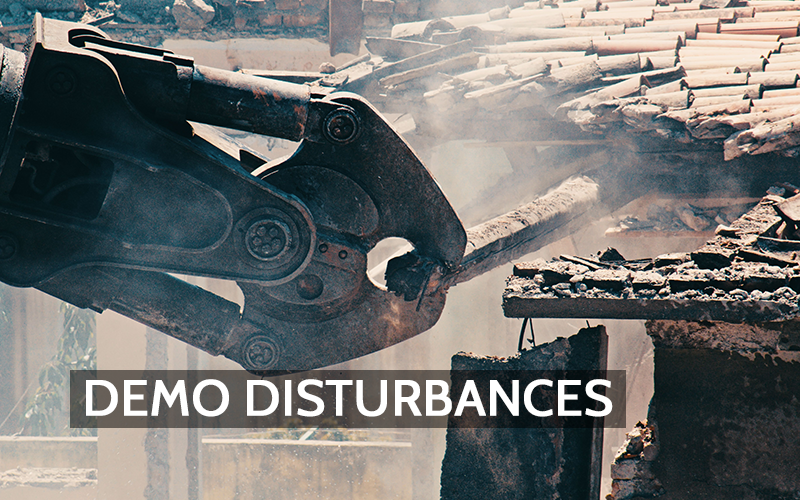
Demolishing a building may look simple from a distance. An excavator tears through walls, debris falls into piles, trucks remove the material, and eventually the site is cleared.
From an air-quality perspective, however, demolition is a carefully managed process. Breaking apart concrete, drywall, insulation, wood, roofing, paint, flooring, and mechanical equipment can release enormous quantities of dust. Older or specialized buildings may also contain asbestos, lead, silica, mercury, PCBs, chemical residues, or other hazardous materials.
The risks depend heavily on what the building was made from, where it is located, how it was used, and how it is being taken apart.
Not All Demolition Dust Is the Same
Most demolition creates ordinary particulate matter from crushed building materials. Concrete, brick, mortar, plaster, and masonry can generate large amounts of fine mineral dust.
One particular concern is respirable crystalline silica. Silica is common in concrete, brick, stone, mortar, and other construction materials. Crushing, drilling, cutting, or breaking these materials can produce particles small enough to penetrate deep into the lungs.
Wood, insulation, drywall, roofing materials, and accumulated dirt create additional airborne particles. Diesel-powered excavators, loaders, generators, and trucks add exhaust containing nitrogen oxides, carbon monoxide, and particulate matter.
The resulting air around a demolition site may therefore contain both mechanically generated dust and combustion pollution.
Older Buildings Require More Investigation
The age of a building can dramatically change the demolition plan.
Older structures may contain asbestos in pipe insulation, floor tile, roofing, fireproofing, siding, textured coatings, and other materials. When intact asbestos-containing products are broken apart, microscopic fibers can become airborne.
Lead-based paint is another concern, particularly in older housing and painted steel structures. Demolition can turn painted surfaces into contaminated chips and dust that may spread beyond the work area.
Older buildings can also contain mercury switches, fluorescent lamps, PCB-containing electrical equipment or caulking, and other materials that should be removed or managed before heavy demolition begins.
For this reason, professional demolition often starts long before an excavator arrives. Building surveys identify hazardous materials so they can be removed, isolated, or handled under appropriate procedures.
The Building’s Purpose Matters
What a building was used for can be just as important as its age.
A typical house may contain asbestos, lead paint, household chemicals, refrigerants, and fuel oil. An industrial facility may contain oils, solvents, metals, process chemicals, contaminated ductwork, or residues from decades of manufacturing.
Laboratories can contain chemical storage areas, compressed gases, biological materials, specialized ventilation systems, or contaminated work surfaces. Hospitals may include medical gases, laboratory chemicals, pharmaceuticals, radioactive materials used in certain medical applications, and specialized mechanical systems.
Former gas stations, dry cleaners, plating shops, factories, and maintenance facilities may also have contamination beneath the building or inside drains and equipment.
Before these structures are demolished, environmental professionals may investigate the building’s history in addition to inspecting the materials themselves.
A warehouse that stored cardboard requires a very different demolition plan from a former chemical-processing facility, even if the buildings are physically similar.
Location Changes the Risk
A building standing alone in an industrial area presents different air-quality challenges from one located between an apartment building and an elementary school.
In dense urban environments, demolition may occur only a few feet from sidewalks, neighboring buildings, ventilation intakes, restaurants, or residences. Dust that travels beyond the property line can immediately affect other people.
Hospitals, nursing homes, schools, and childcare facilities require particular attention because nearby occupants may include people who are especially sensitive to airborne particles.
Wind also matters. Contractors may monitor weather conditions and adjust activities when strong winds could carry dust away from the site. Barriers, fencing, covered debris containers, and careful truck routes can help prevent contamination from spreading through surrounding neighborhoods.
Some projects also use particulate monitors around the perimeter of the site to identify unusually high dust concentrations while work is occurring.
Water Is One of the Most Important Controls
One of the simplest demolition controls is also one of the most effective: water.
Fine mist can be sprayed directly onto walls and debris while an excavator works. Moist material is less likely to break into dry airborne dust, and water droplets can capture some particles before they leave the work area.
The goal is suppression rather than flooding. Too much water creates runoff that can carry sediment, lead, chemicals, or other contamination into storm drains and nearby waterways.
Workers may therefore use hoses, misting equipment, or machine-mounted spray systems that apply water where dust is actually being generated.
Roads and debris piles may also be wetted during dry weather.
Hazardous Materials May Need Containment
Water alone is not sufficient when hazardous materials such as asbestos are involved.
Specialized abatement work may occur inside sealed areas using plastic barriers and negative-pressure ventilation. Air is pulled through HEPA filtration so contaminated air does not escape into adjoining spaces.
Workers may use protective clothing and respirators while contaminated material is carefully removed, packaged, labeled, and transported to an appropriate disposal facility.
This work is often performed before general demolition begins.
Removing hazardous components first prevents an excavator from mixing a relatively small amount of dangerous material into hundreds of tons of ordinary construction debris.
Demolition Method Changes the Air-Quality Impact
Buildings can be dismantled in several ways.
Selective demolition removes individual components or sections while leaving much of the structure intact. This approach is common during renovations and allows materials to be separated more carefully.
Mechanical demolition uses excavators and specialized attachments to pull apart a structure from the outside. Dust can be controlled progressively as each section is removed.
Deconstruction takes the building apart more carefully so materials can be reused or recycled. It is slower but can reduce the amount of material that is immediately crushed.
Implosion uses explosives to rapidly collapse a structure. Although efficient for certain large buildings, it can create a substantial short-term dust cloud. Extensive preparation, hazardous-material removal, exclusion zones, wetting, weather monitoring, and post-demolition cleanup may therefore occur before and after the collapse.
The intended purpose of the project—renovation, complete removal, emergency demolition, redevelopment, or environmental cleanup—helps determine which approach is appropriate.
Cleanup Continues After the Building Falls
Air-quality management does not end when the walls are gone.
Excavators continue disturbing debris as it is sorted and loaded. Trucks can track dust and soil onto nearby streets, where traffic may repeatedly lift it back into the air.
Sites may use wheel-washing stations, street sweepers, covered trucks, speed limits, water sprays, and stabilized haul roads to control this secondary dust.
Once demolition is complete, exposed soil may also become a new source of windblown particles until the property is paved, landscaped, stabilized, or rebuilt.
Bringing down a building is therefore less like knocking over a stack of blocks and more like carefully dismantling a complicated environmental system.
Every wall contains a history of materials. Every building has a history of use. And every neighborhood determines where the resulting dust could travel.
Successful demolition requires understanding all three before the first piece of the structure comes down.
References
- https://www.epa.gov/large-scale-residential-demolition/asbestos-containing-materials-acm-and-demolition
- https://www.epa.gov/large-scale-residential-demolition/lead-based-paint-and-demolition
- https://www.epa.gov/large-scale-residential-demolition/managing-stormwater-and-dust-demolition-sites
- https://www.epa.gov/large-scale-residential-demolition/light-systems-and-demolition
- https://www.epa.gov/asbestos/overview-asbestos-national-emission-standards-hazardous-air-pollutants-neshap
- https://www.epa.gov/compliance/asbestos-demolition-and-renovation-compliance-monitoring
- https://www.epa.gov/natural-disasters/dealing-debris-and-damaged-buildings
- https://www.osha.gov/demolition
- https://www.osha.gov/demolition/standards
- https://www.osha.gov/laws-regs/regulations/standardnumber/1926/1926.1153
- https://www.osha.gov/laws-regs/regulations/standardnumber/1926/1926.62
- https://www.cdc.gov/niosh/silica/work/index.html