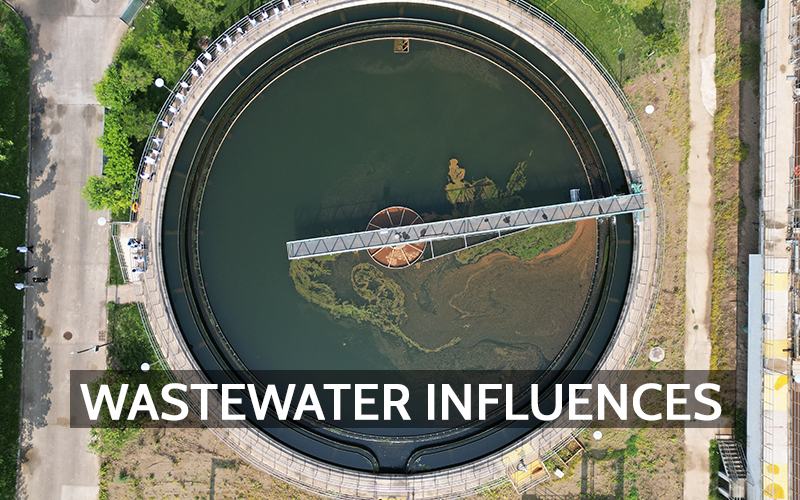
Wastewater treatment plants perform one of the least visible but most important jobs in a community. Every day, they receive water containing human waste, food residue, soaps, oils, chemicals, and industrial contaminants and process it before returning cleaner water to the environment.
That treatment can create its own air-quality challenges.
Wastewater contains large amounts of organic material that microorganisms naturally break down. Pumps, aeration systems, tanks, sludge processing, and chemical treatment can also release gases, odors, droplets, and volatile chemicals into the surrounding air.
Modern treatment plants are therefore designed not only to clean water, but also to prevent the treatment process from becoming a significant source of local air pollution.
Hydrogen Sulfide Creates the Familiar Sewage Odor
One of the best-known wastewater gases is hydrogen sulfide, or H₂S.
Hydrogen sulfide forms when bacteria break down sulfur-containing material under low-oxygen conditions. It is responsible for the characteristic rotten-egg smell associated with sewers and stagnant wastewater.
The human nose can detect hydrogen sulfide at very low concentrations, so a noticeable odor does not automatically mean the air is dangerous. At higher concentrations, however, hydrogen sulfide is toxic and can irritate the eyes and respiratory system.
It is particularly dangerous inside confined spaces such as wet wells, tanks, manholes, and enclosed treatment structures, where concentrations can rise rapidly.
Plants may monitor hydrogen sulfide continuously in areas where accumulation is possible.
Wastewater Can Release More Than One Gas
Ammonia can also be released as nitrogen-containing waste is processed. Like hydrogen sulfide, ammonia has a strong odor and can irritate the respiratory system at elevated concentrations.
Methane presents a different problem.
When organic matter decomposes without oxygen, microorganisms can produce methane. Anaerobic digesters intentionally create these conditions to stabilize sewage sludge.
Methane is a powerful greenhouse gas and is also flammable. Many modern plants capture digester gas rather than allowing it to escape.
The collected gas can be burned in boilers or combined heat-and-power systems to produce electricity and heat for the treatment plant itself. Excess gas may be destroyed in a flare when it cannot be used.
Wastewater treatment can also produce nitrous oxide during biological nitrogen removal. Although it is not normally a local breathing hazard at environmental concentrations, nitrous oxide is a powerful greenhouse gas.
Industrial Wastewater Can Release VOCs
Municipal wastewater is not always composed entirely of household sewage.
Factories, laboratories, hospitals, restaurants, and commercial facilities may discharge wastewater into municipal sewer systems. Depending on what enters the system, that water may contain volatile organic compounds, or VOCs.
Some VOCs can move from water into air when wastewater is pumped, mixed, aerated, or exposed in open tanks.
Industrial wastewater treatment facilities may face even greater concerns if they process water containing solvents, petroleum compounds, or other volatile chemicals.
Facilities can reduce these emissions by covering tanks and channels and capturing the air above them before treating it.
Odor Control Begins With Containment
One of the most common approaches to wastewater air-quality management is preventing contaminated air from freely escaping.
Headworks, screening areas, sludge-processing equipment, pump stations, and other odor-producing operations may be enclosed or covered.
Fans pull air from these areas and maintain slight negative pressure. This causes outside air to flow inward through doors and openings rather than allowing odorous air to escape toward the surrounding community.
The captured air is then sent to an odor-control system.
This approach is similar to local exhaust ventilation used in laboratories and industrial facilities: collect pollution close to its source before it spreads.
Scrubbers, Carbon, and Biofilters Clean the Exhaust
Wastewater plants have several options for treating contaminated air.
Chemical scrubbers pass exhaust through liquids containing chemicals that react with pollutants such as hydrogen sulfide or ammonia. The unwanted gas is transferred from the air into the treatment solution.
Activated carbon systems pass air through beds of highly porous carbon. Gases and VOCs become attached to the enormous internal surface area of the material.
Biofilters use microorganisms instead.
Contaminated air passes through moist organic or engineered media where bacteria consume compounds such as hydrogen sulfide and convert them into less troublesome substances.
Different systems may be combined when a plant needs to control several pollutants at once.
Aeration Creates an Interesting Tradeoff
Many wastewater plants use activated-sludge treatment, where microorganisms consume organic contamination in large aeration tanks.
Blowers pump enormous quantities of air through the wastewater to provide oxygen for these microbes.
This is essential for treatment, but bubbling air through water can also encourage volatile compounds and tiny droplets to enter the atmosphere.
Plant designers therefore balance the amount of aeration needed for biological treatment with energy use and emission control. Fine-bubble diffusers, automated oxygen sensors, covered tanks, and carefully controlled blower systems can improve efficiency.
Some facilities may also enclose particularly problematic treatment units and capture their exhaust.
Bioaerosols Are Another Consideration
Wastewater contains bacteria and other microorganisms. Agitation, splashing, spraying, and aeration can generate small droplets containing biological material.
These airborne droplets and particles are known as bioaerosols.
Workers near aeration basins, screens, sludge handling, or high-pressure cleaning may receive greater exposure than members of the surrounding community because they spend long periods close to the source.
Facilities reduce these exposures through enclosure, ventilation, splash control, equipment design, hygiene practices, and appropriate personal protective equipment.
Location and Weather Matter
Treatment plants are often located near rivers or low-lying land because wastewater moves efficiently downhill and treated water needs a discharge location.
Unfortunately, calm weather and temperature inversions can sometimes allow odors to remain near the ground.
Wind direction is therefore important when designing treatment facilities and locating odor sources, exhaust stacks, and neighboring development.
Modern plants may use weather stations, hydrogen sulfide monitors, odor surveys, and community complaint systems to identify recurring conditions.
A treatment plant may operate normally most of the year yet create noticeable odors during a specific combination of temperature, wind, and treatment conditions.
Protecting Workers and Neighbors Requires Different Controls
Workers face the highest concentrations because they operate directly beside wastewater and enter enclosed equipment.
Gas detectors, confined-space procedures, ventilation, respiratory protection, and worker training help prevent dangerous exposures.
Protecting the surrounding community focuses more heavily on containment, odor treatment, equipment maintenance, process control, and preventing fugitive emissions from leaving the site.
Air requirements may come from federal Clean Air Act regulations as well as state and local environmental agencies, particularly when a facility operates combustion equipment or treats industrial wastewater containing regulated pollutants.
Wastewater treatment plants demonstrate an important environmental tradeoff. Cleaning polluted water requires intense biological and mechanical activity, and that activity can move some contaminants from water into air if it is not carefully controlled.
The solution is not to hide the treatment process. It is to engineer it so that the water leaves cleaner without creating a new pollution problem above the tanks.
References
- https://www.epa.gov/ghgemissions/methane-emissions
- https://www.epa.gov/ghgemissions/nitrous-oxide-emissions
- https://www.epa.gov/air-research/odor-explore-participatory-science-project-using-mobile-app-and-new-measurement
- https://nepis.epa.gov/Exe/ZyPURL.cgi?Dockey=300045C6.TXT
- https://nepis.epa.gov/Exe/ZyPURL.cgi?Dockey=200045MK.TXT
- https://nepis.epa.gov/Exe/ZyPURL.cgi?Dockey=00002V0A.TXT
- https://www.osha.gov/hydrogen-sulfide
- https://www.osha.gov/hydrogen-sulfide/hydrogen-sulfide-workplaces
- https://www.osha.gov/confined-spaces
- https://www.usgs.gov/water-science-school/science/wastewater-treatment-water-use