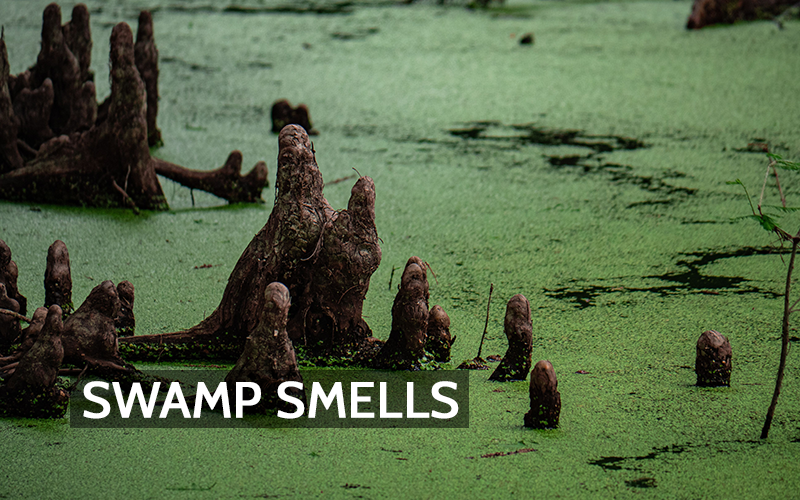
Swamps, marshes, bogs, and other wetlands are full of biological activity. Beneath the water, dead leaves, plant roots, algae, insects, and other organic material are constantly being broken down by microorganisms.
Because waterlogged soil contains very little oxygen, decomposition in a wetland proceeds differently from decomposition on a dry forest floor. The result is the production of gases, most notably methane, along with carbon dioxide and sometimes hydrogen sulfide.
Together, these emissions are commonly described as “swamp gas.”
The name makes swamp gas sound like one mysterious substance rising from the mud. In reality, it is the visible, or occasionally smellable, result of several biological and chemical processes occurring beneath the surface.
Why Does Swamp Gas Form?
The story begins with oxygen.
In dry soil, air can move through spaces between soil particles. Microorganisms use that oxygen while breaking down dead organic matter.
In a swamp, those spaces are filled with water. Oxygen moves through water much more slowly than through air, and microorganisms near the surface quickly consume what is available.
Deeper in the mud, conditions become anaerobic, meaning little or no oxygen remains.
Different groups of microorganisms then take over.
Methanogens are microorganisms belonging to the domain Archaea that can produce methane while obtaining energy under oxygen-free conditions. They consume simple compounds produced as other microbes break down organic matter.
This methane gradually accumulates in the saturated soil and sediment.
Warm temperatures generally increase microbial activity, which is why methane production can become particularly active in warm, waterlogged wetlands containing abundant organic material.
Those Bubbles in the Mud May Be Methane
Anyone who has stepped into muddy wetland sediment or pushed a stick into the bottom of a stagnant pond may have seen bubbles suddenly rise to the surface.
Some of those bubbles may contain methane.
As methane accumulates underground, enough gas can eventually collect to form bubbles. When the pressure becomes sufficient, those bubbles move upward through the sediment and water before breaking at the surface.
Scientists call this process ebullition.
Methane can reach the atmosphere in other ways as well. Some dissolves in water and gradually diffuses across the water’s surface.
Wetland plants can provide another surprisingly efficient pathway. Many marsh plants contain internal air spaces that transport oxygen from their leaves to submerged roots. Methane can move in the opposite direction through those same plant tissues, effectively using the plant as a biological chimney.
Some methane never makes it out at all. Methane-consuming microorganisms living closer to oxygen-rich surfaces can convert part of it before it reaches the atmosphere.
Why Does a Swamp Sometimes Smell Like Rotten Eggs?
Methane itself has no smell.
The familiar rotten-egg odor encountered around some swamps, tidal flats, stagnant ponds, sewers, and mud is usually associated with hydrogen sulfide, or H₂S.
Hydrogen sulfide forms when microorganisms break down organic material under oxygen-poor conditions while using sulfur compounds in their metabolism.
Only very small concentrations are needed for the human nose to detect it.
This helps explain why a wetland can smell extremely strong even though methane—the gas being produced in the greatest climatic quantities—cannot be smelled at all.
Hydrogen sulfide behaves differently from methane from a safety perspective. High concentrations can be toxic, and the gas can accumulate in low-lying or enclosed locations.
Open wetlands normally allow gases to disperse into a very large volume of outside air. Confined locations such as sewers, manure pits, tanks, wells, and underground structures are much more concerning because gases may accumulate instead of dispersing.
Carbon Dioxide Is Part of the Mixture Too
Not every piece of decaying vegetation becomes methane.
Microbial respiration also produces carbon dioxide, particularly in areas where some oxygen remains available.
Wetlands therefore continuously exchange both carbon dioxide and methane with the atmosphere while plants simultaneously remove carbon dioxide through photosynthesis.
This creates a complicated carbon cycle.
Wetlands can store enormous amounts of carbon in waterlogged soils because decomposition is slow enough for partially decayed vegetation to accumulate. Peatlands are particularly important examples.
At the same time, wetlands are the world’s largest natural source of atmospheric methane.
A healthy wetland can therefore store carbon while also releasing a powerful greenhouse gas. Both processes must be considered when scientists study the climate effects of wetlands.
What Happens to Methane After It Reaches the Atmosphere?
Once methane escapes a swamp, wind quickly dilutes it into the surrounding atmosphere.
Unlike a particle of dust that may settle back onto the ground, methane can remain in the atmosphere for roughly a decade.
Its main removal mechanism involves reactions with hydroxyl radicals, highly reactive molecules sometimes described as the atmosphere’s detergent. These reactions gradually oxidize methane and ultimately contribute to products including carbon dioxide and water.
While it remains in the atmosphere, methane acts as a powerful greenhouse gas. It also participates in atmospheric chemistry that can contribute to background ground-level ozone.
This means a bubble rising from wetland mud becomes part of a global chemical system once it reaches the air.
What About Mysterious Lights Over Swamps?
Swamp gas has long been connected with stories of mysterious lights known as will-o’-the-wisps.
Historically, people proposed that methane and trace phosphorus-containing gases produced by decomposition could ignite and create flickering lights over marshes.
The real explanation is less certain.
Methane does burn, but ordinary methane released from a wetland does not simply ignite on its own at normal environmental temperatures. Several chemical explanations for historical swamp lights have been proposed, alongside possibilities involving bioluminescent organisms, distant lights, and optical effects.
The folklore remains an interesting example of people recognizing that unusual gases were emerging from wetlands long before the microbiology was understood.
Swamp Gas Is Usually Part of a Healthy Ecosystem
The presence of methane or occasional sulfur odors does not mean a swamp is polluted.
Anaerobic decomposition is a normal and essential wetland process. It recycles nutrients, supports complex food webs, stores carbon, and helps create the distinctive chemistry of wetland soils.
Human-made environments can produce many of the same gases. Landfills, sewage systems, manure storage, wastewater treatment plants, and flooded reservoirs all contain organic material capable of decomposing without oxygen.
The major difference is often concentration and confinement.
Outdoors, wetland gases generally disperse rapidly. Inside an enclosed pit, sewer, tank, or other poorly ventilated space, the same biological chemistry can produce a serious atmospheric hazard.
“Swamp gas” is therefore much more than a funny smell or old ghost story. It is evidence of an invisible microbial ecosystem operating beneath the water, turning dead organic material into gases that rise from the mud and eventually become part of the atmosphere above us.
References
- https://www.epa.gov/ghgemissions/methane-emissions
- https://nepis.epa.gov/Exe/ZyPURL.cgi?Dockey=P100717T.TXT
- https://www.giss.nasa.gov/research/briefs/2007_matthews_02/
- https://www.usgs.gov/publications/a-synthesis-methane-emissions-71-northern-temperate-and-subtropical-wetlands
- https://www.usgs.gov/publications/modeled-production-oxidation-and-transport-processes-wetland-methane-emissions
- https://gml.noaa.gov/ccgg/carbontracker-ch4/documentation_chem.html
- https://www.osha.gov/hydrogen-sulfide
- https://www.osha.gov/hydrogen-sulfide/hydrogen-sulfide-workplaces
- https://wwwn.cdc.gov/TSP/ToxFAQs/ToxFAQsDetails.aspx?faqid=385&toxid=67
- https://www.cdc.gov/niosh/npg/npgd0337.html