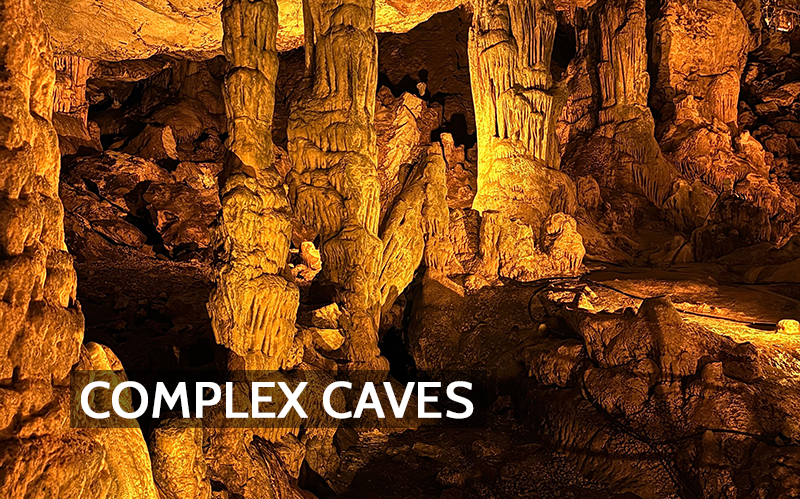
Entering a cave can feel like stepping into an entirely different atmosphere. Temperatures become remarkably stable, humidity often rises, outside winds disappear, and familiar outdoor smells fade.
The air is different chemically as well.
Caves exchange air with the surface, but that exchange can be slow and complicated. Carbon dioxide seeps downward from soil, radioactive rock can release radon, microorganisms may produce methane or hydrogen sulfide, and groundwater can carry dissolved gases into underground passages.
Most developed tourist caves carefully monitor these conditions. In less ventilated or unusual cave systems, however, the atmosphere can become one of the most important hazards underground.
Cave Air Begins With Surface Air
Most caves ultimately receive much of their atmosphere through entrances, cracks, sinkholes, and fractures connecting them with the surface.
Air movement is driven largely by differences in temperature and pressure.
During winter, relatively warm cave air may rise and escape from higher openings while colder outdoor air enters through lower entrances. During warmer weather, that circulation can reverse. Storms and rapid changes in barometric pressure can also change airflow surprisingly quickly.
Caves with several large entrances may exchange enormous amounts of air. Deep chambers connected to the surface by narrow passages may remain much more isolated.
This matters because ventilation determines whether underground gases are quickly diluted or allowed to accumulate.
Carbon Dioxide Comes From the Ground Above
Carbon dioxide, or CO₂, is one of the most important gases studied in cave environments.
Much of it begins in soil.
Plant roots, bacteria, fungi, and other organisms continuously produce CO₂ through respiration and decomposition. Soil air can contain far more carbon dioxide than the atmosphere above it.
Rainwater moving through this soil absorbs some of that CO₂. The resulting water forms weak carbonic acid and seeps downward through cracks in limestone.
This chemistry is responsible for forming many of the world’s caves. Carbonic acid slowly dissolves limestone, enlarging fractures over thousands or millions of years.
When CO₂-rich groundwater eventually enters an open cave passage, some carbon dioxide can escape from the water into the cave air. This same process helps form stalactites and stalagmites as dissolved calcium carbonate is deposited.
People also contribute. Every visitor exhales carbon dioxide, so heavily visited cave chambers can experience temporary changes in CO₂ concentrations.
Poor Ventilation Can Allow CO₂ to Accumulate
In a well-ventilated cave, carbon dioxide entering from soil, water, organisms, and visitors can mix with incoming surface air.
In poorly ventilated sections, concentrations may become much higher.
Carbon dioxide does not support breathing. At sufficiently high concentrations, it can displace oxygen and cause headache, dizziness, confusion, loss of consciousness, and eventually asphyxiation.
Because CO₂ is denser than ordinary air, it can sometimes become concentrated in low areas when air movement is extremely weak, although real cave airflow and gas mixing are more complicated than simply having the gas settle to the floor.
A chamber that was safe under one set of weather conditions may behave differently when cave ventilation changes.
Radon Comes Directly From Rock
Caves can also contain radon, a naturally occurring radioactive gas.
Radon forms during the radioactive decay of uranium present in rocks and soil. Once produced, the gas can escape from mineral surfaces and enter cave passages.
Concentrations vary enormously depending on geology and ventilation.
For an occasional cave visitor, exposure may be brief. Cave guides, researchers, maintenance workers, and others who spend hundreds of hours underground have a different exposure pattern.
At Mammoth Cave National Park, for example, radon concentrations and employee time underground are monitored because repeated long-term exposure can increase lung-cancer risk.
Radon is particularly interesting because it cannot be seen, smelled, or tasted. Its presence can only be determined through measurement.
Some Caves Contain Hydrogen Sulfide
Hydrogen sulfide, or H₂S, creates a completely different underground atmosphere.
The gas has a distinctive rotten-egg odor at low concentrations and may be produced when microorganisms process sulfur compounds in oxygen-poor environments. It can also enter caves through sulfur-rich groundwater or deeper geological sources.
Some cave systems were actually created through hydrogen-sulfide chemistry.
Carlsbad Caverns in New Mexico is a famous example. Hydrogen-sulfide-rich water associated with deep oil and gas deposits moved upward through limestone. When hydrogen sulfide encountered oxygen, chemical and microbial processes produced sulfuric acid.
That acid aggressively dissolved the limestone and helped create enormous cave chambers.
Active sulfur caves can still receive hydrogen sulfide from underground springs today.
At high concentrations H₂S is toxic, making sulfur-rich caves very different environments from an ordinary limestone tourist cavern.
Methane Can Form Where Organic Matter Decays
Methane may occur in caves containing organic-rich sediments, animal waste, flooded passages, or connections to petroleum and natural-gas deposits.
Microorganisms called methanogens can produce methane while decomposing organic material where oxygen is absent.
Large bat colonies provide an interesting example of how biology can influence cave chemistry. Guano introduces enormous quantities of organic material and nutrients. Microbial decomposition can affect gases in the surrounding sediment and air.
Methane itself is not usually a major concern in ordinary ventilated caves, but high concentrations in confined underground environments can create both oxygen-displacement and fire or explosion hazards.
Humans Can Introduce Their Own Gases
Not every dangerous cave gas is natural.
Generators, gasoline-powered equipment, heaters, engines, fires, and other combustion sources can produce carbon monoxide.
Carbon monoxide is particularly dangerous because it is colorless and odorless. It interferes with the blood’s ability to transport oxygen.
Modern show caves carefully manage equipment and ventilation for this reason. Work occurring in mines, tunnels, cave restoration sites, or other underground environments may require direct atmospheric monitoring before combustion equipment is used.
Human activity can also change natural airflow. Doors, elevators, ventilation shafts, tunnels, and enlarged entrances may alter air circulation that developed naturally over thousands of years.
Humidity Is Part of Cave Air Quality Too
Cave atmosphere is not defined only by hazardous gases.
Many caves maintain very high relative humidity because water constantly enters through rock while cool, stable temperatures limit evaporation.
Humidity helps preserve cave ecosystems and geological formations. Changes in airflow can dry cave surfaces, alter mineral growth, and affect species adapted to extremely stable conditions.
Tourist caves therefore monitor temperature, humidity, airflow, and gases not only for human safety but also to protect the cave itself.
An Underground Atmosphere of Its Own
A cave is not simply an empty hole filled with ordinary outdoor air.
Its atmosphere is continuously shaped by surface weather, soil biology, groundwater chemistry, radioactive minerals, microorganisms, animals, geology, and the shape of the cave passages themselves.
In one cave, the dominant concern may be carbon dioxide. In another it may be radon. A sulfur cave may contain hydrogen sulfide, while an organic-rich chamber may generate methane.
That diversity is why cave scientists monitor the atmosphere much like meteorologists monitor the sky.
Aboveground, wind usually carries gases away. Underground, the walls determine where the air can go—and sometimes it has nowhere to go at all.
References
- https://www.nps.gov/articles/caves-and-karst-geological-monitoring.htm
- https://www.nps.gov/maca/learn/nature/air-quality.htm
- https://www.nps.gov/articles/caves-and-aquifers.htm
- https://www.nps.gov/grba/planyourvisit/cave-geology-in-depth.htm
- https://www.nps.gov/cave/learn/nature/geologicformations.htm
- https://www.nps.gov/cave/learn/nature/cave.htm
- https://www.nps.gov/grba/learn/nature/lehman-caves-origin.htm
- https://www.usgs.gov/geology-and-ecology-of-national-parks/geology-carlsbad-caverns-national-park
- https://www.osha.gov/hydrogen-sulfide
- https://www.osha.gov/confined-spaces
- https://archive.cdc.gov/www_cdc_gov/niosh/docs/87-113/default.html