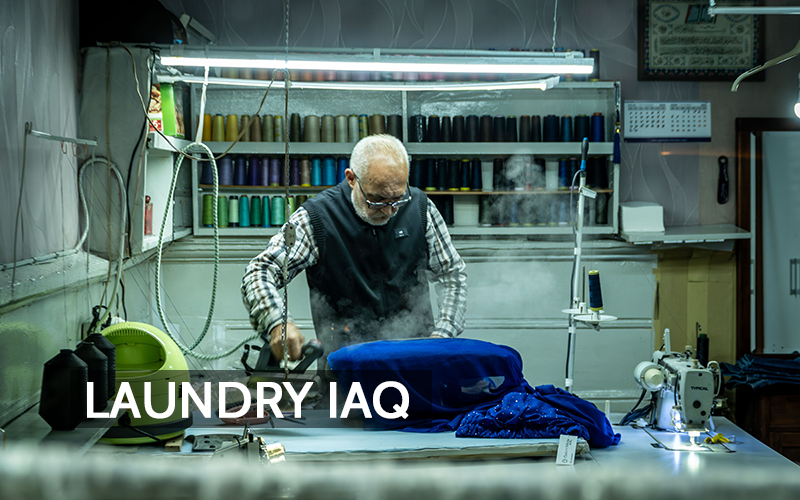
Dry cleaners and commercial laundries may appear relatively simple from the customer side: clothing enters dirty and leaves clean. Behind the counter, however, workers may spend entire shifts around solvents, detergents, stain removers, heated equipment, lint, steam, and contaminated textiles.
These facilities present an unusual indoor air-quality challenge because cleaning clothing can transfer contaminants from fabric into the air. Some chemicals evaporate during processing, while sorting and drying can release fibers and particles. Heat and humidity can further complicate ventilation.
The risks are different between traditional dry cleaning and water-based laundry, but both require careful control of what workers breathe.
Dry Cleaning Does Not Actually Mean “Dry”
Traditional dry cleaning uses liquid solvents instead of water to remove oils, grease, and stains from clothing.
For decades, the most important solvent in the industry has been perchloroethylene, also called tetrachloroethylene, PCE, or “perc.” PCE evaporates readily, meaning workers can inhale vapors if the chemical escapes from equipment during loading, unloading, maintenance, waste handling, or spill cleanup.
Exposure can cause headache, dizziness, drowsiness, confusion, and irritation of the eyes, nose, and throat. Long-term exposure raises additional concerns involving the nervous system, liver, kidneys, reproduction, and cancer risk.
Because of those risks, the industry has been gradually moving away from PCE.
In 2024, the Environmental Protection Agency finalized a federal rule that phases out PCE use in dry cleaning over ten years. New PCE dry-cleaning machines are already prohibited, while existing machines are subject to different phaseout schedules depending on their type.
The transition will significantly change the chemical landscape of American dry cleaning.
Alternative Solvents Still Require Care
Replacing PCE does not mean eliminating chemical exposure.
Some dry cleaners use high-flashpoint petroleum-based hydrocarbon solvents, while others use silicone-based products, modified alcohols, or specialized solvent systems. Professional wet cleaning uses water and computerized washing equipment instead of an organic dry-cleaning solvent.
Each system has different advantages and hazards.
Hydrocarbon solvents, for example, may reduce some toxicological concerns associated with PCE but introduce flammability and volatile-organic-compound considerations.
Workers should therefore avoid assuming that a product marketed as “alternative,” “green,” or “environmentally friendly” is automatically harmless to breathe.
Safety Data Sheets, manufacturer instructions, ventilation requirements, and employee training remain important regardless of the solvent being used.
Spot Cleaning Can Create Concentrated Exposure
Stain removal is one of the most hands-on parts of the dry-cleaning process.
Workers may apply small quantities of specialized products to remove grease, ink, rust, paint, adhesives, food, or other stains. These products can contain solvents, acids, detergents, and other reactive chemicals.
Because spot cleaning often occurs at an open workstation, vapors may be released directly into the employee’s breathing zone.
Spraying a chemical can create even greater exposure by turning liquid into small airborne droplets. Using brushes, controlled dispensing systems, and local exhaust ventilation can reduce the amount entering the air.
A small bottle used for several minutes at a time can therefore present a more direct respiratory exposure than a much larger quantity of solvent sealed inside modern cleaning equipment.
Commercial Laundries Face Different Chemical Hazards
Water-based commercial laundries generally do not rely on PCE, but workers still encounter numerous cleaning chemicals.
Detergents, concentrated soaps, disinfectants, chlorine bleach, oxygen bleaches, alkalis, acids, fabric treatments, and stain removers may be delivered in highly concentrated forms.
Automated chemical-dispensing systems help keep employees from manually measuring and pouring these products. Problems are more likely during container replacement, spills, equipment maintenance, or accidental mixing.
Bleach requires particular care.
Chlorine-containing bleach can release dangerous gases when mixed with incompatible chemicals, especially acids or ammonia-containing products. Such reactions can cause severe respiratory irritation and potentially dangerous exposures within seconds.
Chemical containers should remain labeled, incompatible products should be stored separately, and employees should know what to do if a chemical line leaks or a product is accidentally mixed.
Lint and Fibers Become Airborne
Laundry facilities also generate substantial amounts of textile debris.
Handling, sorting, tumbling, folding, and drying clothing releases lint and small fibers. Much of this material is captured by dryer lint systems, but particles can also settle on machinery, ducts, floors, beams, and ventilation equipment.
Movement and cleaning may put accumulated material back into the air.
Good housekeeping helps prevent buildup. Vacuuming and controlled cleaning are generally preferable to using compressed air, which can spread settled particles through the workplace.
Lint also creates a fire concern when it accumulates around dryers, exhaust ducts, motors, or other heat sources.
Dirty Laundry Brings Contaminants Into the Building
Commercial laundries do not control everything arriving on the clothing they receive.
Hospital linens may contain blood, body fluids, medications, cleaning chemicals, or microorganisms. Industrial uniforms may carry oils, metal dust, solvents, pesticides, or process chemicals. Restaurant textiles may contain grease and food residue.
Workers sorting heavily contaminated laundry can therefore encounter material that originated somewhere completely different.
Healthcare and industrial laundry operations use handling procedures designed to keep contaminated textiles contained until they reach the washing process. Bags, carts, sorting procedures, gloves, ventilation, and employee hygiene all contribute to reducing exposure.
Heat, Steam, and Dryers Change the Indoor Environment
Laundry is also a heat-producing industry.
Dryers, presses, steam systems, irons, boilers, and hot water can raise indoor temperatures substantially. Water-based operations add moisture to the environment as well.
High heat and humidity make work more physically demanding and can reduce comfort even when chemical concentrations are relatively low.
Gas-fired dryers and boilers introduce combustion equipment into the facility. Properly installed systems vent exhaust outdoors, but poorly maintained burners, damaged exhaust ducts, or inadequate makeup air can create carbon monoxide or other combustion concerns.
Ventilation must therefore handle more than solvent vapors. It also manages heat, moisture, odors, and the air removed by large dryers and exhaust systems.
Controlling Exposure Starts at the Machine
Modern dry-cleaning machines are far more enclosed than earlier generations. Rather than transferring solvent-soaked clothing between separate machines, closed-loop systems keep much of the cleaning and drying process within one unit.
Vapor-recovery equipment can capture solvent before the machine is opened.
Local exhaust ventilation can provide additional control around machine doors, maintenance areas, spotting stations, chemical storage, and waste handling. General building ventilation then prevents smaller releases from accumulating throughout the shop.
Equipment maintenance is critical. Leaking seals, hoses, valves, ductwork, and solvent containers can turn a well-controlled process into a continuing source of vapor.
Workplace air monitoring may also be used when hazardous solvent exposure is possible.
Cleaning Clothing Should Not Mean Contaminating the Air
Dry cleaners and laundries perform an essential service, but the process brings workers into contact with chemicals and contaminants most customers never see.
The industry’s air-quality challenges are also changing. PCE is being phased out, newer equipment contains solvents more effectively, automated chemical systems reduce manual handling, and professional wet cleaning provides another option for some garments.
No single technology removes every risk.
Protecting workers requires understanding what chemicals enter the facility, what contaminants arrive on clothing, where vapors and particles can escape, and how air moves through the workspace.
The goal of a modern laundry or dry cleaner is not simply to send clean clothing back out the door. It is to make sure the people doing the cleaning can breathe clean air while they work.
References
- https://www.epa.gov/assessing-and-managing-chemicals-under-tsca/risk-management-perchloroethylene-pce
- https://www.epa.gov/system/files/documents/2025-01/pce-dry-cleaner-compliance-guide.pdf
- https://www.epa.gov/stationary-sources-air-pollution/dry-cleaning-facilities-national-perchloroethylene-air-emission
- https://www.epa.gov/regulatory-information-sector/dry-cleaning-sector-naics-8123
- https://www.osha.gov/dry-cleaning
- https://www.osha.gov/dry-cleaning/hazards
- https://www.osha.gov/dry-cleaning/solutions
- https://www.osha.gov/dry-cleaning/standards
- https://www.osha.gov/etools/hospitals/laundry/hazardous-chemicals
- https://www.osha.gov/chemicaldata/650
- https://www.cdc.gov/niosh/engcontrols/ecd/detail13.html
- https://www.cdc.gov/niosh/bulletin/2015/drycleaning-solvents.html
- https://www.cdc.gov/niosh/reproductive-health/prevention/solvents.html