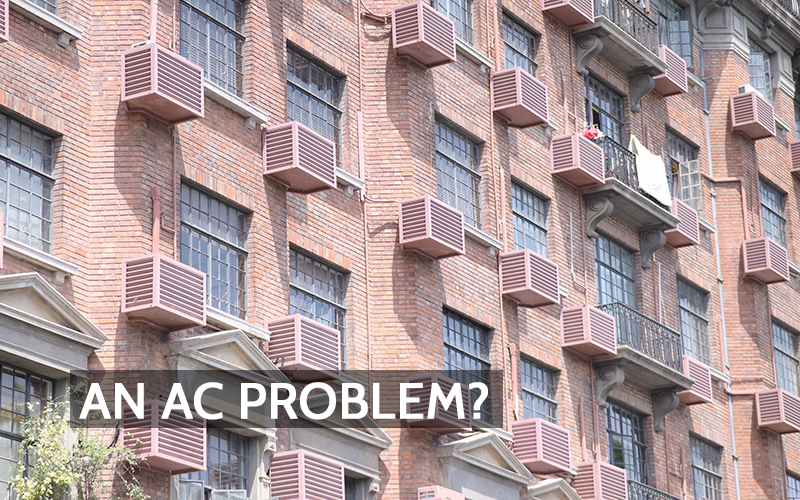
Air conditioning has fundamentally changed how Americans experience summer. It allows people to work, sleep, shop, attend school, and receive medical care safely during extreme heat. During wildfire smoke and other outdoor pollution events, an air-conditioned building can also provide an important refuge from unhealthy air.
But cooling indoor air requires energy, equipment, and refrigerants. The environmental effects therefore extend beyond the room being cooled.
In the United States, widespread air-conditioning use influences local power demand, urban temperatures, indoor air quality, and emissions from electricity generation. On a larger scale, the energy and refrigerants needed to cool buildings contribute to atmospheric changes that can reach far beyond the communities using them.
Air Conditioning Can Protect Indoor Air
During periods of wildfire smoke, high ozone, or extreme heat, an air-conditioned home can provide a much safer indoor environment than simply opening windows.
Central HVAC systems continuously circulate indoor air through a filter. When an appropriately efficient filter is installed and the system can accommodate it, this circulation can remove a portion of airborne particulate matter.
This is especially valuable during wildfire smoke events. Closing windows and doors while operating the system in a recirculation mode can reduce the amount of outdoor smoke entering the building.
Air conditioning also controls humidity. Excessive indoor moisture can encourage mold growth, while hot and humid conditions can make buildings uncomfortable or unsafe.
However, air conditioning should not automatically be confused with ventilation.
Most residential heating and cooling systems primarily recirculate air already inside the house. They do not necessarily provide significant amounts of fresh outdoor air. A home can therefore be comfortably cool while still accumulating carbon dioxide, cooking emissions, cleaning chemicals, or other internally generated pollutants.
Filtration, ventilation, source control, and temperature control perform different jobs, even when they are incorporated into the same HVAC system.
Cooling a Building Moves Heat Outside
An air conditioner does not destroy heat. It moves heat.
Refrigerant flowing through the indoor coil absorbs heat from the building. The compressor then moves that energy toward the outdoor condenser, where a fan releases it into the surrounding atmosphere.
The outdoor unit also releases additional heat produced by the electricity used to operate the system.
For one house, this effect is small. In a dense city where thousands of air conditioners operate simultaneously, the combined waste heat can contribute to warmer outdoor conditions.
This creates an interesting feedback loop. Hot weather causes more people to operate air conditioners. Those systems release additional heat outdoors, which can slightly increase urban temperatures and require even more cooling.
Air conditioning is not the primary cause of the urban heat-island effect, which is strongly influenced by pavement, buildings, limited vegetation, and stored solar energy. It is nevertheless one component of the heat released by modern cities.
Summer Cooling Creates Large Electricity Demand
The larger air-quality effect often occurs far from the air conditioner itself.
Residential air conditioning accounted for about 19 percent of U.S. household electricity consumption in 2020, according to the Energy Information Administration. Commercial buildings, schools, hospitals, stores, and industrial facilities add substantial cooling demand of their own.
Demand can become particularly high during summer afternoons when millions of cooling systems operate simultaneously.
If additional electricity comes from fossil-fuel power plants, increased cooling demand can contribute indirectly to emissions of nitrogen oxides, sulfur dioxide, particulate matter, mercury, and carbon dioxide.
Nitrogen oxides are particularly relevant during hot summer weather because they participate in reactions that form ground-level ozone. Sulfur dioxide and nitrogen compounds can also undergo atmospheric reactions that create fine particulate matter.
Where the electrical grid relies more heavily on nuclear, wind, solar, hydroelectric, or other noncombustion sources, the air-quality impact associated with operating an air conditioner can be considerably different.
The pollution associated with cooling therefore depends not only on the efficiency of the air conditioner but also on how its electricity was generated.
Refrigerants Create a Different Atmospheric Problem
Air conditioners depend on refrigerants that absorb heat indoors and release it outdoors.
Older systems have used several generations of refrigerant chemicals. Chlorofluorocarbons, or CFCs, were largely eliminated because they damaged the stratospheric ozone layer. Hydrochlorofluorocarbons such as R-22 also damage ozone and have been phased out of production and import for most U.S. uses.
Many newer systems shifted to hydrofluorocarbons, or HFCs. HFCs do not significantly damage the ozone layer, but many are powerful greenhouse gases.
Refrigerant normally remains sealed inside the system. Problems occur when equipment leaks, is improperly serviced, or is discarded without recovering the refrigerant.
The United States is now gradually reducing the production and consumption of HFCs under the American Innovation and Manufacturing Act. The federal program is intended to decrease HFC use to 15 percent of historical baseline levels by 2036 while encouraging lower-global-warming-potential alternatives.
Technicians also recover and reclaim refrigerant rather than intentionally releasing it during service.
Efficiency Matters More Than Temperature Settings Alone
Reducing the environmental effect of air conditioning does not mean abandoning cooling. In extreme heat, air conditioning can be a critical health protection.
Efficiency allows the same indoor comfort to be produced with less electricity.
Modern high-efficiency air conditioners and heat pumps can reduce energy consumption compared with older equipment. Proper sizing is important because an oversized system may cycle on and off frequently instead of operating efficiently and controlling humidity.
Dirty filters, clogged outdoor coils, leaking ducts, low refrigerant charge, and poorly maintained equipment can all make a system work harder.
Building design matters too. Insulation, efficient windows, exterior shading, reflective roofs, trees, and sealing uncontrolled air leaks reduce the amount of heat entering the building before the air conditioner needs to remove it.
Utilities can also manage cooling demand through smart thermostats, energy storage, and programs that shift some electricity use away from periods when the grid is under its greatest strain.
A Growing Global Cooling Challenge
The United States is already one of the world’s most air-conditioned societies, but demand for cooling is increasing internationally as cities grow, incomes rise, and extreme heat becomes more common.
Greater access to cooling can save lives and improve working and living conditions. At the same time, billions of additional air conditioners operating on fossil-fuel-heavy electrical grids could significantly increase energy demand and greenhouse-gas emissions.
This creates a challenge with no simple answer.
People need protection from dangerous heat. Buildings also need to become more efficient, electrical generation needs to become cleaner, and cooling equipment must transition toward refrigerants with smaller atmospheric impacts.
Air conditioning demonstrates how indoor and outdoor air are connected. Inside the house, the system may provide a cool, filtered refuge from summer heat and smoke. Outside, the electricity, refrigerant, and waste heat required to create that environment become part of a much larger atmospheric system.
The goal is therefore not simply to use less air conditioning. It is to provide necessary cooling with better buildings, cleaner electricity, efficient equipment, effective filtration, and refrigerants that create fewer problems once they leave the machine.
References
- https://www.eia.gov/tools/faqs/faq.php?id=1174&t=1
- https://www.eia.gov/todayinenergy/detail.php?id=52558
- https://www.eia.gov/energyexplained/use-of-energy/electricity-use-in-homes.php
- https://www.energy.gov/cmei/buildings/heating-ventilation-air-conditioning-refrigeration-and-water-heating
- https://www.energy.gov/documents/future-ac-report-executive-summarypdf-0
- https://www.epa.gov/indoor-air-quality-iaq/air-cleaners-and-air-filters-home
- https://www.epa.gov/indoor-air-quality-iaq/improving-indoor-air-quality
- https://www.epa.gov/power-sector/power-plants-and-neighboring-communities
- https://www.epa.gov/power-sector/human-health-environmental-impacts-electric-power-sector
- https://www.epa.gov/hfcs
- https://www.epa.gov/hfcs/frequent-questions-phasedown-hydrofluorocarbons
- https://www.epa.gov/hfcs/background-hfc-reclamation-and-destruction