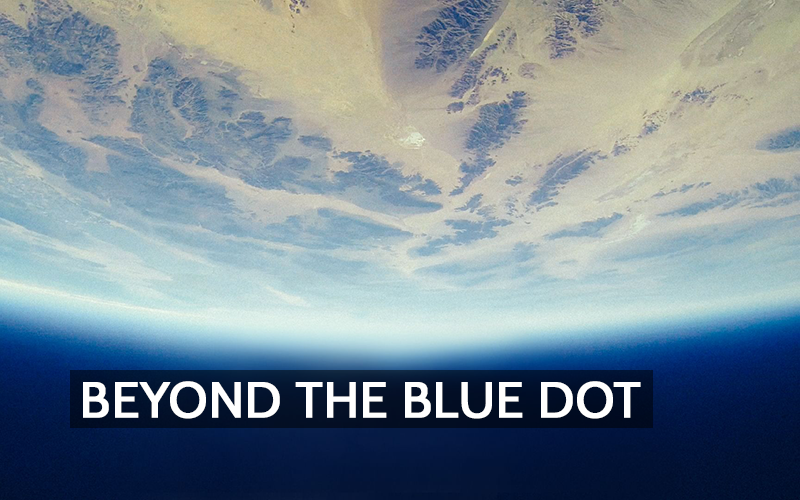
Earth’s atmosphere feels ordinary because we have never known anything else. Nitrogen and oxygen surround us at a comfortable pressure, clouds carry liquid water, and the atmosphere protects the surface while still allowing sunlight through.
Across the rest of the solar system, nothing about an atmosphere is ordinary.
One planet barely has an atmosphere at all. Another has enough carbon dioxide to crush a spacecraft while heating the surface beyond the melting point of lead. The giant planets contain enormous layers of hydrogen, helium, methane, ammonia, and violent weather without a solid surface beneath them.
Comparing the eight planets reveals just how unusual Earth’s air really is.
Mercury: Almost No Atmosphere
Mercury is the closest planet to the Sun, but it has almost no true atmosphere.
Instead, Mercury possesses an extremely thin exosphere composed largely of oxygen, sodium, hydrogen, helium, and potassium. Many of these atoms are knocked from the planet’s surface by sunlight, impacts from tiny meteoroids, and charged particles from the solar wind.
Without a substantial atmosphere, Mercury cannot efficiently move or retain heat.
Its daytime surface can reach around 800°F, while nighttime temperatures can fall to roughly -290°F.
There are no ordinary clouds, rainstorms, or winds. Mercury demonstrates what happens when a rocky planet is essentially exposed directly to space.
Venus: A Runaway Greenhouse
Venus is nearly the same size as Earth but has one of the most hostile atmospheres in the solar system.
Its atmosphere is overwhelmingly carbon dioxide, with clouds containing sulfuric acid.
At the surface, atmospheric pressure is roughly 90 times greater than Earth’s sea-level pressure. That is similar to the pressure experienced deep beneath Earth’s oceans.
Carbon dioxide creates an extraordinarily powerful greenhouse effect. Although Mercury is closer to the Sun, Venus has the hottest planetary surface, reaching approximately 870°F.
High above the surface, sulfuric-acid clouds move around the planet in powerful winds. Venus shows how dramatically atmospheric composition can transform the climate of an otherwise Earth-sized rocky world.
Earth: Nitrogen, Oxygen, and Liquid Water
Earth’s atmosphere is approximately 78 percent nitrogen and 21 percent oxygen, with smaller amounts of argon, carbon dioxide, water vapor, and other gases.
That mixture supports something unique among the planets we currently know: a global biosphere.
Oxygen is largely maintained by photosynthetic organisms. Water exists naturally as vapor, liquid, and ice, creating clouds and weather. Greenhouse gases keep the planet warmer than it would otherwise be, while the ozone layer absorbs much of the Sun’s harmful ultraviolet radiation.
Earth’s atmosphere is also constantly recycled through oceans, rocks, soil, plants, microorganisms, and human activity.
For air-quality science, this complexity matters. Earth’s atmosphere is not merely a container of gas. It is an active chemical and biological system.
Mars: A Thin Carbon-Dioxide Sky
Mars also has an atmosphere dominated by carbon dioxide, but unlike Venus, it is extremely thin.
Nitrogen and argon make up much of the remainder.
Because atmospheric pressure is less than one percent of Earth’s sea-level pressure, Mars cannot retain heat effectively. Surface temperatures can vary enormously, and stable liquid water is difficult to maintain.
The Martian atmosphere also contains large amounts of suspended mineral dust.
Winds can lift fine reddish particles high into the atmosphere, producing dust storms that sometimes expand across much of the planet. Individual Martian winds would feel weaker than equivalent winds on Earth because the atmosphere is so thin, yet they can still transport enormous quantities of dust.
Mars demonstrates that a thin atmosphere can still produce weather.
Jupiter: A Planet Made Mostly of Atmosphere
Jupiter changes the meaning of the word atmosphere.
Unlike Earth or Mars, Jupiter has no ordinary solid surface. Its atmosphere gradually becomes denser with depth until enormous pressures transform hydrogen into increasingly exotic states.
The upper atmosphere consists mainly of hydrogen and helium, with smaller amounts of methane, ammonia, water vapor, and other compounds.
Different chemicals condense at different altitudes, creating layers of clouds thought to include ammonia ice, ammonium hydrosulfide, and water.
Powerful jet streams divide the atmosphere into the familiar light and dark bands visible from Earth.
Jupiter is also home to enormous storms, including the Great Red Spot, a rotating system larger than Earth that has persisted for centuries.
Saturn: Hydrogen Beneath the Rings
Saturn is also composed primarily of hydrogen and helium.
Like Jupiter, it lacks a true solid surface. Atmospheric pressure increases continuously with depth until hydrogen behaves less like an ordinary gas and more like a fluid.
Its upper atmosphere contains clouds, storms, and extremely powerful winds.
Near Saturn’s equator, winds can reach roughly 1,000 miles per hour.
One of the strangest atmospheric structures in the solar system sits at Saturn’s north pole: a persistent six-sided jet stream known as the hexagon.
Despite its enormous size, Saturn’s atmosphere is less visually colorful than Jupiter’s because a high-altitude haze obscures some of the deeper cloud structures.
Uranus: A Methane-Tinted Ice Giant
Uranus marks the transition from the gas giants to the ice giants.
Its atmosphere is mostly hydrogen and helium but contains methane along with traces of water and ammonia.
Methane absorbs red wavelengths of sunlight while allowing blue-green wavelengths to be reflected, contributing to Uranus’s distinctive cyan appearance.
Below the visible atmosphere lies a deep interior rich in water, methane, and ammonia compounds under enormous pressure.
Uranus also rotates almost completely on its side.
Because each pole experiences decades of continuous sunlight followed by decades of darkness, the planet experiences unusual atmospheric seasons that scientists are still working to understand.
Neptune: The Windiest Planet
Neptune has an atmospheric composition broadly similar to Uranus: mostly hydrogen and helium with a smaller amount of methane.
Yet Neptune is dramatically more active.
Despite receiving only a small fraction of the sunlight that reaches Earth, Neptune possesses the fastest known planetary winds in the solar system. Some exceed 1,200 miles per hour.
Large storms appear and disappear within its atmosphere, including dark vortex systems comparable in scale to entire terrestrial continents.
Methane contributes to Neptune’s blue appearance, although scientists now understand that the planet’s color is more subtle than many heavily processed images once suggested.
Some of Neptune’s atmospheric energy appears to come from heat escaping from deep within the planet rather than sunlight alone.
The Atmosphere Makes the Planet
The eight planets demonstrate that distance from the Sun is only part of what determines a world’s environment.
Mercury is hot but nearly airless. Venus is hotter because its massive atmosphere traps heat. Earth maintains liquid oceans beneath a relatively thin nitrogen-rich atmosphere. Mars has lost much of the atmosphere it once possessed.
Farther out, Jupiter and Saturn become enormous atmospheric worlds dominated by hydrogen and helium, while Uranus and Neptune mix those gases with methane and deeper layers of volatile compounds.
On Earth, we usually think about atmospheric composition in terms of clean versus polluted air.
Looking across the solar system provides a much larger perspective.
An atmosphere determines whether water can remain liquid, how heat moves, what kinds of clouds form, whether radiation reaches the surface, how winds behave, and ultimately what kind of world exists beneath the sky.
References
- https://science.nasa.gov/mercury/facts/
- https://science.nasa.gov/venus/venus-facts/
- https://www1.grc.nasa.gov/beginners-guide-to-aeronautics/earth/
- https://science.nasa.gov/mars/facts/
- https://science.nasa.gov/jupiter/jupiter-facts/
- https://science.nasa.gov/saturn/facts/
- https://science.nasa.gov/uranus/facts/
- https://science.nasa.gov/neptune/neptune-facts/