Auto and motorcycle racing places high-powered engines, hot brakes, rapidly wearing tires, fuel, support equipment, and thousands of spectators into a relatively small area.
For fans, the smell of exhaust and fuel may seem like part of the racing experience. From an air-quality perspective, however, a race circuit is a temporary concentration of many pollution sources operating simultaneously.
Most major tracks are outdoors, allowing wind to dilute emissions quickly. Conditions can still vary dramatically between grandstands, pit lanes, garages, parking areas, and different types of racing.
Race Engines Produce Combustion Pollution
Most racing vehicles still rely at least partly on internal-combustion engines.
Burning gasoline, ethanol blends, diesel, methanol, or specialized racing fuels can produce nitrogen oxides, carbon monoxide, volatile organic compounds, carbon dioxide, and particulate matter.
The exact mixture depends on the engine, fuel, exhaust system, operating conditions, and racing category.
Race engines also operate differently from ordinary commuter vehicles. They frequently accelerate at full throttle, brake aggressively, and operate at high temperatures. Cars or motorcycles waiting in paddocks and pit areas may also idle or repeatedly start and stop during preparation.
Out on an open circuit, exhaust generally disperses rapidly. Pit garages and enclosed service areas deserve more attention because pollutants can accumulate where mechanics and officials work for extended periods.
Workers may therefore experience a very different exposure from a spectator watching from an open grandstand.
Tires and Brakes Create Particles Without Exhaust
Tailpipes are only part of the story.
Every time a race vehicle brakes, friction wears small amounts of material from brake pads and rotors. Tire surfaces are also intentionally pushed to their limits, producing wear particles throughout a race.
These materials can enter the atmosphere as particulate matter.
Brake particles may contain iron, copper and other metals or mineral components depending on the braking system. Tire wear produces mixtures of rubber, fillers and other compounds.
Racing can accelerate these processes because vehicles repeatedly brake from high speeds and place enormous mechanical loads on their tires.
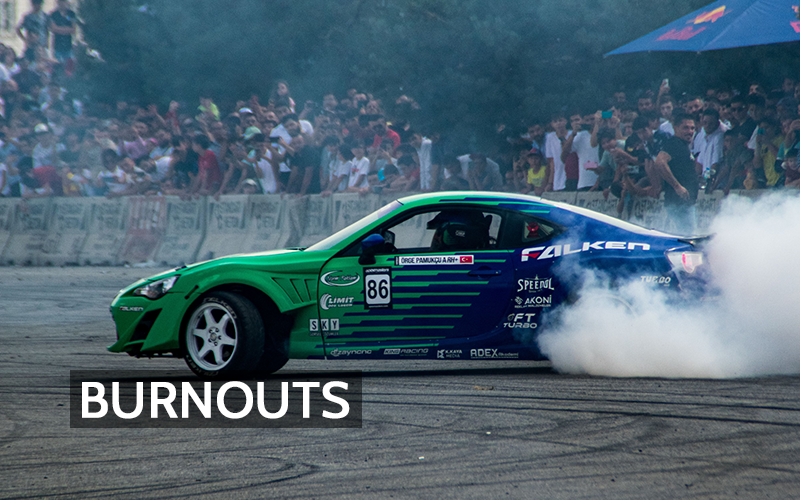
Burnouts and drifting create a particularly obvious example. The visible smoke produced when a spinning tire is deliberately overheated contains airborne material generated as the tire degrades.
Electric race vehicles eliminate tailpipe exhaust, but they do not eliminate tire, brake and track-surface particulate entirely.
Different Racing Styles Create Different Problems
A paved road course produces a different atmosphere from a motocross track.
Off-road motorcycle racing, rallying and dirt-track events can generate large clouds of mineral dust as tires disturb dry soil. The vehicles themselves then create turbulence that keeps settled particles suspended.
Water trucks and track-watering systems are commonly used to keep loose surfaces damp and reduce dust. Organizers must balance this control with traction and racing safety.
Drag racing presents another unusual environment. Certain categories use methanol or nitromethane-based racing fuels, creating exhaust chemistry different from ordinary gasoline-powered competition. Burnouts before a run also create concentrated tire smoke near the starting area.
Indoor motorsport venues create the greatest ventilation challenge. Arenas hosting motorcycle competitions, kart racing or similar events cannot rely on unrestricted outdoor air movement. Mechanical ventilation and careful management of combustion sources become especially important.
Fuel Handling Adds Vapors
Race circuits also contain large quantities of fuel outside vehicle tanks.
Paddocks and pit lanes may include refueling equipment, portable containers and temporary fuel-storage areas. Gasoline and other racing fuels can release volatile organic compounds as they evaporate.
Modern racing organizations use controlled fueling equipment, approved containers, spill-response procedures and designated fuel-handling areas. These measures are primarily designed for fire and chemical safety, but they also reduce unnecessary vapor releases.
Fuel formulation matters as well.
Some racing organizations are increasingly adopting renewable or lower-carbon fuels. INDYCAR has used renewable racing fuel since 2023, while Formula 1 introduced advanced sustainable fuel requirements with its new 2026 power-unit regulations.
These changes are primarily intended to address greenhouse-gas emissions across the fuel lifecycle. They should not be confused with eliminating local exhaust pollution: an internal-combustion engine can still produce nitrogen oxides and other pollutants even when its fuel comes from a more sustainable source.
The Race Cars Are Not the Only Traffic
A major racing event may attract tens or hundreds of thousands of spectators.
Cars waiting to enter parking lots, shuttle buses, delivery trucks, team transporters, generators and service vehicles can collectively become important sources of pollution.
In some cases, the traffic surrounding the race may affect local air as much as activity occurring inside the circuit.
Event organizers can reduce these emissions through public transportation, shuttle systems, organized parking, anti-idling policies and improved traffic flow.
Electric utility vehicles and equipment are also increasingly used inside paddocks and event grounds.
Some motorsport sustainability programs are moving toward renewable electricity and cleaner fuels for generators and transport vehicles in addition to changing the race cars themselves.
Weather Determines Where Pollution Goes
A racetrack does not have one uniform atmosphere.
Wind may carry exhaust away from one grandstand while directing it toward another. Calm conditions can allow pollutants to remain near the track longer.
Hot sunny weather introduces another consideration: ozone. Nitrogen oxides and volatile organic compounds released by traffic and combustion can participate in atmospheric reactions that form ground-level ozone.
Regional wildfire smoke or existing urban pollution can further worsen conditions during an event even when the racetrack itself is not the main source.
This is one reason air-quality monitoring is becoming increasingly relevant to motorsport.
How Racing Organizations Are Responding
The Fédération Internationale de l’Automobile, or FIA, has expanded environmental management requirements across international motorsport.
Its Environmental Accreditation Programme encourages racing organizations, circuits and event promoters to identify their major environmental impacts. Current guidance specifically includes air quality and encourages organizers to identify pollution sources, locate potential exposure hotspots, conduct measurements and develop mitigation strategies.
Monitoring instruments can be placed near pit areas, spectator zones or the circuit boundary to track particulate matter and gases before, during and after an event.
Other improvements happen indirectly. Hybrid race vehicles reduce reliance on combustion during portions of operation. Electric racing eliminates trackside tailpipe emissions entirely. Cleaner generators, renewable electricity, efficient logistics and reduced support-vehicle idling can further improve event conditions.
Motorsport will always involve intense mechanical activity, whether the vehicle is powered by gasoline, electricity or something in between.
The air-quality challenge is recognizing that the excitement visible on the track also produces materials that cannot always be seen.
Managing those emissions means looking beyond the race car itself to the tires, brakes, garages, dirt surfaces, fuel systems, generators, traffic and thousands of people surrounding it.
References
- https://www.epa.gov/transportation-air-pollution-and-climate-change/smog-soot-and-other-air-pollution-transportation
- https://nepis.epa.gov/Exe/ZyPURL.cgi?Dockey=P101CTUW.TXT
- https://www.epa.gov/moves/can-i-model-emissions-electric-fuel-cell-and-hybrid-vehicles-and-equipment-moves
- https://www.fia.com/environmental-accreditation-programme
- https://www.fia.com/fia-environmental-handbook
- https://www.fia.com/file/401797/download
- https://www.fia.com/environmental-observer-programme
- https://www.indycar.com/racingtowardzero
- https://www.formula1.com/en/latest/article/the-beginners-guide-to-the-2026-regulations.6j0tS0hrHG2T01tpmK6XYz
- https://www.fia.com/news/new-era-sustainable-fuel-fia-introduces-major-step-provide-certified-100-sustainable-fuel-all