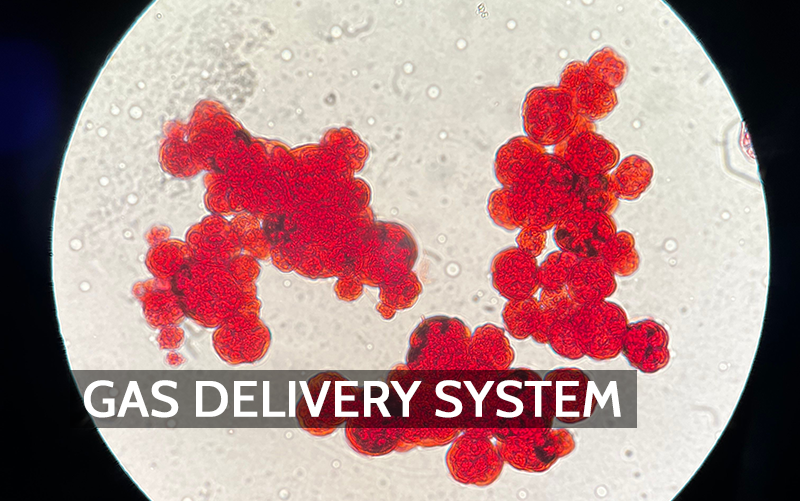
Every breath begins an exchange between the atmosphere and the bloodstream.
Oxygen enters the lungs, crosses an extremely thin layer of tissue, attaches to red blood cells, and is carried throughout the body. At the same time, carbon dioxide produced by working tissues travels in the opposite direction, returning through the bloodstream to the lungs before being released into the air.
Red blood cells do not control breathing itself, the brain and respiratory system determine how quickly and deeply we breathe—but they play a central role in managing how respiratory gases are transported between the lungs and tissues.
This continuous circulation connects the air around us directly to nearly every cell in the body.
The Journey Begins With Inhalation
When we inhale, the diaphragm contracts and expands the chest cavity, drawing air through the nose or mouth.
The air travels through the trachea before dividing into the two main bronchi. These branch repeatedly into smaller bronchi and bronchioles until the air eventually reaches millions of microscopic structures called alveoli.
Alveoli resemble clusters of tiny balloons.
Each alveolus is surrounded by a network of extremely small blood vessels called capillaries. The wall separating the air inside the alveolus from the blood inside the capillary is exceptionally thin.
This creates an ideal location for gases to move between the atmosphere and bloodstream.
Oxygen Moves Across the Lung
Gas exchange occurs largely through diffusion.
Molecules naturally move from areas where their partial pressure is higher toward areas where it is lower. Freshly inhaled air contains a relatively high concentration of oxygen compared with the oxygen-poor blood arriving at the lungs.
Oxygen therefore moves through the alveolar wall, crosses the capillary wall, and enters the blood.
Carbon dioxide follows the opposite gradient. Blood arriving from the body contains more carbon dioxide than the air inside the alveoli, so carbon dioxide moves from the blood into the lung before being exhaled.
This exchange occurs continuously with every breath.
Hemoglobin Makes Oxygen Transport Possible
Only a relatively small amount of oxygen can dissolve directly in blood plasma.
Most oxygen is transported by hemoglobin, a specialized protein contained inside red blood cells.
Each hemoglobin molecule contains iron-bearing structures that can reversibly bind oxygen. As blood passes through the lungs, oxygen attaches to hemoglobin, creating oxyhemoglobin.
This allows the bloodstream to carry vastly more oxygen than could be transported simply by dissolving the gas in plasma.
After leaving the lungs, oxygen-rich blood travels through the pulmonary veins to the left side of the heart. The heart then pumps it into the aorta and throughout the body’s arterial system.
Arteries branch into increasingly smaller vessels until blood reaches capillaries within muscles, organs, the brain, and other tissues.
Working Cells Pull Oxygen From the Blood
Cells continuously use oxygen during cellular respiration, a collection of chemical reactions that extract usable energy from nutrients.
Because tissues consume oxygen, their oxygen concentration is lower than that of newly arriving arterial blood. Oxygen therefore separates from hemoglobin and diffuses from the capillaries into surrounding tissues.
Hemoglobin is remarkably well suited for this task because its attraction to oxygen changes depending on local conditions.
Active tissues tend to contain more carbon dioxide, more hydrogen ions, and often higher temperatures. These conditions reduce hemoglobin’s affinity for oxygen and encourage it to release oxygen where metabolic activity is greatest.
This phenomenon is known as the Bohr effect.
A working muscle therefore helps create the chemical conditions that encourage passing red blood cells to unload more oxygen.
Carbon Dioxide Begins the Return Trip
Cellular respiration produces carbon dioxide as a metabolic waste product.
Carbon dioxide diffuses from tissues into nearby capillaries and begins traveling back toward the lungs.
Unlike oxygen, most carbon dioxide is not simply carried attached to hemoglobin.
A small portion remains dissolved directly in the blood, while another portion attaches to proteins, particularly hemoglobin, forming compounds called carbaminohemoglobin.
Most carbon dioxide, however, is converted into bicarbonate.
Inside red blood cells is an enzyme called carbonic anhydrase. This enzyme rapidly combines carbon dioxide with water to produce carbonic acid.
Carbonic acid quickly separates into hydrogen ions and bicarbonate ions.
The overall reaction can be represented as:
CO₂ + H₂O ⇌ H₂CO₃ ⇌ H⁺ + HCO₃⁻
Bicarbonate then moves out of the red blood cell and circulates largely within the plasma.
This conversion allows the bloodstream to transport large quantities of carbon dioxide without requiring all of it to remain as dissolved gas.
Red Blood Cells Also Help Control Blood Acidity
The conversion of carbon dioxide into bicarbonate produces hydrogen ions, which could make blood more acidic.
Hemoglobin helps buffer these hydrogen ions.
This is another important function of red blood cells. They are not simply oxygen-carrying containers; they also participate in maintaining the chemical environment necessary for normal metabolism.
The bicarbonate system is one of the body’s most important mechanisms for controlling blood pH.
Breathing and circulation therefore work closely with the kidneys and other systems to prevent excessive changes in acidity.
The Blood Returns to the Lungs
Carbon dioxide-rich blood eventually returns through the body’s veins to the right side of the heart.
The right ventricle pumps it through the pulmonary arteries toward the lungs.
Once the blood reaches the capillaries surrounding the alveoli, the chemical process begins reversing.
Bicarbonate moves back into red blood cells and is converted through carbonic acid into carbon dioxide and water.
At the same time, oxygen entering from the alveoli binds to hemoglobin.
Oxygenated hemoglobin becomes less able to carry carbon dioxide and hydrogen ions, encouraging the release of carbon dioxide for removal. This relationship is known as the Haldane effect.
Carbon dioxide then diffuses through the capillary and alveolar walls into the lungs.
The next exhalation carries it out of the body.
One Continuous Atmospheric Circuit
At rest, this entire exchange occurs thousands of times each day without conscious attention. During exercise, both ventilation and circulation increase dramatically to meet the higher oxygen demand of working muscles and remove the additional carbon dioxide they produce.
The lungs provide the exchange surface, the heart provides the pumping force, and the blood provides the transportation system.
Red blood cells sit at the center of that system.
By binding oxygen, converting and buffering carbon dioxide, responding to changing tissue chemistry, and reversing those reactions inside the lungs, red blood cells allow gases from the atmosphere to support metabolism throughout the human body.
Every breath is therefore more than simply air entering and leaving the lungs. It begins a carefully regulated chemical journey from the atmosphere to the blood, into the tissues, and eventually back into the air again.
References
- https://www.merckmanuals.com/home/lung-and-airway-disorders/biology-of-the-lungs-and-airways/exchanging-oxygen-and-carbon-dioxide
- https://www.merckmanuals.com/home/lung-and-airway-disorders/biology-of-the-lungs-and-airways/overview-of-the-respiratory-system
- https://www.ncbi.nlm.nih.gov/books/NBK532988/
- https://www.ncbi.nlm.nih.gov/books/NBK526028/
- https://www.ncbi.nlm.nih.gov/books/NBK482456/
- https://www.ncbi.nlm.nih.gov/books/NBK482413/
- https://www.nhlbi.nih.gov/health/lungs
- https://www.nhlbi.nih.gov/health/blood