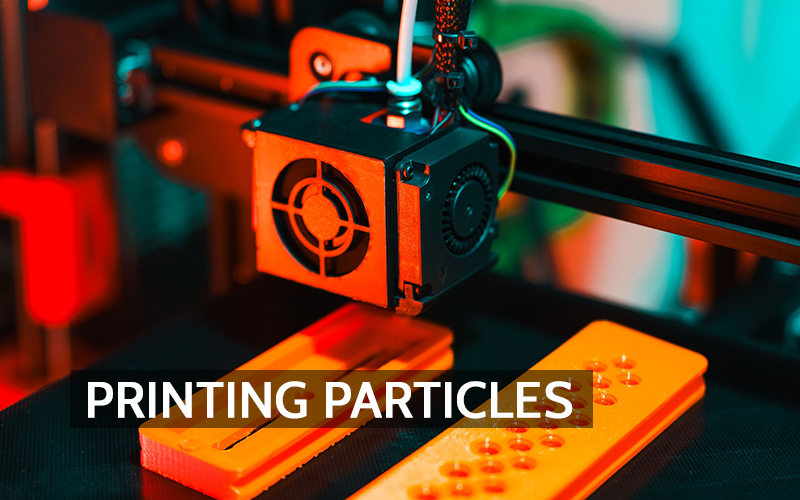
Three-dimensional printing has moved from specialized engineering laboratories into homes, schools, libraries, offices, workshops, and small businesses. Desktop printers can now produce everything from toys and replacement parts to prototypes, tools, and medical models.
Because 3D printing builds an object rather than cutting material away, it can appear to be a relatively clean manufacturing process. There may be little visible dust or smoke. However, several types of 3D printers can release extremely small particles and chemical vapors that are difficult to see and easy to overlook.
The type and amount of pollution depend on the printer, material, operating temperature, ventilation, and even the specific formulation or color of the material being used.
Filament Printers Heat Plastic
The most familiar desktop printers use fused filament fabrication, sometimes called FDM or FFF printing.
A plastic filament is fed into a heated nozzle, partially melted, and deposited layer by layer. Common materials include PLA, ABS, PETG, nylon, polycarbonate, and flexible plastics.
Heating these materials can release volatile organic compounds, or VOCs, along with large numbers of ultrafine particles. Ultrafine particles are generally smaller than 100 nanometers, far smaller than the particles normally discussed as PM2.5.
Their small size allows them to remain suspended in indoor air and potentially deposit deep within the respiratory system.
Emissions are not determined by the plastic name alone. Printer temperature, filament additives, dyes, nozzle condition, and manufacturer formulation can all change what is released.
PLA is often considered a lower-emission choice compared with some other materials, but it should not be treated as emission-free simply because it can be produced from renewable feedstocks. Different PLA products can behave differently.
ABS and Other Materials Produce Different Chemical Mixtures
ABS has received particular attention because heating it can release styrene and other organic compounds.
Other filaments create different mixtures. Nylon, PETG, polycarbonate, and specialty materials containing flame retardants, carbon fibers, metals, or nanoparticles may introduce additional chemicals or particles.
This makes material selection an important part of exposure control.
Users should follow the manufacturer’s recommended printing temperature and avoid unnecessarily increasing nozzle temperature. Higher temperatures can increase thermal decomposition and change emission rates.
Keeping the nozzle clean and properly maintained also reduces overheating and malfunction conditions that may produce unusual emissions.
Resin Printing Creates a Different Exposure
Vat photopolymerization printers use liquid resin rather than melted filament. Ultraviolet light selectively hardens the resin to form the object.
Uncured photopolymer resin commonly contains acrylates and other reactive chemicals. Contact can irritate the skin, and repeated exposure to some resin ingredients can contribute to allergic dermatitis or respiratory sensitization.
Exposure does not end when the printer stops.
Freshly printed parts typically contain uncured resin and must be washed, often using isopropyl alcohol or another solvent. The part is then exposed to additional ultraviolet light and sometimes heat during final curing.
Pouring resin, removing a print, washing parts, curing them, cleaning the resin vat, and handling solvent can all release chemicals into the work area.
Sanding a cured resin print creates another pathway by generating fine solid dust.
Resin printers therefore benefit particularly from a dedicated workspace, good ventilation, appropriate chemical-resistant gloves, careful spill control, and closed solvent containers.
An Enclosure Helps Only If It Controls Emissions
Many modern printers are sold with enclosed build chambers. An enclosure can reduce the immediate movement of particles into the surrounding room, but enclosure alone should not automatically be considered an air-cleaning system.
When the door is opened, accumulated particles and gases may enter the room.
A more effective design combines enclosure with local exhaust or filtration. HEPA filters can capture very small particles, while activated carbon or other gas-phase media may reduce some chemical vapors.
Neither method is universal. HEPA filtration does not remove VOC gases, and small carbon filters can become saturated or may not effectively capture every chemical being emitted.
For commercial printing areas, exhausting contaminated air outdoors or using properly designed local exhaust ventilation can provide stronger control than relying only on general room ventilation.
Location Matters as Much as Printer Type
A single printer operating occasionally in a large, well-ventilated workshop creates a different exposure situation from a printer running overnight in a bedroom.
Whenever practical, printers should be placed away from continuously occupied spaces. A separate workshop, utility room, laboratory, or ventilated makerspace provides more opportunity to control emissions.
Users can also reduce unnecessary exposure by avoiding sitting directly beside a printer for an entire multi-hour job.
Ventilation should remain available after printing, particularly before opening an enclosed machine following a long print or malfunction.
Schools and Offices Need to Think About Scale
One printer may create relatively modest room concentrations under good ventilation. Ten or twenty printers operating simultaneously can create a very different environment.
Schools, libraries, makerspaces, and commercial print farms should therefore consider the combined emissions from all operating equipment.
Dedicated printer rooms, ventilated enclosures, local exhaust, scheduled maintenance, and thoughtful material selection can reduce exposure for employees, students, and visitors.
These environments should also consider who occupies the space. Children may spend hours in classrooms and makerspaces, while commercial employees may work around printers every day. Repeated exposure deserves more attention than occasional hobby use.
Industrial Printing Introduces Additional Hazards
Industrial additive manufacturing may use powdered nylon, titanium, aluminum, nickel alloys, stainless steel, or other materials.
Here the concern extends beyond indoor air quality. Fine powders can be inhalation hazards, and some metal powders are combustible or explosive when dispersed in air.
Powder-bed systems therefore require specialized containment, ventilation, housekeeping, grounding, fire protection, and material-handling procedures.
These controls are very different from those needed for an ordinary desktop filament printer.
3D Printing Can Be Used Safely
Research into the health effects of 3D-printer emissions is still developing. There is no single exposure limit that applies to the overall mixture of ultrafine particles and chemicals produced by every printer.
That uncertainty makes prevention especially useful.
Choosing lower-emission materials, printing at recommended temperatures, maintaining equipment, separating printers from occupied rooms, enclosing the process, and using effective ventilation or filtration can all reduce exposure.
For resin systems, safe chemical handling during washing and curing is just as important as controlling emissions during the actual print.
Three-dimensional printing remains an extraordinarily useful technology. Its air-quality lesson is simply that a process does not need to produce visible smoke to influence the air.
The object forming on the print bed may be easy to see. The smallest products of the printing process are not.
References
- https://www.cdc.gov/niosh/manufacturing/additive/index.html
- https://www.cdc.gov/niosh/publications/numbered/2024-103.html
- https://www.cdc.gov/niosh/bulletin/2018/3d-printing.html
- https://www.cdc.gov/niosh/media/pdfs/3DPrintingInfographic.pdf
- https://www.cdc.gov/niosh/media/pdfs/2025/01/Safe-3D-Printing.pdf
- https://www.epa.gov/chemical-research/3d-printing-research-epa
- https://www.epa.gov/sciencematters/epa-researchers-continue-study-emissions-3d-printers
- https://www.osha.gov/combustible-dust
- https://pubmed.ncbi.nlm.nih.gov/26741485/
- https://pubmed.ncbi.nlm.nih.gov/30471608/
- https://pubmed.ncbi.nlm.nih.gov/39844363/