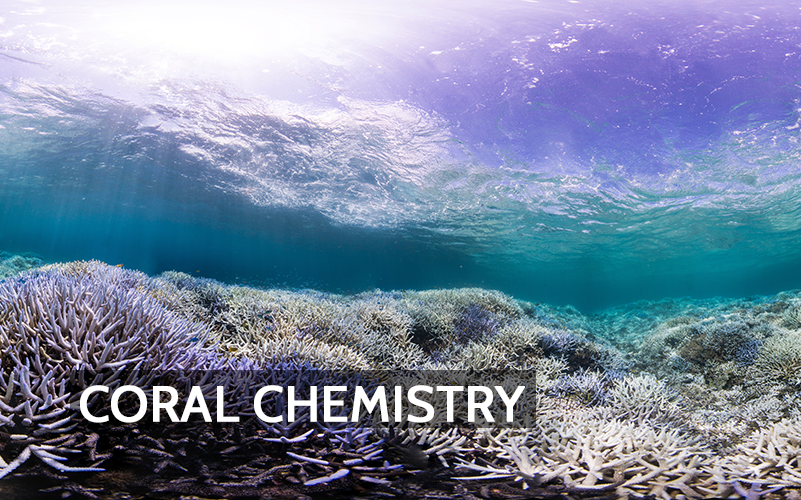
Coral reefs grow beneath the ocean’s surface, but their health is strongly connected to the atmosphere above them. Gases and particles in the air can alter ocean temperature, seawater chemistry, sunlight, rainfall, and the supply of nutrients reaching a reef.
Some atmospheric influences occur worldwide, while others are concentrated near cities, farms, deserts, or industrial regions. Together, they demonstrate that the atmosphere and ocean are not separate environments. They continuously exchange heat, gases, water, and particles.
Carbon Dioxide Changes Seawater Chemistry
The clearest connection between atmospheric chemistry and coral reefs involves carbon dioxide, or CO₂. The ocean naturally absorbs carbon dioxide from the air. Once dissolved in seawater, CO₂ reacts with water and forms carbonic acid.
Carbonic acid releases hydrogen ions, which lower the water’s pH. This process is known as ocean acidification. The ocean is not becoming acidic in the everyday sense, it remains slightly alkaline, but its average pH is declining.
This chemical change matters because reef-building corals construct their skeletons from calcium carbonate. They rely on carbonate ions in seawater to form this hard material. As additional carbon dioxide enters the ocean, more carbonate becomes chemically unavailable.
Corals may therefore need more energy to build and maintain their skeletons. Growth can slow, while existing reef material may become more vulnerable to erosion and dissolution. Young corals and other organisms that produce shells or skeletons can be especially sensitive.
A coral reef is more than a collection of living animals. It is also a large physical structure built from generations of calcium carbonate skeletons. When reef growth can no longer keep pace with erosion, the entire habitat may gradually flatten and weaken.
Greenhouse Gases Increase Heat Stress
Carbon dioxide, methane, nitrous oxide, and other greenhouse gases influence reefs in another way: they trap heat in Earth’s climate system. Much of this additional heat is absorbed by the ocean.
Corals usually live within a limited temperature range. When seawater remains unusually warm, corals become stressed and may expel the microscopic algae living inside their tissues. These algae provide much of the coral’s energy and give many corals their color.
Without the algae, the coral’s pale skeleton becomes visible through its tissue, producing the white appearance known as bleaching. Bleached coral is not always dead, but it has lost an important energy source. If high temperatures continue, it may starve, become diseased, or die.
A reef may recover after a brief bleaching event. Repeated marine heat waves leave less time for recovery, particularly when the reef is also affected by pollution, overfishing, disease, or ocean acidification.
Nitrogen and Sulfur Can Fall from the Air
Fossil-fuel combustion, agriculture, shipping, and industrial activity release nitrogen oxides, sulfur dioxide, and ammonia. These gases undergo chemical reactions in the atmosphere, producing nitrate, sulfate, nitric acid, and sulfuric acid.
The resulting compounds can reach the ocean through rain, snow, fog, or the direct settling of particles. This process is called atmospheric deposition.
Nitrogen is an essential nutrient, but many tropical coral reefs naturally exist in clear, nutrient-poor water. Excess nitrogen can encourage the growth of algae and microorganisms that compete with corals or change the reef’s ecological balance. Some nitrogen and sulfur compounds can also contribute to local changes in seawater acidity.
These effects are generally smaller globally than the influence of atmospheric carbon dioxide. However, atmospheric deposition may become important near heavily populated coastlines, industrial centers, shipping routes, and regions with intensive agriculture.
Dust Can Travel Between Continents
Mineral dust is another connection between the atmosphere and coral reefs. Powerful winds can lift soil from dry regions and transport it thousands of miles. Saharan dust, for example, regularly crosses the Atlantic Ocean and reaches the Caribbean and the Americas.
This dust contains minerals such as iron and phosphorus. When deposited in seawater, these materials may act as nutrients for algae, bacteria, and plankton. Moderate nutrient delivery can support biological activity, but excessive or poorly timed inputs may contribute to algal growth that competes with coral.
Dust can also carry organic material, fungi, bacteria, and human-produced contaminants. Laboratory studies have found that extracts from African dust can alter the growth of some bacteria associated with coral disease. However, the relationship is complicated, and dust should not be treated as the single cause of Caribbean coral decline. Temperature, water pollution, disease, fishing pressure, and local reef conditions all interact.
Airborne Particles Change Sunlight and Rainfall
Atmospheric particles influence the amount of sunlight reaching the sea surface. Corals require light because their symbiotic algae use photosynthesis to produce energy. Heavy haze, smoke, or persistent clouds can reduce that energy supply.
At other times, reduced sunlight may temporarily protect corals during extreme heat by limiting additional light stress. Volcanic sulfate particles can also cool parts of the climate system for a limited period by reflecting sunlight into space.
Aerosols help clouds form and can influence rainfall patterns. Rain then carries atmospheric chemicals into the ocean directly or washes them onto land, where they may enter coastal waters through rivers and runoff.
Protecting Reefs Requires Looking Above the Water
Managing these atmospheric pressures requires action at several levels. Reducing greenhouse-gas emissions addresses the largest global drivers of ocean warming and acidification. Controlling sulfur dioxide, nitrogen oxides, ammonia, and industrial dust can reduce atmospheric deposition near vulnerable coastal environments.
Scientists also monitor atmospheric carbon dioxide, seawater pH, coral growth, ocean temperature, dust movement, and marine heat waves. Satellites can identify regions where reefs are experiencing dangerous heat stress, while instruments placed directly on reefs track local chemical changes.
Local reef management cannot completely protect corals from changing atmospheric chemistry. It can still improve their ability to survive. Reducing sewage, agricultural runoff, sediment, destructive fishing, and physical damage gives corals a better chance of recovering from heat, acidification, and disease.
Coral reefs may grow underwater, but their future is partly written in the sky. The chemistry of the atmosphere determines what the ocean absorbs, how much heat it stores, and which particles and nutrients arrive from distant lands. Protecting reefs therefore requires understanding the entire connected system, from air to sea.
References
- https://www.noaa.gov/education/resource-collections/ocean-coasts/ocean-acidification
- https://oceanservice.noaa.gov/facts/acidification.html
- https://oceanservice.noaa.gov/facts/coralreef-climate.html
- https://oceanservice.noaa.gov/education/tutorial_corals/coral08_climatechange.html
- https://science.nasa.gov/earth/explore/the-ocean-and-climate-change/
- https://www.pmel.noaa.gov/co2/story/Coral%2BReef%2BMoorings
- https://www.usgs.gov/publications/evaluation-coral-pathogen-growth-rates-after-exposure-atmospheric-african-dust-samples
- https://www.usgs.gov/centers/spcmsc/science/coral-disease
- https://pubs.usgs.gov/fs/2009/3089/pdf/brewercoralfs3.pdf
- https://www.pnas.org/doi/10.1073/pnas.0702218104