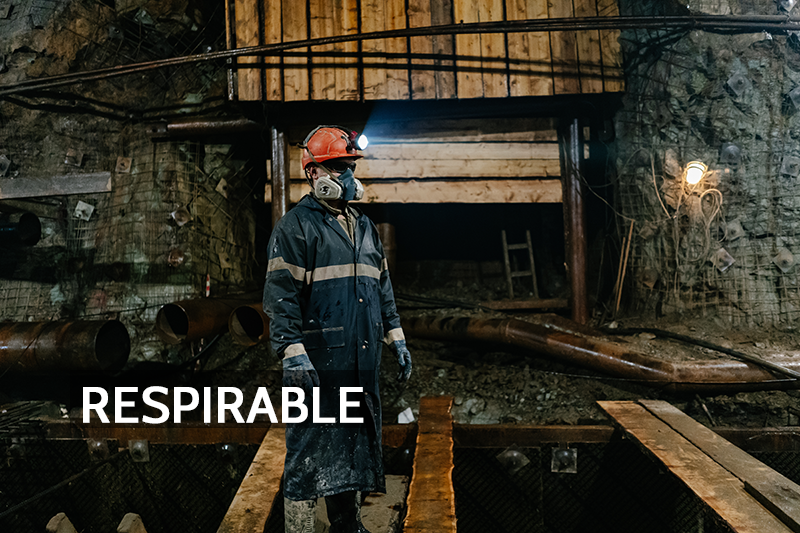
Dust is common in construction sites, mines, factories, farms, and workshops. Much of it appears to settle quickly or becomes trapped in the nose and throat. The smallest particles, however, can remain suspended in the air and travel deep into the lungs.
This portion of airborne material is known as respirable dust. Because it can reach the gas-exchange region of the lungs, long-term exposure may contribute to serious and sometimes irreversible disease. U.S. workplace rules therefore focus not only on how much dust is visible, but also on its particle size, chemical composition, and concentration in a worker’s breathing zone.
What Is Respirable Dust?
Respirable dust is not one specific substance. It is the fraction of airborne particles small enough to pass through the upper respiratory system and enter the deepest parts of the lungs.
A cloud may contain large particles that settle onto floors and equipment, smaller inhalable particles that enter the nose and mouth, and respirable particles that penetrate much farther. Respirable particles are generally smaller than about 10 micrometers, although workplace sampling uses a size-selection curve rather than a single cutoff.
The material making up the dust is equally important. Wood dust, coal dust, grain dust, metal particles, cement, and powdered chemicals may present different hazards. One of the most closely regulated forms is respirable crystalline silica.
Crystalline silica is found in sand, soil, concrete, brick, mortar, stone, and many engineered countertop materials. Cutting, grinding, drilling, crushing, or polishing these materials can release microscopic silica particles. Repeated exposure may cause silicosis, an incurable disease in which lung tissue becomes scarred. Silica exposure is also associated with lung cancer, chronic obstructive pulmonary disease, kidney disease, and certain autoimmune conditions.
Coal mine dust can cause coal workers’ pneumoconiosis, commonly called black lung disease. Other dusts may cause irritation, allergic reactions, asthma, reduced lung function, or toxic effects related to metals and chemicals within the particles.
How Exposure Is Measured
Industrial hygienists usually evaluate respirable dust with a personal sampling pump worn by the worker. Air is drawn from the breathing zone through a size-selective device, often called a cyclone, which separates larger particles from the respirable fraction.
The remaining particles collect on a filter. A laboratory can weigh the filter to determine the total respirable dust concentration and may analyze it for silica, metals, or other hazardous substances.
Results are usually compared with an occupational exposure limit expressed as mass per volume of air. Most federal limits are calculated as a time-weighted average across a work shift. This means a worker’s exposure may rise and fall during the day, but the overall average must remain below the applicable limit.
For respirable crystalline silica, the Occupational Safety and Health Administration sets a permissible exposure limit of 50 micrograms per cubic meter of air, averaged over eight hours. The action level is 25 micrograms per cubic meter. Reaching the action level can trigger requirements such as exposure assessment and repeated monitoring.
Dusts without their own substance-specific standard may fall under OSHA’s limit for particulates not otherwise regulated. That limit is 5 milligrams per cubic meter for the respirable fraction. However, this general limit should not be applied when the dust contains a substance with a more specific and protective standard.
How Workers Are Protected
The most effective approach is to prevent dust from becoming airborne. Employers may substitute a less hazardous material, use prefabricated components, or change a process so less cutting and grinding occur on site.
Engineering controls are the next major layer of protection. Water can be applied to saw blades, drills, crushers, and other equipment to capture dust as it forms. Local exhaust ventilation pulls contaminated air away from the worker and into a dust collector. Enclosed and filtered equipment cabs protect operators in mines, quarries, and construction areas.
Good housekeeping is also important. Dry sweeping and compressed-air cleaning can launch settled dust back into the breathing zone. Wet cleaning and vacuums equipped with high-efficiency filters are generally safer alternatives.
Respirators may be required when engineering and work-practice controls cannot reduce exposure enough or during certain high-exposure tasks. A respirator must be properly selected, medically approved, fit-tested, maintained, and used as part of a complete respiratory-protection program. Simply handing workers disposable masks is not an adequate control plan.
Depending on the hazard and exposure level, employers may also need written exposure-control plans, worker training, restricted work areas, warning signs, air monitoring, recordkeeping, and medical surveillance.
Which Industries Receive the Most Attention?
Construction receives significant attention because workers frequently cut concrete, drill masonry, grind mortar, demolish buildings, and disturb silica-containing materials. OSHA’s construction silica standard includes a table of common tasks and specified control methods.
Mining is another major area of concern. Drilling, blasting, crushing, transporting, and processing coal, ore, and stone generate large quantities of respirable dust. Coal miners also face the risk of black lung disease. Surface and underground mining operations are regulated separately from most other workplaces.
Engineered and natural stone countertop fabrication has become a particularly serious concern. Cutting and polishing high-silica slabs can create extremely concentrated dust, especially when work is performed dry or in poorly ventilated shops.
Foundries, brick and ceramic manufacturing, abrasive blasting, quarrying, tunneling, cement production, and hydraulic fracturing also receive attention because their processes can release silica-containing dust. Grain handling, woodworking, food manufacturing, and metalworking present additional respirable-dust hazards, although the applicable rules depend on the material involved.
Who Regulates Respirable Dust?
OSHA, part of the U.S. Department of Labor, regulates most private-sector workplaces. OSHA establishes exposure limits, conducts inspections, investigates complaints, and can issue citations and penalties. Many states operate OSHA-approved state programs that must be at least as protective as the federal program and may adopt stricter requirements.
The Mine Safety and Health Administration, or MSHA, regulates mines rather than OSHA. MSHA establishes and enforces rules for coal, metal, and nonmetal mining, including limits for respirable crystalline silica and coal mine dust.
The National Institute for Occupational Safety and Health, or NIOSH, conducts research, develops sampling methods, recommends exposure limits, evaluates workplace hazards, and publishes control guidance. NIOSH does not normally issue workplace citations, but its research often influences regulations and industry practices.
Respirable dust cannot always be seen, and visible cleanliness does not prove that the air is safe. Protecting workers requires identifying the material, measuring the respirable fraction, controlling dust at its source, and treating respiratory protection as a final layer rather than the first solution.
References
- https://www.osha.gov/silica-crystalline
- https://www.osha.gov/laws-regs/regulations/standardnumber/1910/1910.1053
- https://www.osha.gov/laws-regs/regulations/standardnumber/1926/1926.1153
- https://www.osha.gov/annotated-pels/table-z-1
- https://www.osha.gov/silica-crystalline/construction
- https://www.osha.gov/silica-crystalline/general-industry-maritime
- https://www.msha.gov/silica-final-rule-30-cfr-part-60-resources
- https://www.msha.gov/regulations/rulemaking/silica
- https://www.cdc.gov/niosh/silica/about/index.html
- https://www.cdc.gov/niosh/silica/work/index.html
- https://www.cdc.gov/niosh/mining/topics/respiratory-hazards.html
- https://www.cdc.gov/niosh/npg/npgd0480.html