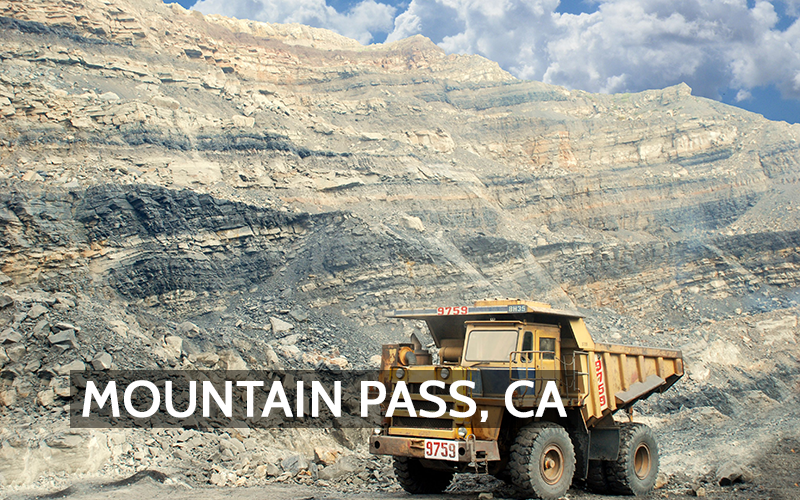
In California’s Mojave Desert, close to the Nevada border, an enormous open pit cuts into rocks containing some of the most strategically important minerals in the modern economy.
The Mountain Pass mine produces rare earth elements used in permanent magnets, electronics, electric vehicles, wind turbines, defense systems, and other technologies.
Rare earths are often associated with cleaner technologies, but extracting and refining them is an intensive industrial process of its own.
At Mountain Pass, that means managing dust, chemical vapors, combustion emissions, wastewater, tailings, and an environmental legacy extending back more than half a century.
Why Mountain Pass Is Important
Mountain Pass contains unusually rich deposits of bastnaesite, a mineral containing rare earth elements.
Mining began in the 1950s, and Mountain Pass eventually became one of the world’s most important rare-earth sources.
The ore contains large quantities of cerium and lanthanum along with valuable neodymium and praseodymium. Those latter elements are particularly important for producing powerful permanent magnets.
Today’s operator, MP Materials, acquired the property in 2017 and restarted production. The company later began producing separated rare-earth materials at Mountain Pass rather than relying entirely on overseas separation.
That distinction is important environmentally.
Mining removes the rock, but refining separates chemically similar elements from one another, requiring substantially more processing.
Mining Begins With Dust
Before chemical refining starts, rare-earth ore must be blasted, excavated, transported, crushed, and ground.
Each of those steps can generate particulate matter.
Large particles generally settle relatively quickly, while smaller PM10 particles can remain airborne longer and travel farther from their source.
Road traffic and exposed piles can also generate fugitive dust in the dry Mojave environment.
Mountain Pass operates under permits from the Mojave Desert Air Quality Management District. Dust-control measures include road treatments, stockpile stabilization, dust collectors, and baghouses that capture particles from processing equipment.
Researchers using satellite spectroscopy have even detected rare-earth signatures around parts of the mine and processing complex, illustrating that mineral-bearing material can be redistributed as dust around an active mining operation.
Refining Introduces Chemical Air Emissions
Once ore is concentrated, rare-earth processing becomes increasingly chemical.
Minerals must be separated from unwanted material and eventually divided into individual or grouped rare-earth products.
At Mountain Pass, permitted equipment includes crushing and drying systems, leaching equipment, filtration systems, kilns, solvent-extraction processes, and other chemical-processing units.
These processes can produce several categories of air emissions.
Particulate matter remains important as material is dried, transferred, and handled. Combustion equipment can produce nitrogen oxides, carbon monoxide, and sulfur-related pollutants.
Chemical processing introduces another concern: acid gases and hazardous air pollutants.
A September 2026 air-permit evaluation for Mountain Pass, for example, identifies a leach thickening and filtration process as a potential source of PM10 and hazardous air pollutants. The system vents through a scrubber, and other facility permits identify equipment designed specifically to control hydrochloric acid emissions.
Solvent-extraction operations can also require controls for volatile organic compounds.
Pollution Controls Become Part of the Refinery
Rare-earth refining therefore depends heavily on engineering controls.
Baghouses remove particles from exhaust streams. Wet scrubbers can capture acidic gases. Adsorption systems can remove certain VOCs or acid vapors, while modern low-NOx burners and catalytic systems reduce combustion pollution.
The local air district maintains hundreds of individual permits associated with equipment at Mountain Pass.
MP Materials also reports using newer Tier 4 engines for much of its mobile equipment and operating a fugitive-dust-control program.
These controls do not mean the operation produces no emissions.
They illustrate the difference between raw industrial exhaust and a regulated facility designed to capture or limit pollution before it enters the surrounding atmosphere.
Mountain Pass Has a Serious Water-Pollution History
The site’s most famous environmental controversy involved water rather than air.
Previous operators generated highly saline wastewater during rare-earth processing.
Beginning in the 1980s, this wastewater was transported through a roughly 13- to 14-mile pipeline from Mountain Pass to evaporation ponds near Ivanpah Dry Lake.
The system developed major problems.
California water regulators documented repeated pipeline spills. In 1996 alone, approximately 230,000 gallons were released at seven locations during pipeline maintenance.
Material associated with the pipeline contained elevated concentrations of substances including barium, uranium, thorium, and radium.
The pipeline crossed lands administered by the National Park Service and Bureau of Land Management, turning what might otherwise have been an industrial-site problem into a broader desert contamination issue.
Regulators eventually prohibited use of the pipeline and evaporation pond system in 1998.
Groundwater Became Another Concern
Waste disposal problems began even earlier.
For decades, process wastewater and tailings were stored in onsite ponds. California regulators later determined that some historical impoundments contributed to groundwater contamination.
Older evaporation ponds at Ivanpah also experienced leakage.
These events became part of Mountain Pass’s long environmental legacy and contributed to cleanup orders, regulatory actions, and changes to how wastewater was handled.
It is important, however, to distinguish those historical operations from the current mine.
MP Materials states that its current operation is a net-zero-discharge facility, recycling most process water and managing tailings onsite rather than sending process wastewater through the former Ivanpah pipeline.
Company regulatory filings state that the offsite pipeline contamination was remediated by Chevron Mining and that the remaining section of pipeline at Mountain Pass was removed in 2023.
Legacy groundwater contamination at and around the mine continues to be monitored and managed under California Water Board requirements.
A Complicated Source of Clean Technology
Mountain Pass demonstrates a difficult reality about modern environmental technology.
Rare earth elements help manufacture electric motors, wind turbines, electronics, and other technologies that can reduce emissions elsewhere.
Producing those materials still requires moving rock, crushing minerals, operating heavy machinery, handling acids and solvents, generating waste, and managing potentially contaminated water.
The environmental question is therefore not whether rare-earth mining has an impact.
It clearly does.
The more useful question is how effectively those impacts are controlled—and whether lessons learned from earlier contamination are incorporated into modern production.
At Mountain Pass, the answer can be seen in both directions: in the regulatory controls surrounding today’s mine and in the decades of environmental cleanup that demonstrate what can happen when waste-management systems fail.
References
- https://science.nasa.gov/earth/earth-observatory/mountain-pass-rare-earth-mine-151085/
- https://www.mpmaterials.com/mountain-pass
- https://records.mdaqmd.ca.gov/evaluations/view
- https://permitting.mdaqmd.ca.gov/facility/view/364
- https://www.mdaqmd.ca.gov/permitting
- https://mpmaterials.com/sustainability/
- https://mpmaterials.com/images/mediakit/mpmaterials-2025-sustainability-report.pdf
- https://www.waterboards.ca.gov/lahontan/publications_forms/available_documents/e_o_reports/2000/april.shtml
- https://www.waterboards.ca.gov/lahontan/publications_forms/available_documents/e_o_reports/2008/oct_nov08.pdf
- https://www.waterboards.ca.gov/lahontan/water_issues/available_documents/molycorp/
- https://www.waterboards.ca.gov/lahontan/board_decisions/adopted_orders/2026/
- https://www.sec.gov/Archives/edgar/data/1801368/000180136825000009/mp-20241231.htm
- https://www.npshistory.com/publications/moja/adhi/chap8.htm
- https://www.nature.com/articles/s41598-024-71395-2