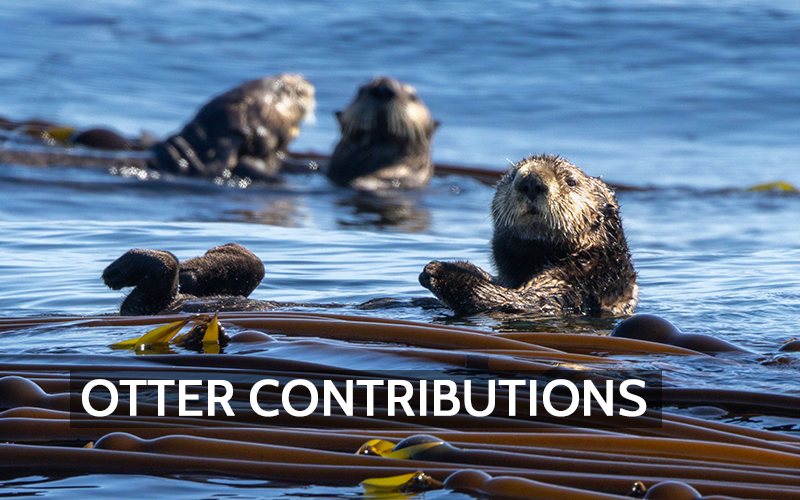
Sea otters are small compared with the ecosystems they influence.
Yet along parts of the Pacific coast, the return of sea otters can trigger a chain reaction that changes entire underwater landscapes.
The connection begins with sea urchins.
Sea urchins eat kelp. Sea otters eat sea urchins. When otters are abundant enough to keep urchin populations and grazing pressure under control, kelp forests can expand.
Because kelp removes carbon dioxide during photosynthesis, that ecological relationship also connects an animal predator to the coastal carbon cycle.
Sea Otters Are a Keystone Predator
Sea otters are often described as keystone species because their influence on an ecosystem is disproportionately large compared with their numbers.
Their role in kelp forests is one of ecology’s classic examples of a trophic cascade.
The basic relationship is:
sea otters → fewer actively grazing sea urchins → more kelp
Sea urchins are normal and important members of kelp ecosystems. Problems can arise when predator populations decline and urchin numbers become high enough to consume kelp faster than it can recover.
The result can be an urchin barren—a rocky seafloor dominated by sea urchins with relatively little large kelp remaining.
Where sea otters return and prey heavily on urchins, grazing pressure can decline enough for kelp forests to recover.
Humans Nearly Removed Otters From Much of the Pacific Coast
Sea otters once occupied a broad stretch of the North Pacific coast.
The maritime fur trade of the 18th and 19th centuries reduced them dramatically, eliminating otters from large portions of their historical range.
Some surviving populations later recovered through protection, natural expansion, and past reintroduction programs.
Those recoveries gave scientists opportunities to compare coastal ecosystems with and without otters.
In Alaska, British Columbia, and California, researchers have repeatedly observed relationships between otter recovery, lower sea-urchin grazing pressure, and healthier kelp forests.
Today, the U.S. Fish and Wildlife Service is still evaluating the possibility of future sea otter reintroduction in parts of northern California and Oregon. No simple rule says that introducing otters will restore every kelp forest, but their ecological role is well established in many North Pacific systems.
Kelp Is an Extremely Productive Carbon Consumer
Kelp is not a land plant, but it performs photosynthesis in much the same basic way.
It takes up dissolved carbon dioxide and bicarbonate from seawater and uses light energy to build organic tissue.
As kelp removes inorganic carbon from surface water, the ocean and atmosphere continually exchange CO₂. This connects kelp growth indirectly to atmospheric carbon dioxide.
Healthy kelp forests can produce enormous amounts of biomass in a relatively short period.
Some giant kelp species can grow rapidly enough to create dense underwater canopies stretching from the seafloor toward the ocean surface.
More kelp therefore means more carbon passing through the ecosystem.
Otters Can Greatly Increase Kelp Carbon
A widely cited 2012 analysis compared coastal ecosystems with and without ecologically effective sea otter populations.
The researchers estimated that areas influenced by otters could contain roughly 4.4 to 8.7 million metric tons more carbon in living kelp biomass across the portion of the North American otter range they studied.
They also estimated much greater kelp productivity where otters kept sea urchins under stronger control.
The striking part of the finding was not simply the amount of carbon.
It demonstrated that a predator could indirectly change carbon cycling by altering the abundance of an entirely different organism.
The sea otter does not photosynthesize.
It changes which organisms dominate the ecosystem, and the kelp does the carbon fixation.
Capturing Carbon Is Not the Same as Storing It Forever
This is where the carbon story becomes more complicated.
Kelp captures carbon while it grows, but much of that carbon eventually returns to the environment.
Kelp blades are eaten, broken apart, decomposed by microorganisms, or washed onto shore. Respiration and decomposition can convert much of the organic carbon back into carbon dioxide relatively quickly.
For kelp to contribute to long-term sequestration, some of its carbon must enter a reservoir where it remains isolated from the atmosphere for many years.
That can happen when pieces of kelp are transported into deep ocean water, buried in coastal sediments, or converted into forms of dissolved organic carbon that resist rapid decomposition.
Recent research suggests that a meaningful fraction of seaweed production can be exported beyond continental shelves and into deeper water, but scientists still place substantial uncertainty around the exact amount.
So it is more accurate to say that sea otters can enhance kelp carbon capture and the potential for sequestration, rather than assuming every additional pound of kelp represents permanently stored carbon.
Kelp Restoration Provides More Than Carbon
Carbon is only one benefit of restoring kelp forests.
Kelp forests create three-dimensional habitat for fish, shellfish, marine mammals, and countless invertebrates.
They provide nursery habitat, dampen wave energy, support fisheries, recycle nutrients, and can locally influence seawater chemistry.
Sea otters may therefore increase ecosystem resilience through several pathways at once.
This becomes increasingly important as Pacific kelp forests face marine heat waves, disease outbreaks among predators such as sunflower sea stars, and expanding sea-urchin barrens in some regions.
Northern California experienced dramatic kelp loss after a combination of extreme warming and the collapse of sunflower sea stars allowed purple urchin populations to expand.
Restoration efforts now include urchin removal, kelp cultivation, sunflower sea star recovery, and consideration of how missing predators such as sea otters might fit into the larger ecosystem.
Returning Otters Also Creates Tradeoffs
Sea otter recovery is not universally welcomed.
Otters eat more than sea urchins.
They also consume crabs, clams, abalone, mussels, and other shellfish that may support commercial, recreational, or Tribal fisheries.
Restoring otters can therefore redistribute marine resources as well as restore ecological processes.
This is one reason reintroduction proposals require extensive consultation with coastal communities and Indigenous nations rather than being treated simply as carbon-management projects.
The ecological benefit to kelp forests can be substantial while the economic and cultural consequences remain complicated.
A Predator Connected to the Atmosphere
Sea otters provide a useful example of how atmospheric carbon can be influenced by relationships deep inside an ecosystem.
The pathway is indirect:
Otters eat urchins.
Fewer urchins consume less kelp.
More kelp performs more photosynthesis.
More carbon enters the coastal food web, and some portion can eventually reach long-term ocean carbon reservoirs.
That chain of events does not make sea otter restoration a replacement for reducing fossil-fuel emissions.
It demonstrates something equally important: protecting predators can change how entire ecosystems function, including the way those ecosystems move carbon between the ocean and atmosphere.
Sometimes restoring a carbon-capturing forest begins not by planting anything, but by bringing back the animal that protects it.
References
- https://www.fws.gov/project/exploring-potential-sea-otter-reintroduction
- https://sanctuaries.noaa.gov/visit/ecosystems/kelpdesc.html
- https://olympiccoast.noaa.gov/science/habitat/kelp.html
- https://www.frontiersin.org/journals/ecology-and-evolution/articles/10.3389/fevo.2025.1587171/full
- https://news.ucsc.edu/2012/09/sea-otters-kelp/
- https://wildlife.ucsc.edu/publications/
- https://www.nature.com/articles/s41561-024-01449-7
- https://www.nature.com/articles/s44183-025-00125-6
- https://www.fisheries.noaa.gov/feature-story/pioneering-project-restore-bull-kelp-forests-greater-farallones-national-marine
- https://www.fisheries.noaa.gov/feature-story/scientists-breed-sunflower-sea-stars-key-reviving-californias-imperiled-kelp-forests