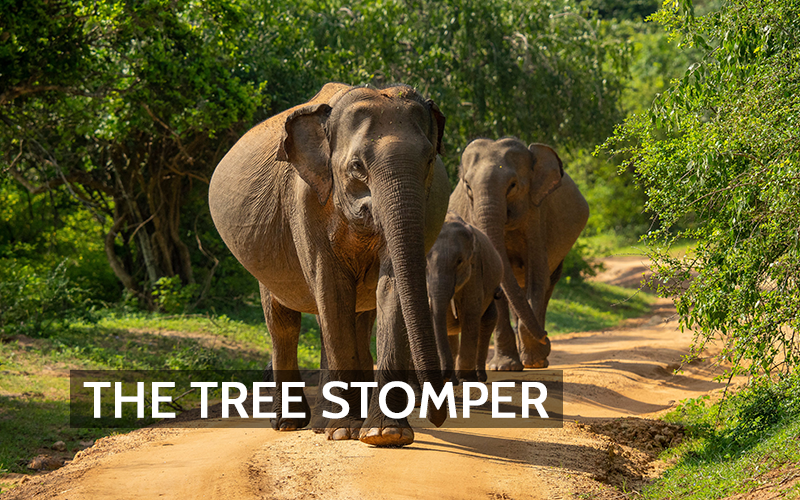
Elephants do not remove pollution from the air, and they do not capture carbon dioxide themselves.
Yet few animals can alter a landscape as dramatically.
By eating vegetation, knocking down trees, dispersing seeds, opening forest canopies, redistributing nutrients, and changing the amount of plant material available to burn, elephants can influence how ecosystems exchange carbon, water, and smoke with the atmosphere.
The effect is not the same everywhere. Forest elephants can help maintain carbon-rich tropical forests, while elephants in savannas may reduce woody carbon by keeping landscapes open.
Their relationship with the atmosphere therefore begins on the ground.
Elephants Physically Restructure Vegetation
An adult elephant can consume well over 100 pounds of vegetation in a day.
They browse leaves, strip bark, break branches, uproot shrubs, and sometimes push over entire trees.
This may appear destructive, but disturbance is a normal part of many ecosystems where elephants evolved.
When elephants remove smaller trees, they reduce competition for sunlight, water, and nutrients. Other plants then gain access to those resources.
In forests, repeated disturbance can change which tree species dominate and how densely trees grow.
In savannas, the same behavior can prevent woodland from becoming too dense and help maintain the mixture of grasses and scattered trees characteristic of the ecosystem.
Those structural changes matter because vegetation is one of the primary pathways through which carbon dioxide moves from the atmosphere into ecosystems.
Forest Elephants Can Favor Carbon-Rich Trees
African forest elephants provide one of the clearest connections between an animal and atmospheric carbon.
Research in Central African rainforests has found that elephants disproportionately damage or remove smaller, faster-growing trees.
With fewer small stems competing for resources, larger trees can grow more successfully.
These surviving trees often have denser wood.
Dense wood generally contains more carbon per unit of volume and tends to remain in the forest for long periods.
A 2019 modeling and field study estimated that typical forest-elephant densities could increase aboveground forest biomass by approximately 26 to 60 metric tons per hectare.
The researchers estimated that losing forest elephants entirely could eventually reduce aboveground biomass across Central African rainforests by roughly 7 percent.
The elephants themselves are not sequestering that carbon.
Instead, their feeding behavior changes the structure of the forest in a way that can allow more carbon to remain stored in wood.
Elephants Plant Forests Through Their Digestive Systems
Elephants also influence what the next generation of forest looks like.
Forest elephants eat large quantities of fruit and can swallow seeds too large for many smaller animals.
Those seeds may travel kilometers through the digestive system before being deposited in dung.
This does two things.
It moves seeds away from the parent tree, where competition and seed predators may be concentrated, and it deposits them in nutrient-rich material that can help support early growth.
Some tropical tree species depend heavily on large animals for this type of dispersal.
Recent research in Gabon has shown that forest elephants frequently disperse seeds from plants with relatively high carbon-storage potential, although the strength of this relationship varies considerably between forests.
This means the atmospheric consequences of elephants can continue decades after an individual elephant moves through an area.
A seed deposited today can eventually become a large tree storing carbon far into the future.
Savanna Elephants Tell a Different Carbon Story
The effect of elephants is not universally an increase in carbon storage.
In African savannas, elephants can strongly reduce woody vegetation.
By breaking, debarking, and uprooting trees, large elephant populations can convert relatively dense woodland into more open savanna.
Long-term research in South Africa’s Kruger National Park found that increasing elephant abundance substantially reduced woody biomass. In some locations, elephant activity was strong enough to shift woody vegetation from a carbon sink toward a carbon source.
This does not make elephants environmentally harmful.
Open savannas are ancient ecosystems with their own biodiversity and carbon cycles. Grasslands can store substantial carbon belowground in roots and soils, and maintaining a savanna as a savanna is not the same as degrading a forest.
It does demonstrate why elephants cannot simply be described as animals that “increase carbon storage.”
Their effect depends on the ecosystem they inhabit.
Elephants and Fire Are Closely Connected
Vegetation structure also determines how fires move across landscapes.
Fire needs fuel.
Grasses, shrubs, dead branches, and trees all contribute differently to fire behavior.
Large herbivores can reduce some fuels by eating vegetation, and studies across African savannas have found that grazing animals can substantially reduce grass biomass and overall fire activity.
Elephants complicate the picture because they both graze and browse.
Removing woody vegetation can reduce one type of fuel while encouraging grass growth that may support another type of fire.
Fallen branches and damaged trees can also alter the amount and arrangement of combustible material.
The interaction between elephants and fire therefore changes from dry savannas to wetter woodlands and with elephant population density.
Fire Connects Elephants to Air Quality
This interaction provides one of the most direct connections between elephant ecology and air quality.
Vegetation fires release fine particulate matter, carbon monoxide, carbon dioxide, nitrogen oxides, and numerous organic compounds.
By changing how much vegetation exists, which kinds of plants dominate, and how fuels are distributed, elephants can influence the conditions under which those emissions are produced.
That does not mean adding elephants to a landscape will automatically reduce wildfire smoke.
In some environments herbivory can reduce fuel loads. In others, elephant-driven shifts from trees toward grasses may change the frequency or character of fire rather than simply reducing it.
The important connection is that wildlife can help determine what is available to burn long before a fire starts.
Canopy Changes Affect the Local Atmosphere Too
Trees do more than store carbon.
They provide shade and release water vapor through transpiration.
When elephants open dense vegetation, more sunlight reaches the ground, wind moves differently through the landscape, and the balance between trees and grasses changes.
These changes can affect local temperature, soil moisture, and evaporation.
In forests, trails and clearings created by elephants also produce small patches with different light, humidity, and vegetation conditions.
The effects are primarily local, but they demonstrate that atmospheric conditions are partly a product of ecosystem structure.
An elephant changing the vegetation is therefore also changing the surface that interacts with the air above it.
Nutrients Follow the Herd
Elephants also move nutrients.
Vegetation eaten in one location may be deposited kilometers away as dung and urine.
Dung contains nitrogen, phosphorus, organic carbon, and partially digested plant material. It supports insects, fungi, microorganisms, and new plant growth.
This redistribution can change soil fertility and plant productivity.
Because plant growth controls carbon uptake, nutrient cycling provides yet another indirect pathway connecting elephants to atmospheric carbon dioxide.
An Atmospheric Influence Measured in Trees and Grass
Elephants demonstrate why air quality and atmospheric science cannot always be separated from ecology.
A forest elephant can remove a small tree and give a dense hardwood more room to grow.
It can carry a large seed several kilometers and deposit the beginning of a future forest.
A savanna elephant can open woodland, change grass growth, and alter the fuels available to the next fire.
Each action changes how carbon, water, and combustion products eventually move between land and atmosphere.
Elephants do not clean the air in the conventional sense.
They do something more complicated: they engineer the ecosystems that help determine what enters the atmosphere in the first place.
References
- https://www.nature.com/articles/s41561-019-0395-6
- https://nsojournals.onlinelibrary.wiley.com/doi/10.1002/oik.11507
- https://www.sciencedirect.com/science/article/pii/S1146609X11000154
- https://besjournals.onlinelibrary.wiley.com/doi/10.1111/1365-2745.12668
- https://onlinelibrary.wiley.com/doi/full/10.1111/ele.14450
- https://pmc.ncbi.nlm.nih.gov/articles/PMC4978867/