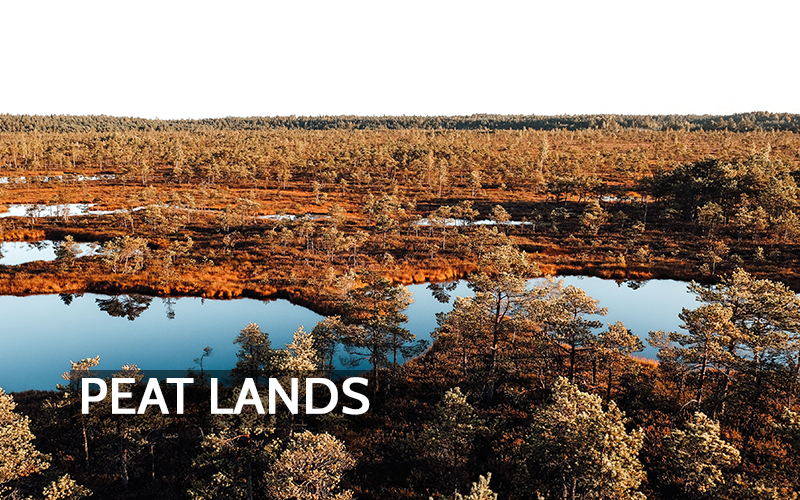
Peatlands can look modest compared with forests.
Many are flat, wet landscapes covered by mosses, grasses, shrubs, or swamp vegetation rather than towering trees. Beneath the surface, however, they contain one of the largest carbon stores on Earth.
Peatlands cover only about 3 percent of the world’s land surface yet contain hundreds of billions of tons of carbon accumulated from partially decomposed plants.
As long as the peat remains wet, much of that carbon can stay locked underground for centuries or even thousands of years.
When peatlands are drained or allowed to dry, that relationship changes dramatically.
Peat Forms Because Decomposition Slows Down
Plants remove carbon dioxide from the atmosphere through photosynthesis and incorporate that carbon into leaves, stems, and roots.
Normally, dead plant material is broken down by microorganisms, eventually returning much of its carbon to the atmosphere.
Peatlands interrupt that cycle.
Their soils remain saturated with water for long periods. Water fills spaces that would otherwise contain air, creating oxygen-poor conditions that slow microbial decomposition.
Plant material therefore accumulates faster than it completely decays.
Over hundreds or thousands of years, layers of partially decomposed vegetation build into peat.
Rather than rapidly cycling back into the atmosphere, some of the carbon originally absorbed by plants becomes stored underground.
Drying Exposes Peat to Oxygen
Water is what protects much of this carbon.
When a peatland is drained for agriculture, forestry, peat extraction, development, or other land uses, its water table falls.
Climate-driven drought and increasing temperatures can also dry peatlands naturally.
As water disappears from the soil, oxygen enters spaces within the peat.
Microorganisms that were previously limited by waterlogged conditions can then break down organic material much more rapidly.
Carbon that accumulated over centuries begins being converted back into carbon dioxide.
A peatland can therefore shift from slowly accumulating carbon to continuously releasing it.
Unlike a single wildfire, this process can continue year after year as long as the peat remains drained.
Dry Peat Can Become Fuel
Drying creates another problem.
Peat itself is combustible.
Because peat consists largely of partially decomposed organic material, sufficiently dry deposits can ignite during wildfires, agricultural burning, lightning events, or accidental fires.
Peat fires behave differently from many ordinary vegetation fires.
Rather than producing only large visible flames, peat often burns through smoldering combustion.
The fire can move slowly beneath the ground, following dry organic layers and remaining active for long periods.
Some peat fires can survive rainfall or continue beneath the surface after nearby vegetation appears to have stopped burning.
This makes them particularly difficult to detect and extinguish.
Peat Fires Release Old Carbon
A forest fire primarily burns vegetation that accumulated during recent decades.
A peat fire can consume organic material that has been stored underground for hundreds or thousands of years.
That makes peat fires especially important to the carbon cycle.
When peat burns, much of its stored carbon is rapidly converted into carbon dioxide and other combustion products.
UNEP has reported that severe peat fires can release substantially more carbon per hectare than typical forest fires because the fire consumes both surface vegetation and carbon-rich soil.
A sufficiently deep peat fire can therefore erase centuries of carbon accumulation in a relatively short period.
The Smoke Creates an Immediate Air-Quality Problem
Carbon dioxide is important for climate, but it is not usually the main immediate health concern from peat smoke.
Fine particulate matter is.
Smoldering peat produces large quantities of PM2.5 along with carbon monoxide and numerous organic compounds.
Because the combustion is incomplete, smoke can persist for long periods and spread far beyond the burning wetland.
Large peat fires in Southeast Asia have repeatedly produced regional haze affecting communities hundreds of miles away.
During Indonesia’s severe 2019 peat-fire season, researchers measured extreme PM2.5 concentrations across parts of Central Kalimantan and estimated substantial health impacts associated with smoke exposure.
Peatland degradation therefore links a long-term carbon problem with an immediate air-pollution emergency.
Fire Can Make Future Fires More Likely
Once a peatland burns, the ecosystem may become even more vulnerable.
Fire can remove vegetation that normally shades the ground and helps retain moisture.
Burned peat may develop cracks and channels that allow additional drainage.
If the water table remains low, vegetation recovery may be slow and exposed peat can dry again during the next drought.
Repeated fires can gradually consume deeper layers of stored carbon.
This creates a damaging cycle:
drainage leads to drying, drying allows fire, fire damages the peatland, and damaged peat becomes increasingly vulnerable to future drying and fire.
Tropical and Northern Peatlands Face Different Threats
Peatlands occur from the tropics to the Arctic.
In Southeast Asia, large areas of tropical peat swamp forest have been drained for agriculture and plantations. Drainage canals lower the water table and make normally wet peat highly vulnerable during drought.
Northern peatlands in Canada, Alaska, Scandinavia, and Russia face somewhat different pressures.
Increasing temperatures, changing precipitation, wildfire, and thawing permafrost can alter hydrology and expose previously protected peat to decomposition or combustion.
Despite their different climates, the basic concern is similar: carbon that was protected by cold or wet conditions becomes increasingly exposed to oxygen and fire.
Rewetting Can Protect the Carbon That Remains
One of the most direct methods of restoring a degraded peatland is to restore its water.
Drainage ditches can be blocked, water tables raised, and native wetland vegetation encouraged to return.
Rewetting slows aerobic decomposition and makes deep peat much more difficult to burn.
The greenhouse-gas picture is not completely simple.
Wet peatlands can naturally produce methane because microorganisms living without oxygen generate methane during decomposition.
Restoration may therefore increase methane emissions in some locations while dramatically reducing carbon dioxide emissions from drying peat.
Scientists evaluate these gases together when determining the long-term climate effects of peatland restoration.
The major advantage is preventing an enormous existing carbon stock from continuing to disappear.
Protecting Carbon Already Underground
Peatlands demonstrate an important distinction in carbon management.
Planting new vegetation can remove additional carbon dioxide from the atmosphere.
Protecting peatlands primarily prevents carbon that has already been removed from returning.
That carbon may represent thousands of years of accumulated plant growth.
Once a peat deposit is deeply burned or oxidized away, rebuilding the same carbon stock would require far longer than a human lifetime.
Keeping peat wet is therefore not simply about preserving a wetland.
It is about maintaining one of Earth’s oldest natural carbon-storage systems—and preventing the soil beneath it from becoming both a source of greenhouse gases and fuel for some of the world’s most persistent fires.
References
- https://www.iucn.org/resources/issues-brief/peatlands-and-climate-change
- https://www.unep.org/news-and-stories/story/seven-things-you-should-know-about-peatlands
- https://www.unep.org/news-and-stories/press-release/smoke-water-countering-global-threats-peatland-loss-and-degradation
- https://www.unep.org/news-and-stories/story/peat-fires-stoke-global-warming
- https://www.nature.com/articles/ngeo2325
- https://www.nature.com/articles/s43247-024-01813-w
- https://www.iucn.org/news/water/202102/world-wetlands-day-2021