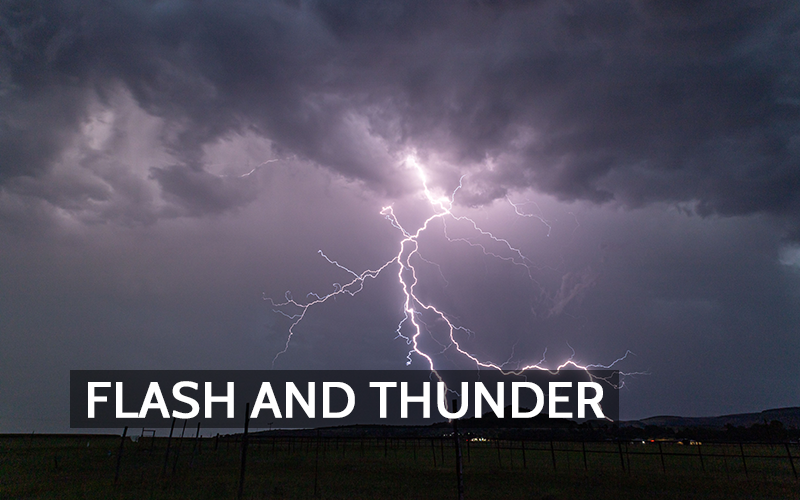
A lightning bolt lasts only a fraction of a second.
Chemically, however, its effects can continue for days.
The enormous temperature inside a lightning channel briefly transforms ordinary atmospheric nitrogen and oxygen into reactive nitrogen compounds. Thunderstorm winds then carry those chemicals through the atmosphere, where they participate in reactions involving ozone, methane, and some of the atmosphere’s most important oxidants.
Lightning is therefore much more than an electrical event.
Every major thunderstorm also functions as a temporary atmospheric chemical reactor.
Ordinary Air Is Difficult to React
Earth’s atmosphere is composed primarily of nitrogen and oxygen.
About 78 percent is molecular nitrogen, or N₂, while roughly 21 percent is molecular oxygen, or O₂.
Both molecules are relatively stable under ordinary atmospheric conditions.
The two nitrogen atoms in N₂ are held together by an especially strong chemical bond. This makes atmospheric nitrogen abundant but difficult for most chemical processes to use directly.
Lightning changes the situation.
Temperatures inside a lightning channel can exceed 20,000 kelvin—several times hotter than the surface of the Sun.
At those temperatures, nitrogen and oxygen molecules can temporarily break apart.
The Lightning Channel Creates Nitric Oxide
As the superheated air begins cooling, free nitrogen and oxygen atoms recombine in new arrangements.
One important product is nitric oxide, or NO.
The simplified chemistry can be thought of as:
nitrogen + oxygen + extreme heat → nitric oxide
Once the lightning channel cools, the NO survives long enough to enter normal atmospheric chemistry.
It quickly begins reacting with other molecules and becomes part of a larger family of compounds called nitrogen oxides, or NOx.
NOx primarily refers to nitric oxide and nitrogen dioxide, or NO₂.
These are the same general classes of pollutants produced by vehicle engines, power plants, boilers, and other high-temperature combustion processes.
Lightning creates them naturally using a similar principle: extreme heat allows nitrogen and oxygen to react.
Thunderstorms Move NOx High Into the Atmosphere
Lightning does not occur in still air.
It occurs inside enormous convective storms.
Strong thunderstorm updrafts can carry air several miles above Earth’s surface in a short period.
Lightning-produced NOx therefore often ends up in the middle and upper troposphere rather than remaining close to the ground.
This makes lightning especially important to atmospheric chemistry.
NOx survives longer at high altitude than it typically does near the surface, and chemical conditions there allow it to influence ozone efficiently.
Lightning is consequently considered the largest natural source of NOx in much of the upper troposphere.
Globally, current scientific estimates suggest lightning accounts for roughly 10 to 15 percent of total NOx emissions.
NOx Helps Create Ozone
Nitrogen dioxide can absorb sunlight and break apart:
NO₂ + sunlight → NO + O
The free oxygen atom can then combine with an ordinary oxygen molecule:
O + O₂ → O₃
The resulting molecule is ozone.
The chemistry does not end there.
Nitric oxide can react with ozone and convert it back into nitrogen dioxide:
NO + O₃ → NO₂ + O₂
By itself, this cycle can simply create and destroy ozone repeatedly.
Other atmospheric chemicals change the balance.
Oxidation of carbon monoxide, methane, and volatile organic compounds creates reactive molecules that can convert NO back into NO₂ without consuming ozone.
The newly created NO₂ can then absorb sunlight and produce another ozone molecule.
Under the right conditions, the result is net ozone production.
Ozone Is Different Depending on Altitude
Ozone has very different consequences depending on where it forms.
High in the stratosphere, ozone protects life by absorbing harmful ultraviolet radiation.
In the troposphere, ozone is a greenhouse gas and an important part of atmospheric chemistry.
Near Earth’s surface, elevated ozone is also an air pollutant capable of irritating the respiratory system and damaging vegetation.
Lightning-generated NOx tends to have its strongest ozone effect high in the troposphere rather than directly at ground level.
The upper atmosphere is especially sensitive because NOx is relatively scarce there compared with polluted urban environments.
Adding a relatively small amount can therefore significantly change local chemistry.
A Storm Can Change Air After It Has Passed
Thunderstorm chemistry does not remain directly beneath the storm.
High-altitude winds can transport lightning-produced NOx hundreds or thousands of miles.
During that journey, nitrogen compounds continue reacting and ozone can continue forming.
Researchers use aircraft measurements, lightning-detection networks, satellites, and atmospheric models to track this process.
NASA instruments capable of measuring atmospheric NO₂ have detected enhanced nitrogen oxides associated with major thunderstorm systems.
Those observations help scientists estimate how much NOx individual flashes produce and how storm chemistry influences regional ozone.
Can Lightning Affect Surface Air Quality?
Usually, lightning’s largest effect occurs above the surface.
That does not mean surface air is completely isolated from it.
Storm systems can transport chemically altered air downward, while mountainous terrain can place the surface closer to air that was recently part of the middle or upper troposphere.
A 2026 scientific review concluded that lightning-generated NOx can contribute around 1 to 2 parts per billion to maximum eight-hour surface ozone under some conditions, with larger effects occasionally occurring at higher elevations.
Compared with severe urban ozone pollution, that contribution is generally modest.
For air-quality models attempting to explain ozone concentrations precisely, however, it matters.
Ignoring lightning can cause models to underestimate NOx and ozone during thunderstorm seasons.
Lightning Also Changes the Atmosphere’s Cleaning Chemistry
Ozone is not the only molecule affected.
Lightning NOx influences concentrations of the hydroxyl radical, or OH.
OH is sometimes called the atmosphere’s detergent because it reacts with many pollutants and trace gases, beginning the processes that eventually remove them from the air.
Changes in OH also affect methane.
More lightning-produced NOx can encourage chemistry that increases OH, shortening the atmospheric lifetime of methane.
That creates an interesting climate interaction.
Lightning-generated ozone tends to contribute warming, while enhanced destruction of methane can produce an opposing influence.
Atmospheric chemistry rarely moves in only one direction.
Lightning Is Also a Natural Form of Nitrogen Fixation
Lightning performs another ancient chemical function.
Atmospheric N₂ is abundant but unavailable to most organisms.
By converting some of that nitrogen into reactive nitrogen oxides, lightning effectively fixes nitrogen.
Those compounds can eventually become nitric acid, nitrates, and other nitrogen-containing materials.
Rain and atmospheric deposition can then deliver them to Earth’s surface, where nitrogen becomes available to ecosystems.
Long before humans manufactured nitrogen fertilizer, lightning was one of the natural mechanisms converting atmospheric nitrogen into chemically useful forms.
A Flash That Outlives the Storm
Lightning appears instantaneous.
Its chemistry is not.
For a brief moment, a lightning channel reaches temperatures high enough to tear apart some of the most stable molecules in the atmosphere.
The resulting nitrogen oxides are swept through towering storm clouds and released into air where they influence ozone, methane, reactive radicals, and eventually the nitrogen cycle.
The thunderstorm may disappear by evening.
Some of the chemistry it created can continue far downwind for days.
Lightning therefore offers a dramatic example of how energy can transform the atmosphere—not by adding a new substance from outside, but by rearranging the gases that were already there.
References
- https://agupubs.onlinelibrary.wiley.com/doi/10.1029/2026JD046484
- https://science.nasa.gov/mission/aura/mid-latitude-lightning-nitrogen-oxides-production-efficiency/
- https://ntrs.nasa.gov/citations/20190034005
- https://airbornescience.nasa.gov/nsrc/content/Estimating_the_influence_of_lightning_on_upper_tropospheric_ozone_using_NLDN_lightning_data
- https://repository.library.noaa.gov/view/noaa/63573
- https://acp.copernicus.org/articles/7/3823/2007/
- https://www.epa.gov/sciencematters/how-does-lightning-impact-air-pollution-epa-researchers-use-innovative-air-quality
- https://www.epa.gov/ground-level-ozone-pollution/ground-level-ozone-basics