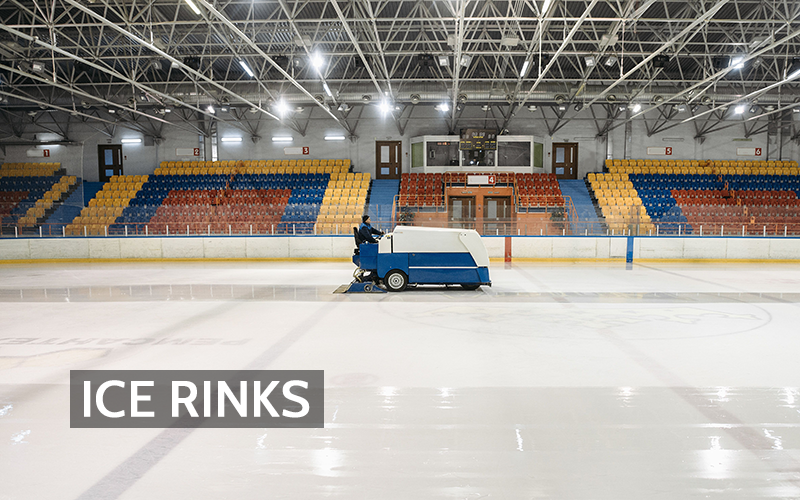
An indoor ice rink seems like a simple environment: a refrigerated sheet of ice inside a large, cold building.
From an air-quality perspective, however, it is unusually complicated.
For decades, many arenas have maintained their ice using resurfacing machines powered by gasoline, propane, or natural gas. These engines operate directly inside an enclosed building, sometimes several times during a single tournament or busy skating day.
Their exhaust can contain carbon monoxide, nitrogen dioxide, particulate matter, and other combustion products.
Unlike a car driving down an open road, those emissions have nowhere to go unless the building’s ventilation system removes them.
The Resurfacer Is an Indoor Engine
An ice resurfacer performs several jobs during each trip around the rink.
A blade shaves a thin layer from the ice. The machine collects the resulting snow, washes the surface, and spreads clean water behind it to freeze into a new layer.
Traditional machines use internal-combustion engines much like other industrial vehicles.
Gasoline, propane, and natural gas can all power resurfacers, and all can produce combustion emissions.
Two pollutants receive particular attention: carbon monoxide, or CO, and nitrogen dioxide, or NO₂.
Carbon monoxide forms when fuel does not burn completely.
Nitrogen oxides form when high-temperature combustion allows nitrogen and oxygen in the air to react. Some of that nitrogen oxide chemistry ultimately produces NO₂.
The amount produced depends heavily on engine condition, fuel, tuning, catalytic controls, and operating conditions.
Carbon Monoxide Can Accumulate Without Warning
Carbon monoxide is particularly dangerous because it has no color or smell.
A poorly tuned engine can therefore contaminate a rink without producing an obvious warning.
Ice arenas have experienced documented mass-exposure incidents.
During a 1996 incident in Seattle, a malfunctioning propane resurfacer combined with inadequate ventilation caused elevated CO levels throughout an arena. Other investigations have documented dozens of hockey players and spectators becoming ill after combustion gases accumulated indoors.
Athletes can face additional exposure because strenuous exercise increases breathing rate.
A hockey player skating hard for an hour inhales substantially more air than a spectator sitting in the stands.
Propane Can Create a Different Problem
Propane-powered machines are often thought of as cleaner than gasoline engines.
They can produce less of some pollutants, but that does not mean their exhaust is harmless.
Older research on ice arenas found that gasoline-powered machines were often associated with higher carbon monoxide concentrations, while propane-powered machines could produce substantial nitrogen dioxide under certain operating conditions.
Engine tuning matters.
Adjusting combustion to reduce CO can sometimes increase nitrogen oxide formation.
NO₂ is a respiratory irritant that can affect the eyes, nose, throat, and lungs. High exposures can cause coughing and shortness of breath, while people with asthma or other respiratory conditions may respond at lower concentrations.
A 2011 investigation in New Hampshire linked a propane-powered resurfacer operating without adequate ventilation to NO₂ exposure among dozens of people.
The Ice Creates an Unusual Airflow Problem
Ice arenas also behave differently from ordinary buildings.
The ice continuously cools the air immediately above it.
That creates a layer of cold, dense air near the skating surface while warmer air remains higher in the arena.
This thermal stratification can reduce vertical mixing.
Rink boards and surrounding plexiglass can further interfere with air movement across the ice.
The result is that pollutants emitted by a resurfacer can remain concentrated closer to the skating surface rather than immediately mixing throughout the entire building.
That makes ventilation design especially important.
Simply having a very large building does not guarantee good air quality if contaminated air is not being removed from the area where people are actually breathing.
Ventilation Has to Work During Resurfacing
EPA recommends continuous ventilation whenever an arena is occupied.
Mechanical systems bring outdoor air into the building while exhausting contaminated indoor air.
During and after resurfacing, additional ventilation may be necessary to dilute combustion gases.
Operators also have to consider where outdoor-air intakes are located. An intake beside a loading dock, idling vehicle, or combustion exhaust outlet can simply bring pollution back into the building.
Fuel-powered edgers, forklifts, heaters, boilers, and generators can add additional combustion sources.
The resurfacer may be the most visible engine on the ice, but it is not necessarily the only one affecting rink air.
Monitoring Provides an Early Warning
Because CO cannot be detected by smell and NO₂ may accumulate without an obvious visual sign, direct measurement is an important part of rink management.
Some states regulate this specifically.
Massachusetts requires indoor skating rinks using combustion-powered resurfacing equipment to monitor carbon monoxide and nitrogen dioxide, maintain measurement records, and take corrective action when concentrations become elevated.
Minnesota similarly requires regulated arenas using internal-combustion ice-maintenance equipment to measure both gases.
Measurements may be taken near the center of the ice and around the breathing height of skaters rather than only high in the stands.
That placement matters because pollutant concentrations can differ substantially throughout the building.
Maintenance Can Make a Major Difference
A properly maintained combustion engine can emit far less pollution than a malfunctioning one.
Engine timing, air-fuel mixture, catalytic converters, oxygen sensors, exhaust systems, and routine servicing can all affect emissions.
EPA notes that newer engines meeting stricter emissions standards produce substantially less CO and nitrogen oxides than older resurfacing equipment.
Studies have also found that increasing ventilation, properly tuning engines, and adding emission-control equipment can substantially reduce rink pollutant concentrations.
Those strategies still manage exhaust after choosing to operate a combustion engine indoors.
Electric equipment approaches the problem differently.
Electric Resurfacers Remove the Tailpipe
Battery-electric ice resurfacers eliminate combustion exhaust at the point of use.
No gasoline or propane is burned while the machine crosses the ice, so the resurfacer does not directly emit CO or NO₂ into the arena.
Electric resurfacing is not new. Zamboni has manufactured electric machines since the late 1970s and now offers lithium-ion models alongside fuel-powered equipment. Other manufacturers also offer battery-electric machines.
Modern batteries have made electric equipment increasingly practical by improving operating time, charging speed, and maintenance requirements.
Historical rink studies have repeatedly found the lowest NO₂ concentrations in facilities using electric resurfacers.
Electrification does not eliminate the need for ventilation. Arenas still contain occupants, humidity, refrigeration equipment, cleaning products, restaurants, and other potential indoor-air sources.
It does remove one major pollution source directly from the building.
An Indoor-Air Problem Hidden in a Recreational Space
Ice arenas demonstrate an important principle of indoor air quality.
Pollution does not need to come from an industrial factory or a visible cloud of smoke.
A relatively small engine operating for only a few minutes can influence air throughout a large building when emissions accumulate faster than ventilation removes them.
Modern engine controls, continuous monitoring, adequate ventilation, and increasingly electric equipment have made the problem much more manageable.
But the basic challenge remains unusual:
To maintain a frozen surface indoors, an arena must constantly control temperature, humidity, airflow—and, when engines operate on the ice, the exhaust produced only a few feet from the people breathing above it.
References
- U.S. EPA — Indoor Air Quality and Ice Arenas
- Massachusetts Department of Public Health — Indoor Skating Rinks
- Minnesota Department of Health — Enclosed Sports Arenas
- CDC — Carbon Monoxide Poisoning at an Indoor Ice Arena, Seattle
- CDC — Nitrogen Dioxide and Carbon Monoxide Intoxication in an Indoor Ice Arena
- PubMed — Nitrogen Dioxide in Indoor Ice Skating Facilities
- PubMed — Determinants of Nitrogen Dioxide Concentrations in Indoor Ice Skating Rinks
- Zamboni — Air Quality and Emissions
- Zamboni — Electric and Fuel-Powered Ice Resurfacers