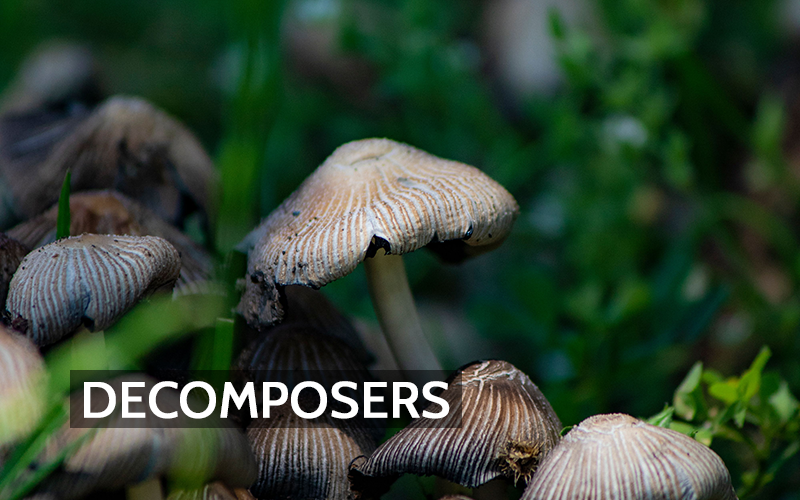
A fallen tree may remain recognizable for decades, but it is not inactive.
Soon after wood, leaves, and other plant material die, fungal networks begin growing through them. Microscopic threads called hyphae penetrate the material, release enzymes, absorb nutrients, and gradually dismantle structures that plants spent years building.
This process makes fungi some of the most important decomposers on Earth.
It also connects them directly to the atmosphere.
As fungi digest dead vegetation, they return carbon dioxide to the air, release volatile organic compounds, produce vast quantities of airborne spores, and participate in chemical reactions involving nitrogen.
A rotting log is therefore more than decaying wood.
It is a small biological reactor exchanging material with the atmosphere around it.
Fungi Can Break Apart Wood
Wood is difficult to decompose because plants build it from extremely durable materials.
Cellulose fibers provide strength, while lignin surrounds and reinforces those fibers.
Lignin is particularly resistant to decay.
Certain fungi evolved remarkable chemical systems capable of attacking it.
White-rot fungi can break down lignin along with cellulose and other plant polymers. They release powerful oxidative enzymes that dismantle the complicated molecular structure of wood.
Brown-rot fungi use a different strategy. They rapidly attack cellulose and hemicellulose while leaving much of the modified lignin behind.
Together, wood-decaying fungi unlock carbon that might otherwise remain trapped inside dead trees for much longer periods.
Carbon Returns to the Atmosphere
Plant carbon originally came from atmospheric carbon dioxide.
Through photosynthesis, a tree captures CO₂ and turns it into wood, leaves, roots, and other tissues.
When fungi later consume that material, part of the carbon becomes fungal tissue.
Much of it eventually returns to the atmosphere.
Fungi use organic molecules for energy. During respiration, carbon from those molecules is converted into carbon dioxide.
That CO₂ moves out of decomposing wood, leaf litter, or fungal tissue and enters the surrounding air.
Globally, decomposition is therefore an essential part of the carbon cycle.
Forests may capture enormous quantities of atmospheric carbon while trees are growing, but after those trees die, fungal decomposition helps determine how quickly some of that stored carbon returns.
Not All Dead Wood Decays at the Same Speed
Fungal decomposition depends heavily on the surrounding environment.
Moisture is particularly important.
Wood that is too dry may support relatively little fungal activity, while damp wood can become heavily colonized.
Temperature also influences fungal metabolism.
A warm, moist forest may therefore recycle dead plant material much more rapidly than a cold or extremely dry environment.
The fungal community itself matters as well.
Different species decompose wood at different rates, attack different compounds, and compete with one another for territory.
Research has even found situations where greater fungal diversity was associated with slower CO₂ release from decomposing wood because competing fungi spent energy fighting one another rather than simply consuming the substrate.
Decomposition is not one chemical reaction.
It is an ecosystem.
Fungi Release Volatile Chemicals
Carbon dioxide is not the only gas produced by fungi.
Fungal metabolism generates a wide variety of volatile organic compounds, or VOCs.
One of the best known is 1-octen-3-ol, sometimes called mushroom alcohol because it contributes to the characteristic smell associated with mushrooms and fungal growth.
Other fungal VOCs include alcohols, ketones, aldehydes, terpenes, sulfur-containing compounds, and many other chemicals.
These molecules can act as biological signals.
They may influence plants, attract or repel insects, discourage competing microorganisms, or communicate information across spaces that fungal hyphae cannot physically cross.
Once released, some can also enter the surrounding atmosphere.
Like plant VOCs, fungal compounds may react with ozone, hydroxyl radicals, and other atmospheric oxidants. Scientists are still determining how important fungal VOC emissions are compared with the much larger global emissions from vegetation.
Spores Become Airborne Particles
Fungi also influence air quality in a much more physical way.
They release spores.
Some species launch spores actively into the air, while others depend on wind, raindrops, animals, or disturbance.
Once airborne, fungal spores become primary biological aerosol particles.
They can represent a significant portion of airborne organic particulate matter in forests, particularly under humid conditions when many fungi are actively reproducing.
One study in a Japanese forest found that fungal-spore material contributed substantially to measured organic aerosol, particularly at night when humidity approached saturation.
Unlike secondary particles created through atmospheric chemistry, these particles are biological material emitted directly into the air.
Rain Can Trigger Fungal Aerosols
Weather strongly affects spore release.
Humidity can encourage fungi to produce or discharge spores, while raindrops striking leaves and soil can launch spores and tiny fungal fragments into the atmosphere.
Wind then transports them away from their original source.
Some travel only short distances.
Others can remain airborne long enough to move between ecosystems or across regions.
This means a rainstorm can temporarily change not only atmospheric moisture but also the biological composition of the air.
Fungal Particles Can Interact With Clouds
Some fungal material can influence cloud physics.
Certain fungal spores and fragments contain molecules capable of encouraging supercooled water to freeze.
These particles are known as ice-nucleating particles.
When carried high enough into the atmosphere, they can provide surfaces that help ice crystals form inside clouds.
Fungal fragments may also sometimes participate in cloud-droplet formation.
Scientists do not believe fungal particles dominate global cloud formation. Dust, sea salt, combustion particles, and other aerosols are far more abundant in many environments.
But in biologically active regions, fungal aerosols may contribute to the mixture of particles controlling when cloud droplets or ice crystals develop.
The organism decomposing a log on the forest floor can therefore produce material that eventually reaches a cloud.
Some Fungi Produce Nitrous Oxide
Certain fungi also participate in nitrogen chemistry.
Under oxygen-poor conditions, some species can perform fungal denitrification, using nitrogen compounds during metabolism and producing nitrous oxide.
Nitrous oxide, or N₂O, is a powerful greenhouse gas and also contributes to destruction of stratospheric ozone.
Fungal denitrifiers appear to represent a relatively small fraction of the total organisms performing denitrification in most environments.
A global analysis found fungal denitrifiers were widespread but made up only about one percent of identified denitrifier communities on average.
Their importance may become greater under particular conditions, including acidic forest soils with high carbon availability.
This makes fungal N₂O production real, but considerably less dominant than the fungal role in carbon decomposition.
Fungi Decide How Long Dead Carbon Stays Dead
The atmospheric importance of decomposer fungi ultimately comes from their ability to unlock material other organisms struggle to consume.
A tree may remove carbon dioxide from the atmosphere for a century.
After it falls, fungal networks begin deciding what happens to that carbon next.
Some becomes fungal biomass.
Some enters soil organic matter.
Some feeds insects and other organisms.
And some returns to the atmosphere as carbon dioxide and other gases.
At the same time, fungal VOCs enter the air, spores become atmospheric particles, and certain fungal compounds may participate in cloud and nitrogen chemistry.
Fungi therefore do much more than make dead material disappear.
They help complete the connection between the living forest and the atmosphere above it.
References
- https://research.fs.usda.gov/treesearch/46539
- https://research.fs.usda.gov/treesearch/61051
- https://research.fs.usda.gov/treesearch/41508
- https://www.nature.com/articles/s41579-026-01321-y
- https://www.nature.com/articles/srep31066
- https://acp.copernicus.org/articles/21/4381/2021/
- https://acp.copernicus.org/articles/16/7497/2016/
- https://acp.copernicus.org/articles/7/4569/2007/
- https://pmc.ncbi.nlm.nih.gov/articles/PMC10559904/
- https://pmc.ncbi.nlm.nih.gov/articles/PMC10269876/
- https://pmc.ncbi.nlm.nih.gov/articles/PMC9249623/