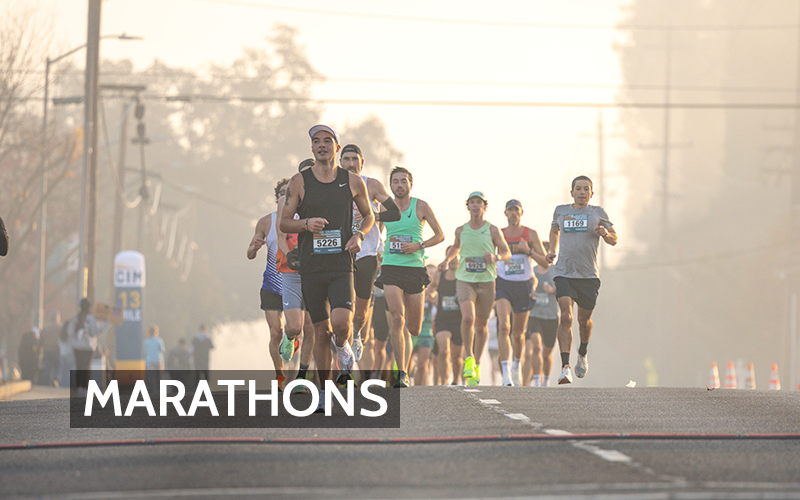
A marathon asks the human respiratory system to operate at high capacity for hours.
Over 26.2 miles, runners dramatically increase how much air they inhale compared with someone standing along the course. That extra airflow supplies working muscles with oxygen—but it also increases the amount of whatever happens to be suspended in the surrounding atmosphere.
For an urban marathon, that can include nitrogen dioxide, fine particulate matter, ozone, traffic emissions, road dust, and occasionally wildfire smoke.
A major race is therefore not simply an athletic event occurring in a city.
It is also a prolonged interaction between thousands of heavily breathing people and the urban atmosphere.
Running Changes How Much Pollution Reaches the Lungs
At rest, an adult may breathe only several liters of air each minute.
During sustained endurance exercise, minute ventilation—the total volume of air moving through the lungs each minute—can increase many times over.
Runners also increasingly breathe through their mouths as exercise intensity rises.
Nasal passages normally provide some filtration of larger particles. Heavy mouth breathing allows more inhaled material to bypass that route.
Exposure therefore depends on more than the pollutant concentration displayed by an air monitor.
A runner breathing heavily for several hours can inhale a much larger total volume of polluted air than a relatively inactive spectator exposed to the same concentration.
Researchers increasingly describe this as the inhaled dose of air pollution.
Traffic Creates a Complicated Urban Course
Many major marathons travel directly through dense cities.
That places runners near roads that normally contain cars, buses, trucks, taxis, delivery vehicles, and other combustion sources.
One pollutant particularly associated with traffic is nitrogen dioxide, or NO₂.
NO₂ is produced largely through fuel combustion and contributes to respiratory irritation as well as the atmospheric chemistry that creates ozone and secondary particles.
Closing streets to racers can substantially remove traffic directly from the course.
But the surrounding city continues operating.
Vehicles diverted onto nearby streets, buses transporting spectators, generators, police vehicles, support trucks, and pre-race traffic can all contribute to local emissions.
The atmosphere encountered by runners can therefore change continuously across the route.
A Study of 2.7 Million Marathon Performances
A large 2026 study examined this connection across six of the world’s best-known marathons.
Researchers analyzed 2,756,553 finishing times from Berlin, Boston, Chicago, London, New York City, and Tokyo races held between 2010 and 2024.
They compared finishing times with race-day NO₂ and PM2.5 concentrations while accounting for factors including heat index, wind, and long-term trends.
NO₂ showed the strongest association.
Higher race-day NO₂ concentrations were associated with slower finishing times among both men and women.
The effect was also considerably larger among recreational runners than elite competitors. Researchers estimated that the association between NO₂ and finishing time was roughly six times stronger among recreational participants.
The study found no statistically significant association between PM2.5 and finishing time after weather adjustments.
That does not mean PM2.5 is harmless during exercise. It means this particular study did not detect a clear effect on marathon finishing time.
The research also identified an association, not proof that NO₂ alone directly caused every observed difference in performance.
Fine Particles Present a Different Concern
PM2.5 consists of particles less than 2.5 micrometers across.
Because of their small size, these particles can penetrate deep into the respiratory system.
Urban PM2.5 may come from combustion, regional pollution, construction, secondary atmospheric chemistry, and other sources.
Wildfire smoke can rapidly become an especially important source.
A marathon scheduled months in advance may suddenly face a smoke plume that develops only days or hours before the race.
This creates a difficult logistical problem because thousands of runners may already have traveled to the city.
Public-health guidance generally recommends reducing strenuous outdoor exercise as smoke concentrations increase because harder exercise increases the amount of polluted air inhaled.
Ozone Can Rise as the Day Warms
Ground-level ozone presents another challenge.
Unlike NO₂ emitted directly from combustion sources, ozone forms in the atmosphere when nitrogen oxides and volatile organic compounds react in sunlight.
Ozone concentrations often increase during warm, sunny afternoons.
That means marathon timing can matter.
Large races frequently begin early in the morning partly for logistical and temperature reasons. An early start can also place more of the race before the typical afternoon ozone peak.
For slower participants, however, a marathon can extend well into late morning or afternoon.
The runners spending the longest time on the course may therefore experience a different atmospheric environment from elite athletes who finish several hours earlier.
Heat and Humidity Complicate the Picture
Air pollution is only one environmental stressor affecting marathon performance.
Heat and humidity place additional demands on the cardiovascular system.
The body must move blood toward the skin for cooling while simultaneously supplying working muscles.
High humidity makes sweat evaporation less effective.
Pollution and heat can also occur together.
Hot, stagnant weather can encourage ozone formation while limiting atmospheric mixing, allowing some pollutants to accumulate.
Race organizers therefore increasingly evaluate air quality alongside temperature, humidity, wind, and other weather conditions rather than treating each variable independently.
Race Organizers Can Reduce Pollution Around the Course
A marathon cannot control regional air pollution.
It can reduce emissions associated with the event itself.
World Athletics recommends limiting traffic around competition areas, avoiding heavily polluted locations where possible, monitoring air conditions, and using low-emission vehicles for race operations.
The 2025 Daegu Marathon in South Korea provides one example.
Organizers implemented vehicle restrictions, promoted a car-free approach, and used road-cleaning equipment to reduce resuspended dust.
Other races are experimenting with electric lead vehicles and tighter controls on vehicle access around runners.
Closing a marathon course therefore provides an unusual opportunity to temporarily create a low-traffic corridor through an otherwise busy city.
Monitoring Can Follow the Runners
Traditional city air monitors are fixed in one location.
A marathon is 26.2 miles long.
Those two facts create an obvious limitation.
Pollution near a congested intersection may differ significantly from conditions several miles away in a park.
World Athletics has begun experimenting with dynamic monitoring, including portable instruments that travel along race routes.
The Mexico City Marathon has used both stationary monitoring and mobile equipment moving along the course.
This approach allows organizers to see how conditions change spatially rather than relying entirely on a citywide average.
Smoke May Require Difficult Decisions
Wildfire smoke creates one of the hardest situations for race directors.
Conditions can change rapidly, and postponing or cancelling a major marathon affects tens of thousands of runners, volunteers, businesses, and spectators.
Nevertheless, organizers need predetermined contingency plans.
Those plans can include continuous AQI monitoring, public communication systems, medical coordination, alternative start times, shortened events, or cancellation thresholds when conditions become sufficiently hazardous.
The advantage of establishing those procedures beforehand is that decisions can be based on measured environmental conditions rather than improvisation on race morning.
Twenty-Six Miles Through an Atmosphere
A marathon measures athletic endurance, but it also measures environmental exposure.
For hours, runners move through changing neighborhoods while dramatically increasing the amount of air passing through their lungs.
Traffic pollution may dominate one section.
Road dust may increase in another.
Ozone may rise as sunlight strengthens.
A distant wildfire may unexpectedly change the entire race-day atmosphere.
The 26.2-mile course therefore exists not only on streets but inside a moving mass of air.
As cities become better at measuring that atmosphere, air quality may increasingly join temperature, humidity, hydration, and course design as one of the environmental factors considered when planning the world’s largest races.
References
- https://link.springer.com/article/10.1186/s40798-026-01099-6
- https://pubmed.ncbi.nlm.nih.gov/42668336/
- https://www.epa.gov/sciencematters/should-you-exercise-outside-air-pollution
- https://www.airnow.gov/aqi/aqi-basics/using-air-quality-index/
- https://www.airnow.gov/wildfires/when-smoke-is-in-the-air/
- https://www.epa.gov/ozone-pollution-and-your-patients-health/patient-exposure-and-air-quality-index
- https://worldathletics.org/athletics-better-world/sustainability/air-quality-guidance
- https://worldathletics.org/organisation/better-world/air-quality-program
- https://pubmed.ncbi.nlm.nih.gov/41005809/
- https://pmc.ncbi.nlm.nih.gov/articles/PMC12028381/