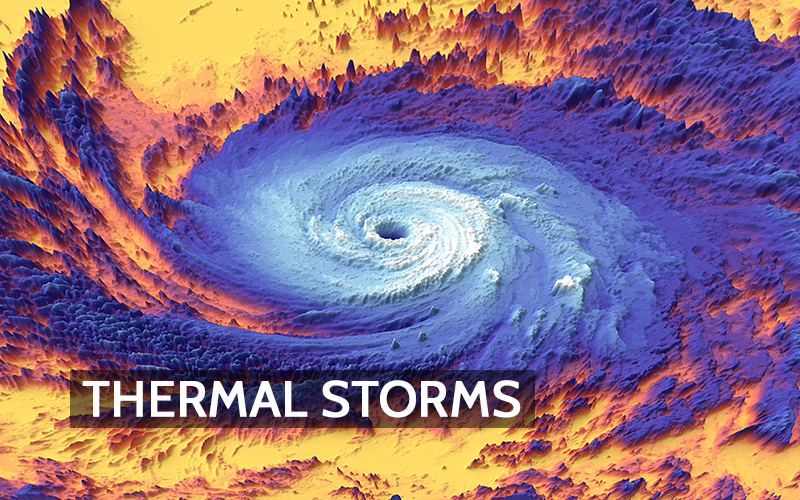
Storms can appear to be sudden and chaotic, but they develop through recognizable exchanges of heat, moisture, and energy. Differences in air temperature help move the atmosphere, while warm seas supply water vapor and heat to many powerful weather systems.
Temperature alone does not create a storm. Moisture, atmospheric instability, pressure patterns, wind, and a mechanism that lifts air are also necessary. However, temperatures in the air and ocean help determine how much energy is available and what kind of storm may form.
Why Warm Air Rises
Air expands as it warms. When a pocket of air becomes warmer than the surrounding atmosphere, it becomes less dense and may begin to rise. As it moves upward into lower atmospheric pressure, it expands and cools.
If the rising air contains enough water vapor, some of that vapor condenses into tiny droplets, forming a cloud. Condensation releases heat into the surrounding air. This additional energy can keep the air rising and help the cloud grow taller.
A small rising cloud may produce little more than a brief shower. Under unstable conditions, however, the upward motion can continue through a large portion of the atmosphere. The result may be a towering thunderstorm capable of producing heavy rain, lightning, hail, damaging wind, or tornadoes.
Meteorologists often describe three basic ingredients for thunderstorms: moisture, instability, and lift. Warm surface air can contribute to instability, particularly when much colder air is present higher in the atmosphere. A cold front, mountain range, sea breeze, or another storm’s outflow may then provide the push needed to start the air rising.
Temperature Differences Create Weather
Some of the atmosphere’s largest storms are driven not by uniformly warm conditions, but by sharp differences between warm and cold air.
A weather front is a boundary between air masses with different temperatures and moisture levels. Because cold air is denser, an advancing cold air mass can push beneath warmer air and force it upward. If the warm air is moist and unstable, clouds and thunderstorms may rapidly form along the front.
Large low-pressure systems in the middle latitudes draw much of their energy from these horizontal temperature contrasts. These systems, called extratropical or mid-latitude cyclones, can produce widespread rain, snow, strong winds, coastal flooding, and severe thunderstorms.
They differ from tropical cyclones because they are usually connected to cold and warm fronts. Tropical storms are powered mainly by heat and moisture from warm ocean water, while mid-latitude storms are strongly influenced by the meeting of different air masses.
Temperature contrasts also help create the jet stream, a narrow band of powerful winds high in the atmosphere. The jet stream guides fronts and low-pressure systems and can help storms strengthen when upper-level winds remove air from above a developing surface low.
Warm Seas Supply Storm Fuel
The ocean stores a tremendous amount of heat. When the sea surface is warm, more water evaporates into the atmosphere. This creates warm, humid air above the water.
As that air rises and cools, its water vapor condenses into clouds and rain. The released heat strengthens upward motion, lowers surface pressure, and draws additional warm, moist air toward the developing storm. Under the right conditions, this cycle can organize into a tropical depression, tropical storm, or hurricane.
Tropical cyclones generally require ocean water of approximately 26.5 degrees Celsius, or about 80 degrees Fahrenheit, extending through a substantial depth. A thin layer of warm surface water may not be enough. A storm’s winds can stir the ocean and bring colder water upward, weakening the system. Deep ocean warmth allows the storm to continue drawing energy even after the water becomes mixed.
This is why forecasters examine ocean heat content as well as sea-surface temperature. Exceptionally warm water extending far below the surface can support rapid strengthening when other atmospheric conditions are favorable.
Why Warm Water Is Not Enough
A warm ocean does not guarantee that a hurricane will form. Tropical systems also need abundant atmospheric moisture, an existing disturbance, sufficient distance from the equator to begin rotating, and relatively low vertical wind shear.
Wind shear is a change in wind speed or direction with height. Strong shear can tilt a tropical cyclone and separate its thunderstorms from its center. This disrupts the organized heat engine the storm needs to strengthen.
Dry air can have a similar effect. When dry air enters a storm, it can weaken thunderstorms and reduce the release of heat from condensation. Land also cuts a tropical storm off from its ocean energy source while adding friction and disrupting its circulation.
Storm intensity therefore depends on the entire environment, not sea temperature alone.
Air Temperature Influences Rainfall
Warmer air can contain more water vapor than cooler air. When a storm develops in a warm, moisture-rich atmosphere, it may have access to more water that can eventually fall as rain.
This does not mean every warm day will produce a storm. It means that when lifting and instability are already present, additional moisture can increase the potential for intense rainfall. Slow-moving thunderstorms can be especially dangerous because they repeatedly release rain over the same location.
Warm air moving over colder ground or water can sometimes become more stable, limiting upward motion. In contrast, cold air moving over a relatively warm lake or ocean can become unstable from below. This process can produce strong coastal showers, snow squalls, and lake-effect snow.
Storms Also Change Temperature
The relationship works in both directions. Temperature helps drive storms, but storms also redistribute heat.
Thunderstorms carry warm, moist air upward and bring cooler air toward the surface through rain-cooled downdrafts. Hurricanes transfer heat from tropical oceans into the atmosphere and can leave trails of cooler water behind them. Large weather systems move warm air toward the poles and cold air toward the equator.
Storms are therefore part of Earth’s natural heat-transport system. They help reduce temperature imbalances, even while producing destructive local conditions.
Air and sea temperatures provide the contrasts, moisture, and stored energy that many storms need. Whether that energy becomes a brief shower, a winter cyclone, a severe thunderstorm, or a hurricane depends on how temperature interacts with humidity, pressure, wind, and the larger structure of the atmosphere.
References
- https://www.weather.gov/safety/lightning-thunderstorm-development
- https://www.weather.gov/spotterguide/ingredients
- https://www.weather.gov/lmk/basic-fronts
- https://www.nesdis.noaa.gov/news/mid-latitude-cyclone-the-first-day-of-summer
- https://www.aoml.noaa.gov/hrd/project97/tcfaqA.html
- https://oceanservice.noaa.gov/facts/how-hurricanes-form.html
- https://oceantoday.noaa.gov/fuelforthestorm/
- https://coastwatch.noaa.gov/cwn/news/2019-03-20/tropical-cyclone-heat-potential.html
- https://svs.gsfc.nasa.gov/20048/
- https://science.nasa.gov/earth/climate-change/a-force-of-nature-hurricanes-in-a-changing-climate/