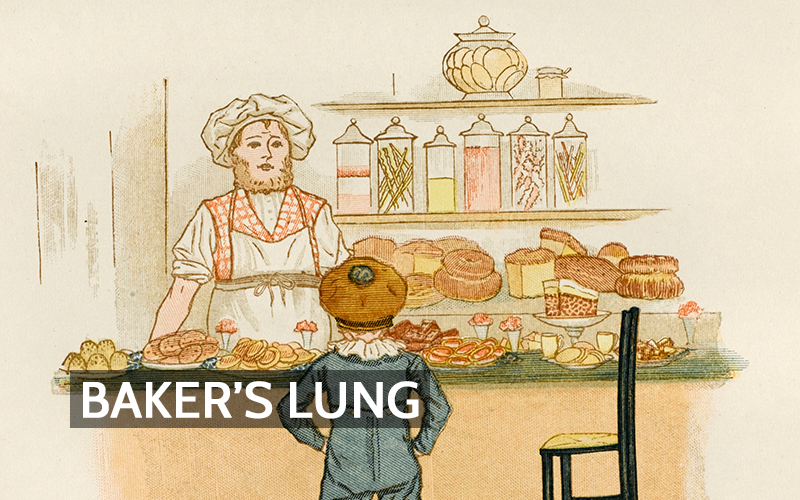
Bread was one of the most important foods in Victorian England. For London’s rapidly growing population, a fresh loaf was an inexpensive and filling part of nearly every meal. Yet the bread appearing in shop windows each morning came at an enormous cost to the people who made it.
Victorian bakers often worked through the night in hot, dusty and poorly ventilated rooms. Many spent most of their lives breathing clouds of flour while laboring for extraordinarily long hours. The respiratory illness that followed became known as baker’s lung, or more commonly today, baker’s asthma.
What Was Baker’s Lung?
“Baker’s lung” was not always used as a precise medical diagnosis. Victorian doctors lacked modern lung-function testing and could not easily distinguish asthma from chronic bronchitis, pneumonia, tuberculosis and other respiratory diseases. Historical records therefore describe bakers suffering from a broad collection of symptoms, including coughing, wheezing, breathlessness, irritated throats and declining physical strength.
Modern occupational medicine recognizes baker’s asthma as a form of work-related asthma caused by repeated exposure to flour and other airborne bakery ingredients. Wheat proteins can act as allergens, causing the immune system to become sensitized. Once this happens, even a relatively small exposure may cause the airways to tighten and become inflamed. Runny noses, irritated eyes and persistent sneezing often appear before more serious asthma symptoms develop.
The danger was not simply that flour was dusty. Bakery workers could become exposed to a complicated mixture of grain proteins, molds, storage mites and other biological materials carried within flour. Modern bakeries may also use enzymes such as alpha-amylase, another powerful respiratory sensitizer. Flour dust and bakery enzymes remain recognized causes of occupational asthma today.
Flour in the Air
Nearly every stage of traditional breadmaking could release flour into the atmosphere. Bakers opened and emptied heavy sacks, weighed dry ingredients, sifted flour, dusted work surfaces and mixed large batches of dough by hand. Flour was also thrown across tables to prevent sticking, while floors and equipment were commonly cleaned with dry brushes.
These actions created short but intense clouds of dust directly within a baker’s breathing zone. Modern occupational research suggests that these peak exposures may be especially important in causing respiratory sensitization, even when the average amount of dust measured across an entire workday appears relatively low.
For Victorian bakers, however, the workday could last most of the day and night.
Underground, Hot and Poorly Ventilated
Many London bakehouses were built beneath shops because underground space was cheaper and allowed valuable street-level rooms to be used for selling bread. These basement bakeries were difficult to ventilate, naturally dark and often affected by dampness, drains and nearby privies.
Historical inspections documented large numbers of underground bakehouses throughout London. Inspectors repeatedly encountered poorly lit rooms, broken drains, accumulated refuse and inadequate airflow.
Ventilation sometimes existed but was deliberately restricted. Bakers needed warm rooms for dough fermentation and feared that outside air would create drafts or interfere with production. Factory inspectors noted the difficulty of maintaining both fresh air and the high temperatures required inside basement bakehouses.
The resulting environment trapped flour dust close to the workers. Heat from the ovens added to their physical stress, while humidity and poor sanitation may have increased exposure to molds and other biological irritants. Some contemporary accounts described dough being prepared in underground rooms with temperatures ranging from approximately 76 to 90 degrees Fahrenheit.
Exhaustion Without Recovery
The demand for fresh morning bread meant that much of the work took place overnight. Dough had to be prepared, fermented, shaped and baked before shops opened. Once the morning production was finished, workers might still be required to clean, deliver bread, prepare ingredients or begin the next batch.
Historical evidence described some London bakers beginning around 11 p.m., producing bread through the morning and remaining occupied with other duties until the evening. Shifts approaching 16 or even 18 hours became one of the central grievances raised by journeymen bakers.
These hours mattered for more than fatigue. A worker inhaling flour for most of the day received an enormous cumulative exposure, with little time away from the contaminated environment. Exhaustion also made it harder for the body to recover from respiratory irritation and left bakers vulnerable to infection, injury and chronic illness.
Some workers even slept beside or near their bakehouses. Victorian regulations eventually required sleeping areas to be separated from production rooms and provided with an opening window, indicating that the practice was common enough to require government intervention. Inspectors still found sleeping rooms divided from active bakehouses by little more than a wooden partition.
Tasting History’s Look at the Victorian Baker
Max Miller examines this forgotten occupation in the Tasting History episode “The Deadly Job of a Victorian Baker.”
Watch the episode here:
https://youtu.be/yf8rxJk4QzQ?si=I_g19X4dJkUtkcZd
Using an unusual ginger loaf recipe from 1857 as the culinary centerpiece, Miller explores the harsh labor behind the breads and cakes enjoyed by Victorian consumers.
The episode is especially effective because it connects food history with the experiences of the people who produced that food. Rather than presenting Victorian baking as a charming collection of old recipes, Miller describes the exhausting hours, physical labor and unhealthy rooms hidden behind the bakery counter.
His discussion of baker’s lung also demonstrates how an ordinary material can become hazardous when exposure is intense and continuous. A small amount of flour used in a home kitchen is unlikely to create the conditions experienced by a worker spending years inside a dusty basement bakery. The danger came from the combination of concentration, repetition, poor ventilation and extreme working hours.
Reform Came Slowly
Public concern eventually led to an official investigation into the grievances of journeymen bakers in 1862. The resulting pressure helped produce the Bakehouse Regulation Act of 1863, which introduced requirements involving cleanliness, ventilation and sleeping accommodations. It also placed limits on when younger workers could be employed.
Enforcement was inconsistent, however. Later inspectors continued to find underground bakehouses with poor ventilation, dirty equipment, accumulated flour waste and defective sanitation. Further factory and workshop laws gradually strengthened inspection, but dangerous conditions remained in portions of the industry throughout the Victorian period.
Baker’s asthma has not disappeared. Modern bakeries use ventilation, enclosed ingredient handling, low-dust flour, careful cleaning methods and respiratory protection to reduce exposure. The continuing need for these controls shows that the hazard was never merely a product of Victorian weakness or poor health. It was, and remains, an air-quality problem.
Victorian London’s bakers supplied one of the city’s most basic necessities. Yet the flour-covered rooms where they worked turned the production of daily bread into a potentially disabling occupation. Baker’s lung serves as a reminder that even familiar and natural materials can become dangerous when workers are surrounded by them for hours, days and years without adequate protection.
References
- https://www.hse.gov.uk/asthma/bakers.htm
- https://www.hse.gov.uk/coshh/industry/baking.htm
- https://stacks.cdc.gov/view/cdc/194799
- https://upload.wikimedia.org/wikipedia/commons/b/b1/Report_addressed_to_Her_Majesty%27s_Principal_Secretary_of_State_for_the_Home_Department%2C_relative_to_the_grievances_complained_of_by_the_journeymen_bakers_-_with_appendix_of_evidence_%28IA_b22352673%29.pdf
- https://upload.wikimedia.org/wikipedia/commons/3/34/The_sanitary_regulation_of_bakehouses_%28IA_b24401493%29.pdf
- https://en.wikisource.org/wiki/Once_a_Week_%28magazine%29/Series_1/Volume_8/The_impurities_of_the_loaf
- https://www.tastinghistory.com/episodes/gingerloaf
- https://youtu.be/yf8rxJk4QzQ?si=I_g19X4dJkUtkcZd