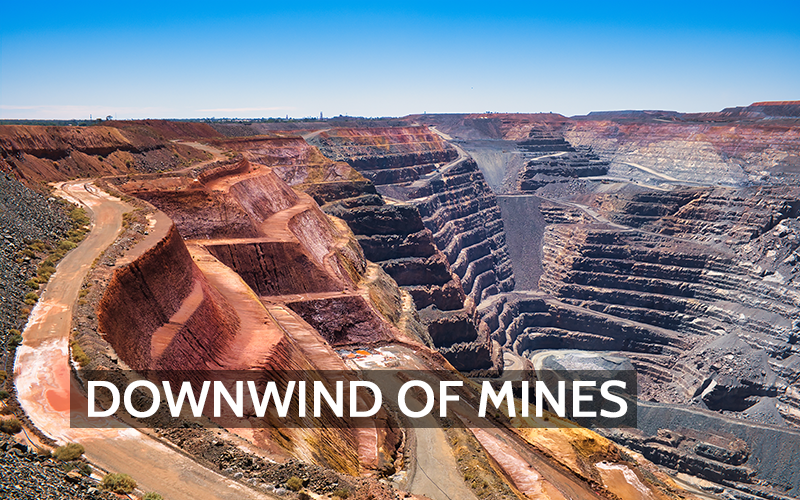
Open-pit mining makes it possible to recover large mineral deposits located close to the Earth’s surface. These mines supply copper, iron, coal, gold, limestone, and many other raw materials used in buildings, electronics, transportation, and energy systems. However, removing millions of tons of soil and rock from an exposed pit can also create significant air-quality challenges for workers and nearby communities.
The most visible problem is dust. Before miners can reach an ore deposit, they often remove vegetation, topsoil, and layers of unwanted rock known as overburden. Drilling, blasting, digging, loading, crushing, and transporting this material can release particles into the air. Large haul trucks are especially important sources because their tires repeatedly disturb loose material on unpaved mine roads. Wind can also lift dust from exposed ground, waste-rock piles, ore stockpiles, and tailings storage areas.
Not all mining dust behaves in the same way. Larger particles usually settle relatively close to their source, where they may coat homes, vehicles, crops, or vegetation. Smaller particles can remain airborne longer and travel farther. PM10 includes inhalable particles with diameters of 10 micrometers or less, while PM2.5 refers to even finer particles. These smaller particles can enter deep portions of the lungs. Depending on the geology of the mine, dust may also contain crystalline silica, metals, or other mineral components that require additional attention.
Open-pit mines can release more than mineral dust. Diesel-powered trucks, excavators, generators, and other heavy equipment produce nitrogen oxides, carbon monoxide, and fine diesel particles. Blasting can briefly generate clouds containing dust and gases. Mineral-processing equipment, including crushers and screens, may add emissions if it is not enclosed or properly ventilated.
The effect on surrounding air quality depends on many local conditions. Dry weather and strong winds generally increase dust movement, while rainfall and moist surfaces can reduce it. The depth and shape of the pit, the location of roads and stockpiles, nearby terrain, and the distance to homes all influence where emissions travel. Air inversions can also trap pollution near ground level. For these reasons, two mines of similar size may have very different effects on nearby communities.
Poorly controlled mine emissions may cause eye, nose, and throat irritation and can worsen asthma or other respiratory conditions. Long-term exposure to fine particulate matter is associated with heart and lung disease. Workers who regularly encounter respirable crystalline silica face the additional risk of silicosis, an incurable lung disease. The risk to any individual depends on the pollutant concentration, exposure time, particle composition, and personal health.
Modern mines generally use several layers of control rather than relying on a single solution. Water trucks and fixed spray systems keep haul roads, work areas, and stockpiles damp so particles are less likely to become airborne. Some sites apply approved dust suppressants that help road surfaces retain moisture. Speed limits, road maintenance, gravel placement, and limits on unnecessary vehicle travel can further reduce road dust.
At crushing and material-transfer areas, mines may use enclosed conveyors, covered transfer points, water mist, local exhaust ventilation, and filtered dust-collection systems. Vehicle cabins can be sealed and supplied with filtered air to protect equipment operators. Regular engine maintenance and newer low-emission or electric equipment can reduce diesel pollution.
Mine planning is another important control. Operators can place waste piles and processing equipment farther from communities, build windbreaks, reduce drop heights when loading material, and schedule blasting during favorable weather. Progressive reclamation, covering and revegetating areas as soon as they are no longer active, reduces the amount of bare land available to generate dust. Tailings and waste-rock surfaces may also be capped, kept moist, stabilized, or planted.
Monitoring allows these controls to respond to real conditions. Mines may operate particulate monitors around the property boundary and near surrounding communities, along with weather stations that track wind speed and direction. Dust-deposition gauges can measure material settling from the air. Worker sampling is used to evaluate occupational exposure, particularly for silica. Some management plans establish trigger levels that require extra watering, reduced vehicle activity, changes to blasting, or temporary shutdowns when weather or pollution readings become unfavorable.
Community involvement can strengthen these programs. Public reporting, complaint hotlines, independent audits, and meetings with nearby residents help identify recurring problems that may not be obvious from a single monitoring station. Regulators may also require permits, emission estimates, operating controls, and corrective action when standards are exceeded.
Open-pit mining will always disturb large areas of land, so completely eliminating emissions is unlikely. However, careful design, dust controls, cleaner equipment, continuous monitoring, progressive reclamation, and transparent communication can greatly reduce the effect on surrounding air. Effective management depends on treating air quality as an ongoing operating responsibility rather than a one-time permit requirement.
References
- https://www.epa.gov/air-emissions-factors-and-quantification/section-119-western-surface-coal-mining-related
- https://www.cdc.gov/niosh/publications/numbered/2019-124.html
- https://www.cdc.gov/niosh/mining/topics/respiratory-hazards.html
- https://www.who.int/teams/environment-climate-change-and-health/air-quality-energy-and-health/health-impacts
- https://www.who.int/news-room/fact-sheets/detail/ambient-%28outdoor%29-air-quality-and-health
- https://www.epa.nsw.gov.au/sites/default/files/10994coalminedust.pdf
- https://www.msha.gov/silica-final-rule-30-cfr-part-60-resources