Every person in a room changes its air. When people breathe, they take in oxygen and release carbon dioxide, commonly written as CO₂. If enough outdoor air enters the room, this additional carbon dioxide is diluted and removed. If ventilation is limited, CO₂ gradually accumulates.
This relationship makes carbon dioxide a useful indicator of how well an occupied room is being ventilated. Small electronic monitors can continuously measure CO₂ and show whether fresh air is keeping pace with the number of people using a space.
However, CO₂ should be understood as a ventilation metric, not a complete air-quality score.
What Is an Air Exchange?
An air exchange occurs when an amount of air equal to the volume of a room is supplied or removed. Air changes per hour, or ACH, describes how many room volumes of air are delivered during one hour.
For example, a room receiving three air changes per hour is supplied with an amount of air equal to three times its volume every hour. This does not mean every molecule of old air is completely replaced three times. New and existing air mix together, causing pollutants to become progressively diluted.
Engineers can measure airflow directly through ventilation ducts and calculate ACH using the room’s volume. CO₂ monitors offer a more accessible way to evaluate ventilation behavior, although they do not usually provide an exact ACH reading by themselves.
How CO₂ Indicates Ventilation
Outdoor air generally contains much less carbon dioxide than the air inside a crowded room. When people enter a space, their breathing begins adding CO₂. The indoor concentration depends on several factors, including the number of occupants, their activity levels, the room’s size, the outdoor CO₂ level, and the rate at which indoor air is replaced.
A steadily rising reading suggests that people are producing CO₂ faster than ventilation is removing it. A relatively stable concentration suggests that the ventilation system is keeping closer pace with occupancy.
A monitor may also show how quickly CO₂ falls after people leave. This is called a decay test. When the room is reasonably well mixed and the outdoor concentration is known, the rate of decline can be used to estimate air changes. Building professionals may use this method during ventilation assessments.
There is no single CO₂ concentration that proves a room is safe, healthy, or properly ventilated under every condition. A reading must be interpreted in context. A large ballroom, a small guest room, and a busy restaurant have different occupancy patterns and ventilation needs.
CO₂ also does not detect particles, mold, carbon monoxide, volatile organic compounds, or cleaning-product fumes. A room can have a low CO₂ reading while still containing another pollutant.
Why CO₂ Matters in Hotels
Hotels present unusual ventilation challenges because rooms are used by changing numbers of people throughout the day. Guest rooms may remain empty for hours and then become occupied overnight with doors and windows closed. Conference rooms can shift from nearly empty to crowded within minutes. Restaurants, fitness centers, lobbies, indoor pools, and event halls each produce different ventilation demands.
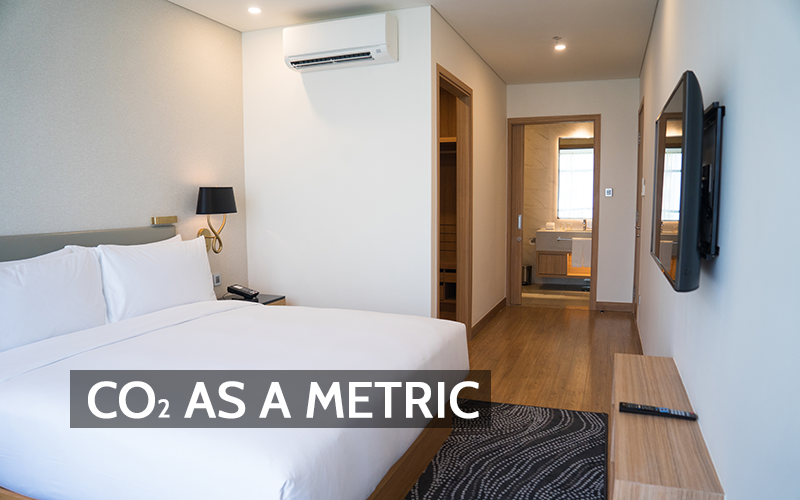
In a guest room, rising overnight CO₂ may indicate that the outdoor-air supply is not keeping pace with the sleeping occupants. Guests may describe the room as stuffy even though they cannot identify the cause. Ventilation problems can also contribute to lingering odors and allow moisture or pollutants from furnishings, cleaning products, and personal-care products to accumulate.
Meeting and banquet rooms create an even stronger case for monitoring. A ventilation system operating at one fixed rate may provide unnecessary outdoor air while the room is empty but insufficient air during a crowded event. Real-time CO₂ readings can help hotel staff identify these changes.
Demand-Controlled Hotel Ventilation
Hotels may increasingly connect CO₂ monitors to building-management systems. This approach is known as demand-controlled ventilation.
When a conference room is empty, the ventilation system can operate at a lower setting while still meeting building requirements. As guests enter and CO₂ begins to rise, the system can increase the outdoor-air supply. After the event ends, the system can continue ventilating the room until concentrations return closer to the outdoor baseline.
Demand-controlled operation can reduce the energy needed to heat, cool, and dehumidify outdoor air. It may be especially valuable in hotels because many spaces experience highly variable occupancy.
Future guest rooms could combine CO₂ readings with door sensors, thermostats, humidity sensors, and occupancy controls. The system might lower energy use while the room is vacant, restore comfortable conditions before check-in, and adjust ventilation while guests are sleeping.
Hotels could also use CO₂ data to identify mechanical problems. A room that repeatedly develops unusually high readings may have a blocked vent, incorrect fan setting, closed damper, or poorly balanced air system. Maintenance teams could receive an alert before the issue produces repeated guest complaints.
The Future Guest Experience
CO₂ monitoring may eventually become part of the information hotels provide to guests. A room control panel or mobile application could display basic ventilation status alongside temperature and humidity. Conference organizers might request indoor-air data when selecting meeting spaces, particularly for crowded or multi-day events.
Privacy will remain important. CO₂ monitors measure gas concentrations rather than identifying individual people, but their data can still indicate when a space is occupied. Hotels will need clear policies governing how readings are collected, stored, and used.
The strongest future systems will not rely on CO₂ alone. They may combine carbon dioxide with particulate matter, carbon monoxide, humidity, temperature, and volatile organic compound sensors. Together, these measurements can provide a more complete picture of guest comfort, ventilation performance, and indoor air quality.
Carbon dioxide monitoring cannot guarantee that a hotel room is free from every pollutant. It can, however, make one important part of indoor air management visible. Used carefully, CO₂ data can help hotels deliver fresh air when it is needed, reduce wasted energy when rooms are empty, detect ventilation problems, and create more comfortable spaces for guests and employees.
References
- https://www.ashrae.org/file%20library/about/position%20documents/pd-on-indoor-carbon-dioxide-english.pdf
- https://www.cdc.gov/niosh/ventilation/faq/index.html
- https://www.epa.gov/indoor-air-quality-iaq/can-i-measure-carbon-dioxide-co2-indoors-get-information-ventilation
- https://www.epa.gov/indoor-air-quality-iaq/low-cost-air-pollution-monitors-and-indoor-air-quality
- https://tsapps.nist.gov/publication/get_pdf.cfm?pub_id=933362
- https://nvlpubs.nist.gov/nistpubs/Legacy/IR/nistir5329.pdf
- https://betterbuildingssolutioncenter.energy.gov/sectors/hospitality
- https://www1.eere.energy.gov/buildings/publications/pdfs/alliances/creea_guest_room_occupancy-based_controls_report.pdf
- https://betterbuildingssolutioncenter.energy.gov/sites/default/files/attachments/Small_Hotels_BB_Carbon_Strategies.pdf