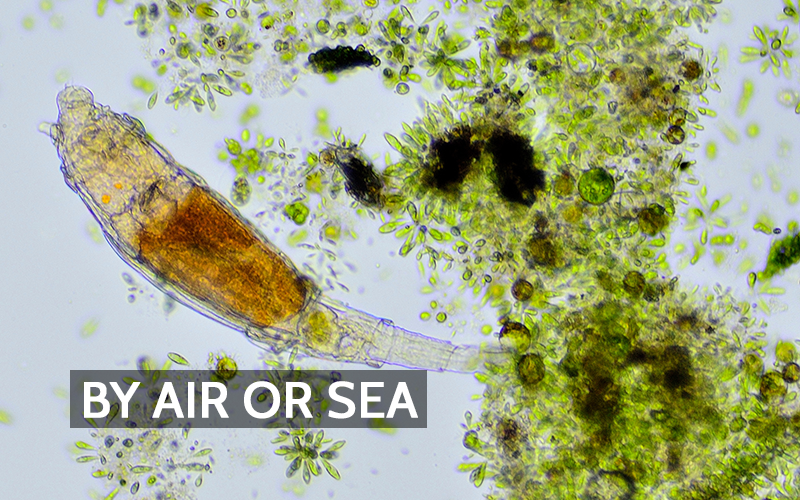
Rotifers are tiny aquatic animals found in ponds, lakes, wetlands, moist soils, mosses, lichens, and even temporary puddles. Most are only a fraction of a millimeter long, yet they possess muscles, a digestive system, sensory structures, and microscopic jaws. Many have a crown of beating hairs called cilia around their heads. The motion of these cilia resembles a turning wheel, giving rotifers their name: “wheel animals.”
Despite being aquatic animals, some rotifers can travel through the atmosphere. They do not fly, and they are not normally active while airborne. Instead, certain rotifers survive drying or produce durable eggs that can be lifted with dust and carried by wind. This ability helps explain how such small animals appear in isolated ponds, rooftop gutters, patches of moss, and other temporary habitats around the world.
Two Different Survival Strategies
Rotifers include several major groups, but two are especially important when discussing airborne dispersal: bdelloid rotifers and monogonont rotifers.
Many bdelloid rotifers can survive the drying of their habitat through a process called anhydrobiosis, meaning “life without water.” As conditions become dry, the rotifer contracts its body, loses most of its water, and enters a state in which normal activity and metabolism become extremely limited.
The dried rotifer may remain trapped among soil particles, moss, leaf litter, or other organic material. When rain or moisture returns, it can absorb water, expand, and become active again. This transformation allows an animal normally dependent on water to wait through droughts that would kill many other aquatic organisms.
Many monogonont rotifers use a different strategy. During unfavorable conditions, they can produce thick-walled resting eggs. These eggs may remain dormant in soil or sediment until temperature, water, light, and food conditions improve. Resting eggs serve as both survival capsules and potential transportation units.
How Does a Rotifer Enter the Air?
A dried rotifer or resting egg is extremely small and light. Once its surrounding soil, moss, or sediment dries, wind can disturb the surface and lift microscopic material into the air.
The rotifer may travel as an individual dried animal, as a resting egg, or while attached to a fragment of dust or plant material. Strong winds, agricultural activity, animal movement, construction, and ordinary disturbance of dry ground can all help release small biological particles.
Dust storms may transport dormant microinvertebrates along with mineral dust. Studies of windblown material have found viable dormant stages of several small aquatic animals, including rotifers. Wind experiments have also demonstrated that dried bdelloid rotifers can be physically dispersed and later establish active populations after receiving water.
The exact distance traveled varies. Some rotifers probably move only between nearby patches of moss or neighboring ponds. Others may be carried much farther during powerful wind events. Small size makes long-distance transport possible, but it does not guarantee success.
Landing Is Only the Beginning
Most airborne rotifers probably land somewhere unsuitable. A dormant animal deposited on a dry roof, paved road, or exposed rock may never encounter enough water to revive. Others may be damaged by sunlight, heat, repeated drying, or long periods without protection.
Successful dispersal requires the rotifer to reach a habitat with water and appropriate food. A rain-filled tree hollow, wet patch of moss, temporary pool, or damp soil layer may be enough.
Once conditions improve, a surviving bdelloid rotifer can become active and begin feeding on bacteria, algae, fungi, and organic material. Bdelloids reproduce through parthenogenesis, meaning females produce offspring without mating. As a result, one successfully dispersed individual may potentially begin a new population without first finding a partner.
Monogonont resting eggs can create a similar colonization opportunity. When an egg hatches in a new water body, rapid asexual reproduction may allow its descendants to multiply quickly while conditions remain favorable.
Escaping More Than Drought
Drying and wind dispersal may also help bdelloid rotifers escape parasites.
Researchers studying a lethal fungal parasite found that infected rotifer populations could rid themselves of the fungus by completely drying. Wind then carried the dormant rotifers away from the contaminated location. After rehydration, some established new populations without the parasite.
In this case, traveling through the air provided both transportation and an ecological escape route. The rotifers did not defeat the parasite directly. They temporarily stopped living actively, endured conditions the fungus could not tolerate as well, and moved to a new location.
Are Rotifers Really Everywhere?
Rotifers are found across an extraordinary range of environments and continents. Their small size, dormant stages, rapid reproduction, and passive transportation by wind, water, and animals all contribute to their broad distribution.
Scientists once suggested that microscopic organisms might be essentially everywhere, with local environmental conditions determining which species become active. Modern genetic research presents a more complicated picture. Many rotifer lineages are extremely widespread, but not every species occurs everywhere. Geographic barriers, climate, habitat chemistry, chance, and limits on dispersal still shape their distribution.
Rotifers are therefore not truly airborne animals in the way that insects or birds are. The atmosphere is more like a temporary bridge between aquatic habitats. By becoming dormant, tolerating extreme water loss, and allowing themselves to be carried with dust, these microscopic animals can cross landscapes that would otherwise be impossible for them to navigate.
Their journey shows that air moves more than gases, pollen, and microorganisms. Under the right conditions, it can also transport a complete multicellular animal, one small and hardy enough to dry up, blow away, and begin life again when the rain returns.
References
- https://www.mbl.edu/research/research-organisms/rotifer
- https://ucmp.berkeley.edu/phyla/rotifera/rotifera.html
- https://www.science.org/doi/10.1126/science.1179252
- https://pmc.ncbi.nlm.nih.gov/articles/PMC6884325/
- https://pmc.ncbi.nlm.nih.gov/articles/PMC5931521/
- https://pmc.ncbi.nlm.nih.gov/articles/PMC6434837/
- https://pmc.ncbi.nlm.nih.gov/articles/PMC5916493/
- https://pubmed.ncbi.nlm.nih.gov/14561331/
- https://pmc.ncbi.nlm.nih.gov/articles/PMC11657207/
- https://functionalbio.com/wp-content/uploads/2017/05/Robeson_Soil_Rotifier.pdf