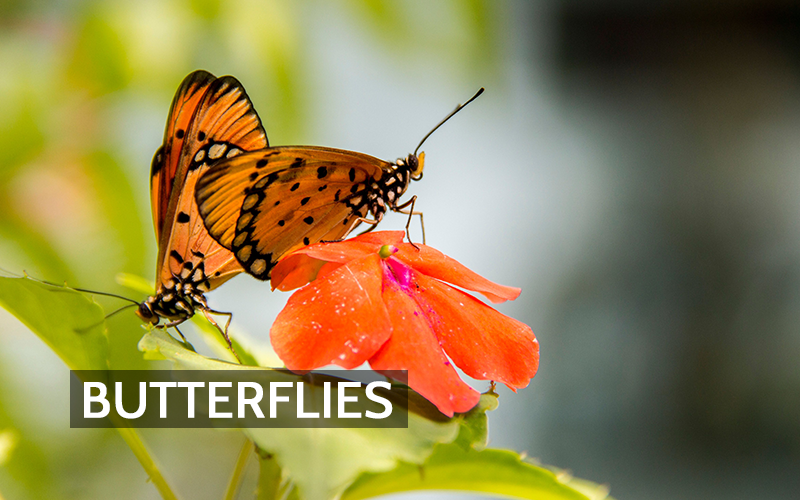
Butterflies may be associated with flowers and gardens, but much of their lives is governed by the atmosphere.
Temperature determines when they can fly. Wind can carry them across landscapes. Chemical scents drifting through the air help them locate flowers and host plants. Rain, drought, wildfire smoke, ozone, and airborne pollution can all change the environment through which they move.
Because butterflies depend so closely on both plants and atmospheric conditions, changes in air quality can affect them in surprisingly complicated ways.
Butterflies Depend on Warm Air
Unlike humans and other mammals, butterflies cannot internally maintain a constant body temperature.
Their flight muscles must become warm enough to function efficiently.
On cool mornings, butterflies can often be seen sitting with their wings positioned toward the Sun. By absorbing solar radiation, they raise their body temperature until they can fly.
Air temperature, cloud cover, wind, and sunlight therefore influence when butterflies become active.
Extremely hot conditions create the opposite problem. Butterflies may seek shade, reduce activity, or position their wings to minimize heat absorption.
The atmosphere is not simply something butterflies move through. It helps determine whether they can move at all.
Wind Can Become Transportation
Butterflies are lightweight enough for moving air to have an enormous effect on their journeys.
Many species make relatively short movements between feeding and breeding areas, while others undertake migrations covering hundreds or thousands of miles.
Monarch butterflies provide the best-known North American example.
Rather than powering every mile entirely through wingbeats, migrating monarchs can use rising columns of warm air called thermals to gain altitude and then glide. Favorable winds can help carry them toward overwintering areas while conserving energy.
Strong headwinds, storms, cold fronts, and changing wind directions can slow migration or force butterflies to shelter.
The movement of air therefore becomes part of the transportation system butterflies use to cross entire regions.
Butterflies Navigate a World of Smells
A butterfly’s environment contains an invisible chemical landscape.
Flowers release volatile organic compounds that create recognizable scents. Plants damaged by insects can release different chemical signals, while butterflies themselves use chemical communication during reproduction.
Antennae contain sensory structures capable of detecting many of these compounds.
Air movement transports those chemical signals away from their sources, creating scent plumes that insects can follow.
Air pollution can interfere with this system.
Ozone and other reactive pollutants can chemically alter floral scent molecules while they travel through the atmosphere. Instead of reaching an insect intact, some signals may be degraded or transformed before they are detected.
Research has shown that elevated ozone can reduce the effectiveness of floral odors in attracting pollinating insects.
Pollution may therefore disrupt communication between organisms without visibly harming either one.
Ozone Can Affect the Plants Butterflies Need
Butterflies also experience air pollution indirectly through vegetation.
Ground-level ozone enters plant leaves through microscopic openings called stomata.
Once inside, ozone can damage cells, reduce photosynthesis, slow growth, and alter plant chemistry.
For butterflies, that matters because caterpillars are often highly dependent on particular host plants.
Monarch caterpillars, for example, depend on milkweed. Other butterfly species may rely on only one plant family or a small group of closely related species.
If air pollution changes the nutritional quality, growth, or abundance of those plants, the effects can move upward through the food web.
Experiments involving large cabbage white butterflies have found that ozone exposure to host plants can alter egg-laying behavior and caterpillar development.
The butterfly does not necessarily need to directly encounter a high concentration of ozone for atmospheric pollution to influence its life.
Particulate Matter Can Land on Insects
Particles suspended in air eventually settle onto surfaces.
Those surfaces include insects.
Researchers have found that particulate pollution can accumulate on insect antennae, potentially interfering with the sensory structures used to detect odors.
A 2025 experiment involving painted lady butterflies also examined direct exposure to biomass-burning smoke.
Researchers detected smoke particles on the butterflies’ antennae and bodies and observed significant changes in their flight behavior. Under particulate-containing smoke conditions, the butterflies increased their flight speed, which researchers interpreted as a possible escape response.
Scientists are still determining how important these effects are in natural butterfly populations.
Nevertheless, the research demonstrates that wildfire smoke is not exclusively a human respiratory concern. Small flying animals physically encounter the same particulate pollution moving through the atmosphere.
Nitrogen Pollution Can Change Butterfly Habitat
Some air pollution alters ecosystems long after pollutants leave the atmosphere.
Nitrogen compounds released from agriculture, vehicles, and industrial activities can eventually settle onto soil and vegetation.
This process is called nitrogen deposition.
Nitrogen is an essential plant nutrient, but excessive deposition can favor fast-growing vegetation while reducing plants adapted to nutrient-poor environments.
Over time, the composition and structure of a meadow or grassland can change.
That matters for butterflies because different species require particular host plants, nectar sources, vegetation heights, and microclimates.
Research in Switzerland found that higher nitrogen deposition was associated with lower butterfly species richness and abundance, with particularly strong effects among some species of conservation concern.
In this case, the pollutant may no longer even be airborne when the butterfly experiences its effects.
Wildfire Smoke Creates a Moving Habitat Disturbance
Wildfires introduce particles, carbon monoxide, nitrogen oxides, volatile organic compounds, and many other chemicals into the atmosphere.
A smoke plume can travel hundreds or thousands of miles.
For a migrating butterfly, that creates a moving environmental disturbance rather than a permanently polluted location.
Smoke can reduce incoming sunlight, alter temperatures, coat vegetation with particles, and expose insects directly to airborne material.
The ecological consequences of increasingly large smoke events are still being studied, particularly for insects.
Butterflies may avoid some conditions, fly through others, or encounter pollution far from the fire that produced it.
Are Butterflies Air-Quality Indicators?
Butterflies are often described as environmental indicators because their populations can respond relatively quickly to changes in habitat, vegetation, climate, and pollution.
But seeing fewer butterflies does not automatically mean that local air quality is poor.
Pesticides, habitat destruction, drought, mowing, invasive plants, extreme temperatures, disease, and numerous other factors can change butterfly populations.
They are therefore not substitutes for air-quality monitors.
Instead, long-term changes in butterfly communities can provide scientists with clues about broader environmental changes occurring across an ecosystem.
A Different Perspective on the Atmosphere
Humans usually evaluate air quality according to what enters our lungs.
Butterflies remind us that the atmosphere affects living things in many other ways.
Air carries the chemical signals they use to find flowers. Wind helps determine where they travel. Temperature controls when their muscles can function. Ozone can alter their food plants, nitrogen pollution can reshape their habitats, and particulate matter can settle directly onto their bodies.
For something weighing less than a paperclip, the atmosphere is an enormous part of the environment.
Watching a butterfly cross a garden may therefore be one of the simplest ways to see just how closely life on Earth is connected to the air surrounding it.
References
- https://www.epa.gov/ground-level-ozone-pollution/ecosystem-effects-ozone-pollution
- https://www.epa.gov/air-quality/air-animals-and-plants
- https://monarchjointventure.org/blog/fall-migration-how-do-they-do-it
- https://monarchjointventure.org/monarch-biology/monarch-migration
- https://doi.org/10.1111/nph.13620
- https://www.nature.com/articles/s41598-019-56234-z
- https://www.nature.com/articles/s41467-023-39469-3
- https://www.sciencedirect.com/science/article/pii/S0269749125006013
- https://pubmed.ncbi.nlm.nih.gov/40222607/
- https://conbio.onlinelibrary.wiley.com/doi/10.1111/cobi.13744