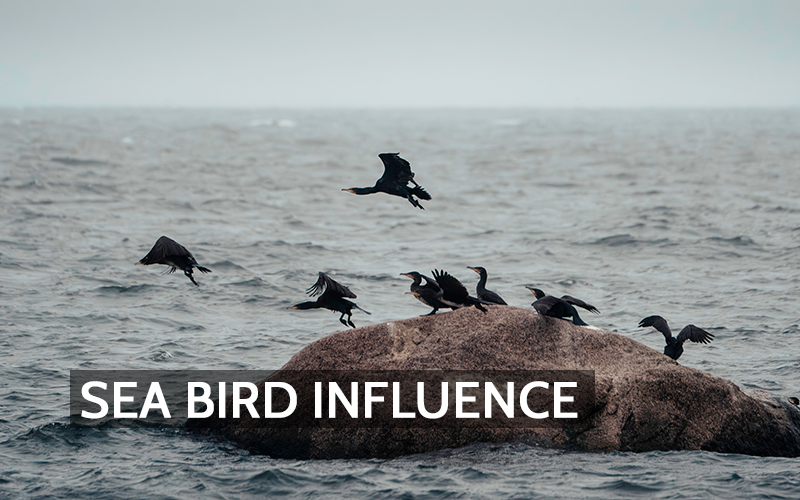
Seabirds spend much of their lives moving between two very different environments.
They feed on fish, squid, krill, and other organisms at sea, then return to islands, cliffs, beaches, and coastal nesting colonies. In doing so, they transport nutrients that originated in the ocean onto land—and some of those nutrients eventually enter the atmosphere.
Large seabird colonies can become important natural sources of ammonia, alter the chemistry of airborne particles, fertilize coastal vegetation, stimulate marine productivity, and even influence cloud formation in remote regions.
Their effect on air quality is mostly indirect, but it provides a remarkable example of how animals can connect the ocean, land, and atmosphere.
Seabirds Carry Ocean Nutrients Onto Land
A seabird feeding offshore consumes nutrients contained within marine organisms.
Nitrogen, phosphorus, iron, and other elements eventually become incorporated into the bird or released through guano, feathers, eggs, and carcasses.
When thousands or millions of birds return to the same breeding colonies, these materials accumulate rapidly.
Research comparing seabird colonies with nearby areas without birds consistently finds much higher concentrations of nitrogen and phosphorus in colony soils.
In this way, seabirds act as biological transport systems.
Nutrients originally distributed through the ocean food web can be concentrated onto a relatively small island or stretch of coastline.
Some remain in soil and vegetation. Some wash back into the ocean.
And some enter the air.
Guano Can Release Ammonia
One of the most important atmospheric products of seabird colonies is ammonia, or NH₃.
Guano contains large quantities of nitrogen, particularly in compounds derived from the breakdown of proteins and uric acid.
As microorganisms and chemical processes break down fresh waste, part of that nitrogen can become gaseous ammonia and escape into the atmosphere.
Measurements at seabird colonies have shown that they can become unusually strong ammonia sources, especially in remote environments where there are few agricultural or industrial emissions nearby.
Temperature, rainfall, nesting behavior, colony density, and the amount of exposed guano all influence how much ammonia is released.
Warm conditions generally favor volatilization, although recent measurements have also shown that rainfall can trigger substantial short-term increases as accumulated guano becomes wet and chemically active.
Ammonia Can Become Particulate Matter
Once ammonia enters the atmosphere, its chemistry does not necessarily stop there.
Ammonia is reactive.
When it encounters acidic atmospheric compounds such as sulfuric acid or nitric acid, it can help form ammonium-containing particles.
These reactions contribute to secondary particulate matter—particles created through atmospheric chemistry rather than emitted directly from a source.
Around cities and agricultural regions, ammonia frequently interacts with pollution from combustion and industry.
Seabird colonies are usually located in much cleaner environments, so the chemistry can be different.
Still, the same fundamental process occurs: an animal-derived gas can participate in creating new airborne particles.
Arctic Seabirds May Even Affect Clouds
One of the most unusual examples comes from the Arctic.
Researchers studying the summertime atmosphere near Alert, Nunavut, found that ammonia released from seabird colonies contributed to the formation and growth of extremely small atmospheric particles.
Those particles could accumulate sulfuric acid and organic compounds until some became large enough to act as cloud condensation nuclei.
Cloud condensation nuclei provide surfaces upon which water vapor can condense to form cloud droplets.
Computer modeling suggested that seabird-derived ammonia could influence cloud properties across parts of the Arctic, potentially increasing the amount of sunlight reflected by clouds.
This does not mean seabirds control Arctic weather.
It demonstrates something more subtle: biological activity in a bird colony can become chemically connected to atmospheric particles and eventually to cloud formation.
Birds Also Fertilize the Land
Not all seabird nutrients become airborne.
Much of the nitrogen and phosphorus deposited in colonies remains in soils.
This fertilization can dramatically increase plant productivity, particularly on nutrient-poor islands.
Vegetation surrounding colonies may grow faster, become denser, or shift toward species adapted to extremely nutrient-rich conditions.
More plant growth means more photosynthesis, which connects seabirds indirectly with the exchange of carbon dioxide between vegetation and the atmosphere.
The relationship is not always beneficial.
Extremely heavy nutrient deposition can overwhelm sensitive ecosystems, alter soil chemistry, and reduce plant diversity.
Seabirds therefore act less like a carefully measured fertilizer application and more like a powerful natural nutrient source whose effects depend on the environment receiving it.
Some Nutrients Return to the Ocean
Rain and runoff can wash guano-derived nitrogen, phosphorus, and trace elements from nesting areas into nearby coastal waters.
These nutrients can stimulate algae and phytoplankton.
Experiments have demonstrated that water enriched by seabird guano can increase marine primary production, particularly where nutrients are otherwise limited.
Recent research in the North Atlantic found that seabird guano releases phosphorus, ammonium, urea, iron, and other compounds capable of supporting phytoplankton growth.
Phytoplankton remove dissolved carbon dioxide from seawater through photosynthesis.
That provides another indirect atmospheric connection because surface oceans continuously exchange CO₂ with the atmosphere.
However, additional phytoplankton growth does not automatically mean long-term carbon sequestration. Much of that carbon is quickly recycled through marine food webs, while only a fraction reaches deeper ocean reservoirs.
Seabirds Can Transport Pollution Too
Animals do not transport only beneficial nutrients.
Seabirds feed across enormous areas and can accumulate pollutants present in marine food webs.
Metals, persistent organic pollutants, and plastic material may eventually be deposited at colonies through guano, regurgitated material, feathers, eggs, or carcasses.
Research on some island colonies has found higher concentrations of mercury, cadmium, arsenic, and other elements in soils associated with seabird activity.
Seabirds therefore connect environments in both directions.
They can move essential marine nutrients onto land, but they can also redistribute contaminants humans have introduced into the ocean.
A Natural Source Is Not Necessarily Air Pollution
Ammonia produced by seabirds is a natural atmospheric emission.
Calling it an air pollutant depends partly on context.
Near a large colony, ammonia concentrations can become far higher than the regional background. The gas can alter vegetation and soils after depositing nearby and can participate in particle formation.
At the same time, seabird-derived ammonia is part of a natural nitrogen cycle that existed long before industrial air pollution.
This distinction is important.
Air-quality science studies both human-made and natural emissions because atmospheric chemistry responds to molecules regardless of where they originated.
Birds Connecting Three Environments
A seabird catches a fish at sea.
Hours later, it returns to a nesting island and deposits nutrients carried from that meal.
Some nitrogen enters the soil and feeds plants. Some washes back into coastal water and supports algae. Some becomes ammonia and enters the atmosphere.
There, it can travel with the wind, deposit onto another ecosystem, participate in particle formation, or even contribute to the microscopic ingredients needed to create clouds.
Seabirds therefore do much more than move through the atmosphere.
They help chemically connect the ocean, land, and air.
Their colonies demonstrate one of ecology’s most important lessons: atmospheric chemistry is not driven only by smokestacks, engines, and wildfires.
Sometimes it begins with a bird returning home from the sea.
References
- Nature Communications — Seabird Colonies as Important Global Drivers in the Nitrogen and Phosphorus Cycles
- Nature Communications — Contribution of Arctic Seabird-Colony Ammonia to Atmospheric Particles and Cloud-Albedo Radiative Effect
- Atmospheric Environment — Measurement of Ammonia Emissions From Tropical Seabird Colonies
- Atmospheric Environment — Measurement of Ammonia Emissions From Temperate and Sub-Polar Seabird Colonies
- Atmospheric Environment — The Global Distribution of Ammonia Emissions From Seabird Colonies
- Journal of Animal Ecology — The Influence of Seabirds on Their Breeding, Roosting and Nesting Grounds
- Science of the Total Environment — The Role of Seabird Guano in Maintaining North Atlantic Summertime Productivity
- Science of the Total Environment — Seabird Droppings: Effects on a Global and Local Level