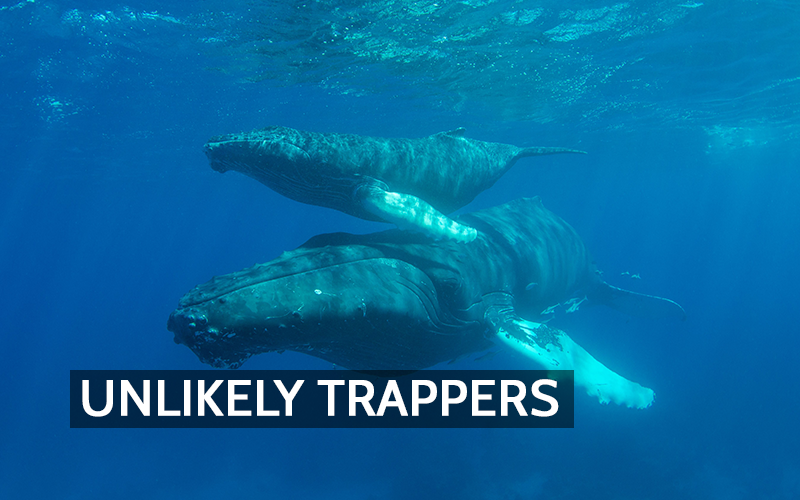
Few animals consume food on the scale of a whale.
A large baleen whale can filter enormous volumes of seawater while feeding on krill, copepods, and other small organisms. In the Southern Ocean, blue, fin, humpback, and minke whales collectively consume millions of tons of krill.
At first glance, eating huge quantities of marine life might seem unrelated to atmospheric carbon dioxide.
The connection appears after digestion.
Whales recycle nutrients from their prey back into surface waters, where microscopic phytoplankton use those nutrients to grow. Phytoplankton perform photosynthesis, removing carbon dioxide from seawater and helping drive the exchange of CO₂ between the ocean and atmosphere.
Scientists call one part of this relationship the whale pump.
Krill Are Part of a Nutrient Cycle
Antarctic krill feed heavily on phytoplankton.
Those phytoplankton require sunlight, carbon dioxide, and nutrients to grow. In much of the Southern Ocean, however, one particularly important nutrient is scarce: iron.
There may be plenty of nitrogen and phosphorus available, yet phytoplankton growth can remain limited because there is not enough biologically available iron.
Krill accumulate iron as they feed.
Whales then consume enormous quantities of krill.
Rather than retaining all of that iron, whales return much of it to the environment through feces.
This creates an unusual ecological recycling system:
phytoplankton feed krill, krill feed whales, and whales return nutrients that can help feed new phytoplankton.
Whales Bring Nutrients Back Toward the Light
Location matters almost as much as the nutrients themselves.
Phytoplankton need sunlight, so most photosynthesis occurs near the ocean surface.
Many nutrients, however, gradually sink into deeper water as organisms die, produce waste, or release sinking particles.
Whales can counter part of that downward movement.
Some whales feed at depth and repeatedly return to the surface to breathe. They also release nutrient-rich waste near the upper ocean.
This movement of nutrients from deeper feeding areas toward sunlit surface waters is what scientists commonly describe as the whale pump.
Whales therefore act somewhat like biological elevators, moving nutrients through the water column.
Whale Feces Can Be Rich in Iron
This process is especially important in iron-limited regions such as the Southern Ocean.
Research on baleen whales has found extremely high iron concentrations in whale feces compared with surrounding seawater.
Digestion may also change the chemical form of some of that iron, potentially making a portion of it more accessible to phytoplankton.
More recently, researchers have found organic compounds in whale excrement that can help keep iron chemically available in surface waters.
The result is not that every whale automatically creates a massive phytoplankton bloom.
Instead, whales contribute to a larger nutrient-recycling system that can support productivity where iron would otherwise restrict growth.
Whales Eat Far More Than Scientists Once Thought
Modern tracking technology has revealed the enormous scale of this process.
Researchers equipped hundreds of baleen whales with tags while simultaneously measuring the density of nearby prey.
The results, published in Nature in 2021, suggested that earlier estimates had substantially underestimated how much large whales eat.
Before industrial whaling dramatically reduced their populations, baleen whales in the Southern Ocean may have consumed approximately 430 million metric tons of Antarctic krill each year.
Researchers estimated that those historic whale populations may also have recycled roughly ten times more iron than today’s reduced populations.
That finding helped explain an apparent ecological puzzle.
Fewer whales did not necessarily produce more krill.
Instead, removing whales may also have weakened the nutrient-recycling system that helped support the enormous phytoplankton productivity on which krill themselves depended.
Phytoplankton Connect Whales to Atmospheric CO₂
The carbon connection begins with photosynthesis.
Phytoplankton take carbon dioxide dissolved in seawater and convert it into organic matter.
As surface-water CO₂ is consumed, additional carbon dioxide can move from the atmosphere into the ocean.
Some of the carbon captured by phytoplankton is quickly returned through respiration and decomposition.
But some moves downward.
Dead organisms, fecal pellets, aggregates of organic matter, and other particles sink from surface waters toward the deep ocean.
This movement is part of the biological carbon pump.
If carbon reaches sufficiently deep water or sediments, it can remain separated from the atmosphere for decades, centuries, or longer.
Whales may strengthen parts of this system by helping maintain the phytoplankton production that begins the process.
Krill Help Move Carbon Downward Too
Krill are not simply food for whales.
They participate in carbon transport themselves.
After feeding on phytoplankton near the surface, krill produce dense fecal pellets containing organic carbon.
Those pellets can sink rapidly into deeper water.
Krill also migrate vertically through the ocean, feeding nearer the surface and moving to greater depths during portions of the day.
The whale–krill relationship is therefore better understood as a cycle than as a simple predator eating prey.
Phytoplankton capture carbon.
Krill consume phytoplankton and move carbon and nutrients through the water.
Whales consume krill and recycle nutrients.
Those nutrients support additional primary production.
Whales Also Transport Nutrients Across Oceans
Whales move nutrients horizontally as well as vertically.
Many baleen whales spend summers feeding in highly productive polar or temperate waters before migrating toward warmer breeding grounds.
They carry nutrients accumulated during feeding with them.
Urine, feces, shed material, placentas, and other biological material then redistribute some of those nutrients along migration routes and within comparatively nutrient-poor breeding regions.
Researchers sometimes call this process the great whale conveyor belt.
An animal migrating thousands of miles can therefore physically move nutrients between marine ecosystems.
A Whale’s Body Stores Carbon Too
Whales also represent carbon storage in their own bodies.
The carbon contained in the krill and other prey they consume becomes incorporated into muscle, blubber, organs, and other tissues.
Because large whales can live for many decades, some of that carbon remains stored for much of the animal’s lifetime.
When a whale dies, another pathway becomes possible.
Some carcasses sink to the deep ocean floor in events known as whale falls.
The carcass then becomes an ecosystem supporting scavengers, worms, microorganisms, and other deep-sea organisms.
Some of its carbon is eventually incorporated into deep-sea sediments or remains within deep-ocean food webs, physically separated from the atmosphere.
Carbon Capture Is Not Automatically Carbon Sequestration
The whale-carbon story requires an important qualification.
Phytoplankton capturing CO₂ does not mean all of that carbon has been permanently removed from the atmosphere.
Much of it is recycled quickly through marine food webs.
Even carbon contained in whale feces, krill, or phytoplankton may eventually return to surface waters and the atmosphere.
Long-term sequestration depends on how much carbon reaches deep water or sediments and how long it remains there.
Researchers agree that whales play significant roles in nutrient cycling. Quantifying their additional contribution to long-term global carbon sequestration is much harder and remains an active area of research.
Restoring a Missing Part of the Ocean Cycle
Industrial whaling removed enormous numbers of large whales during the 19th and 20th centuries.
That loss removed more than animals.
It reduced the feeding, nutrient transport, waste production, migration, and eventual whale falls that had operated throughout ocean ecosystems for thousands of years.
As whale populations recover, some of those ecological processes can recover with them.
Whales will not solve rising atmospheric carbon dioxide, and protecting them cannot substitute for reducing greenhouse-gas emissions.
Their importance is more fundamental.
Whales demonstrate that ocean carbon cycling is partly biological.
A blue whale consuming krill may seem several steps removed from atmospheric chemistry, but its feeding and digestion help move iron, nitrogen, carbon, and other nutrients through the sea.
Sometimes the pathway between an animal and the atmosphere begins with something as simple as a whale eating lunch.
References
- https://www.fisheries.noaa.gov/feature-story/whales-and-carbon-sequestration-can-whales-store-carbon
- https://www.nature.com/articles/s41586-021-03991-5
- https://www.nature.com/articles/s43247-024-01965-9
- https://www.frontiersin.org/journals/marine-science/articles/10.3389/fmars.2023.1117409/full
- https://www.nature.com/articles/climate.2010.32
- https://www.nature.com/articles/nature07716
- https://www.nature.com/articles/s41467-023-36992-1
- https://www.fisheries.noaa.gov/west-coast/marine-mammal-protection/frequent-questions-san-pedro-basin-whale-falls