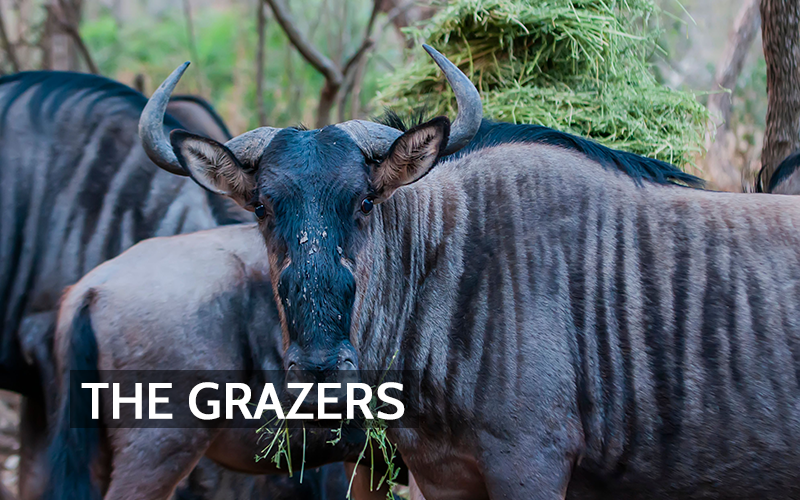
Millions of grazing animals can reshape a landscape simply by eating.
Across grasslands and savannas, wildebeest, zebras, antelope, buffalo, cattle, and other large herbivores remove vegetation, redistribute nutrients, disturb soil, and change the amount of plant material available to burn.
Those effects eventually reach the atmosphere.
Grazers can influence wildfire smoke, carbon storage, methane emissions, dust production, and even the balance between grasses and trees.
One of the clearest examples comes from the Serengeti, where the recovery of wildebeest populations transformed both the landscape and its relationship with fire.
Wildebeest Can Remove Fuel Before It Burns
Grass is food for a wildebeest, but during the dry season it is also fuel.
When large quantities of grass remain uneaten, dead vegetation can dry and form a nearly continuous layer capable of carrying fire across enormous areas.
Large grazing herds interrupt that process.
By consuming grass during the growing season, wildebeest reduce the amount of dry material available later.
This does not eliminate fire from savannas. Fire is a natural and important ecological process in these ecosystems.
It can, however, change how frequently fires occur and how much land they burn.
That creates a direct connection between herbivores and air quality because vegetation fires release smoke containing PM2.5, carbon monoxide, nitrogen oxides, volatile organic compounds, and other pollutants.
The Serengeti Offers a Natural Experiment
During the late 19th and early 20th centuries, the viral disease rinderpest devastated cattle and wild ungulates across Africa.
Wildebeest populations in the Serengeti remained suppressed for decades.
After vaccination campaigns brought rinderpest under control during the mid-20th century, wildebeest numbers recovered dramatically.
The expanding herds consumed much more grass.
Long-term ecological studies found that greater wildebeest abundance was associated with a major decline in the proportion of the Serengeti burned each year.
Less grass remained available to carry extensive dry-season fires.
Researchers also observed increasing tree density as fire pressure declined.
An animal population recovery had produced a chain reaction:
more wildebeest → more grazing → less fuel → less fire → more surviving woody vegetation.
Less Fire Means Less Smoke
The atmospheric consequence is straightforward.
Vegetation that is eaten rather than burned does not generate a smoke plume.
Savanna and grassland fires can release large quantities of fine particles and gases, and those emissions can continue changing chemically after entering the atmosphere.
Smoke plumes may contribute to regional particulate pollution and can also form secondary pollutants such as ozone under suitable atmospheric conditions.
Large grazers therefore have the potential to influence air quality indirectly by changing the amount and arrangement of combustible vegetation.
This does not mean that adding more grazing animals will always improve air quality.
If grazing becomes too intense, a different set of environmental problems can appear.
Grazers Can Influence Carbon Storage
Fire also affects carbon.
When vegetation burns, some of the carbon stored in plants is quickly released into the atmosphere as carbon dioxide and other carbon-containing compounds.
When fire becomes less frequent, more trees may survive long enough to accumulate woody biomass.
Research on the Serengeti suggests that the wildebeest recovery and resulting decrease in fire may have helped shift portions of the ecosystem from a net carbon source toward a carbon sink.
Grazing also affects carbon belowground.
Grasslands store substantial quantities of carbon in roots and soil. Moderate grazing can sometimes stimulate new plant growth and nutrient cycling, while very heavy grazing can reduce plant cover and carbon inputs to the soil.
The effect depends on rainfall, soil type, vegetation, fire frequency, and grazing intensity.
Hooves Can Also Help Put Dust Into the Air
Grazers can influence particulate pollution without fire.
Hooves disturb soil, particularly around watering areas, migration routes, and heavily used pastures.
More importantly, excessive grazing can remove the vegetation that normally protects soil from wind erosion.
Research in dry grasslands has found greater local dust emissions from heavily grazed areas than from sites where vegetation remained intact.
This creates an important contrast.
Enough grazing to reduce excessive fire fuel may decrease smoke production, while grazing intense enough to expose large amounts of bare soil can increase airborne dust.
Healthy grassland management therefore depends on balance rather than simply maximizing or eliminating grazing.
Grazers Recycle Nutrients
Animals also change where nutrients are located.
A wildebeest may eat grass in one location and deposit dung or urine somewhere else hours later.
Dung contains nitrogen, phosphorus, carbon, and other nutrients that can stimulate plant and microbial activity.
Across large migrations, millions of animals continuously redistribute material through an ecosystem.
Different grazers and browsers can even produce dung with different nutrient ratios, influencing competition between grasses and trees.
Those vegetation changes eventually affect photosynthesis, soil carbon, and the quantity of biomass available for future fires.
The atmospheric influence of a grazer can therefore continue after the animal itself has moved many kilometers away.
Grazers Produce Greenhouse Gases Too
There is another side to the carbon story.
Wildebeest, cattle, buffalo, and other ruminants digest grass using microorganisms living inside specialized digestive systems.
This fermentation produces methane.
Wild herbivores therefore contribute natural methane emissions just as domesticated ruminants do.
Their dung and urine can also influence emissions of methane, ammonia, and nitrous oxide as microorganisms process waste in the soil.
Studies comparing wildlife-dominated and livestock-dominated African savannas show why replacing one type of large herbivore with another does not automatically eliminate greenhouse-gas emissions.
Large populations of wild animals are part of the natural atmospheric chemistry of these ecosystems.
Grazing Is Neither Automatically Good nor Bad for Air
It is tempting to simplify the relationship by saying that more grazers mean fewer fires and cleaner air.
Real ecosystems are more complicated.
Too few grazers can allow grass fuel to accumulate in some savannas.
Moderate populations may limit fire while maintaining productive vegetation.
Excessive grazing can remove plant cover, increase erosion, reduce soil carbon, and generate more dust.
Different animals also eat different plants, move differently across landscapes, and return nutrients in different places.
The atmospheric outcome depends on the entire ecosystem.
A Herd Can Change the Sky
Wildebeest demonstrate how air quality can be shaped by animals that never directly interact with pollution control.
A wildebeest eats grass.
That grass does not become wildfire fuel.
A smaller fire produces less smoke.
More trees may survive.
Roots and soils change.
Nutrients move across the landscape.
Meanwhile, the animal itself releases methane and physically disturbs the ground beneath its feet.
Multiply those processes by more than a million migrating animals, and grazing becomes an atmospheric force.
The lesson is not that grazers clean the air.
It is that the atmosphere above a grassland is partly determined by what happens on the ground—and sometimes by the millions of hooves moving across it.
References
- A Disease-Mediated Trophic Cascade in the Serengeti and its Implications for Ecosystem Carbon
- Anthropogenic Modifications to Fire Regimes in the Wider Serengeti-Mara Ecosystem
- Plant Compensation to Grazing and Soil Carbon Dynamics in a Tropical Grassland
- Major Secondary Aerosol Formation in Southern African Open Biomass Burning Plumes
- Comparable GHG Emissions From Animals in Wildlife- and Livestock-Dominated Savannas
- Effects of Grazing and Topography on Dust Flux and Deposition
- A Stoichiometric Perspective of the Effect of Herbivore Dung on Ecosystem Functioning
- EPA — Wildfire Smoke: A Complex Mixture