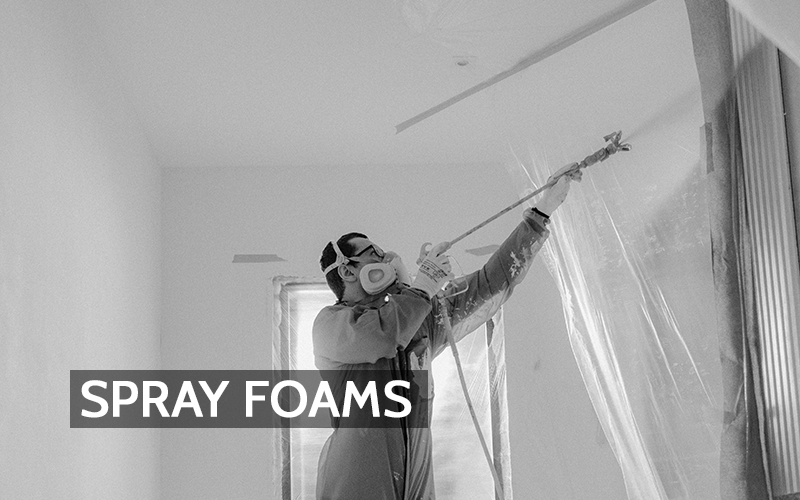
Spray polyurethane foam expands into gaps and hardens to help insulate and air-seal a building. The material is created through chemical reactions at the installation site. During application and curing, some ingredients can enter the air as droplets or vapors. Controlling those emissions protects workers and helps determine when occupants can return.
What Goes Into the Foam
Professional spray foam insulation is often produced by combining two liquid mixtures at the spray gun. One mixture contains isocyanates, which react with compounds called polyols in the other mixture to form polyurethane. Amine catalysts help control these reactions, while blowing agents release or generate gas that creates the foam’s bubbles. The mixtures can also contain flame retardants and other additives. Formulations differ, which changes both the foam’s properties and the chemicals that may enter the air.
Aerosols, Vapors, and Dust
During spraying, some of the reacting liquid becomes tiny airborne droplets called aerosols. Vapors can also come from volatile ingredients, including some amine catalysts and blowing agents. Some emissions are volatile organic compounds, or VOCs, which readily enter the air as gases. The mixture of droplets and vapors means that particle measurements alone cannot describe the full exposure. Cutting or trimming foam before it is fully cured can add dust containing unreacted chemicals.
Isocyanates can irritate the eyes, skin, and lungs and can cause work-related asthma. They can also cause sensitization, in which a person develops an allergic response to the chemical. After sensitization, even small exposures may trigger serious breathing problems. Skin contact matters because it can contribute to sensitization as well as causing irritation. Amine catalysts can also irritate the eyes and respiratory tract.
Ventilation Must Capture and Contain Emissions
Installers need to isolate the work area so aerosols and vapors do not spread into untreated rooms. A ventilation plan should bring in clean replacement air and exhaust contaminated air outdoors, drawing pollutants away from workers. Keeping the work zone at lower air pressure than surrounding spaces helps air move into the enclosure instead of carrying contamination outward. Heating and cooling openings in the work area should be isolated to prevent contaminants from circulating through the building. Exhaust outlets must be positioned away from people, open windows, and fresh-air intakes.
Ventilation needs to continue after spraying ends because vapors and suspended particles can remain. Its effectiveness depends on the room’s shape, airflow paths, and the location of the exhaust. A fan that simply recirculates indoor air does not remove pollutants from the building. Cleanup is also necessary to remove overspray and settled dust before the space returns to normal use.
Workers Need More Than a Dust Mask
For indoor, high-pressure spraying, guidance generally calls for full-face or hooded supplied-air respirators for applicators and nearby helpers. This equipment provides breathing air from a clean source. An N95 respirator filters particles but does not remove chemical vapors. Chemical-resistant gloves, protective clothing, and eye protection also help prevent exposure. Respirator selection, training, medical evaluation, and fit testing where applicable belong within an employer’s respiratory protection program.
Curing Determines When People Can Return
Foam can feel dry within minutes while its ingredients are still reacting, a process called curing. The curing process depends on the formulation, mixing and application technique, foam thickness, temperature, and humidity. Ventilation also affects how quickly airborne chemicals are removed. There is no single waiting period that fits every spray foam product and installation. The manufacturer’s guidance needs to address the specific product and job conditions.
Before work begins, occupants should receive the product name, safety information, and written instructions for returning. Residents and other trades should vacate the premises during professional spraying and remain away for the specified post-installation period. Reoccupancy should follow the manufacturer’s directions after the required curing, ventilation, and cleanup have been completed. Because air sealing reduces uncontrolled air exchange, the finished building also needs planned fresh-air ventilation to manage indoor pollutants.
References
- EPA: Chemicals and Production of Spray Polyurethane Foam
- EPA: Health Concerns About Spray Polyurethane Foam
- EPA: Potential Chemical Exposures From Spray Polyurethane Foam
- EPA: Ventilation Guidance for Spray Polyurethane Foam Application
- EPA: Vacating and Reentry After Spray Foam Application
- OSHA: Respiratory Protection for Insulating and Sealing Work
- NIST: Characterization of Emissions From Spray Polyurethane Foam