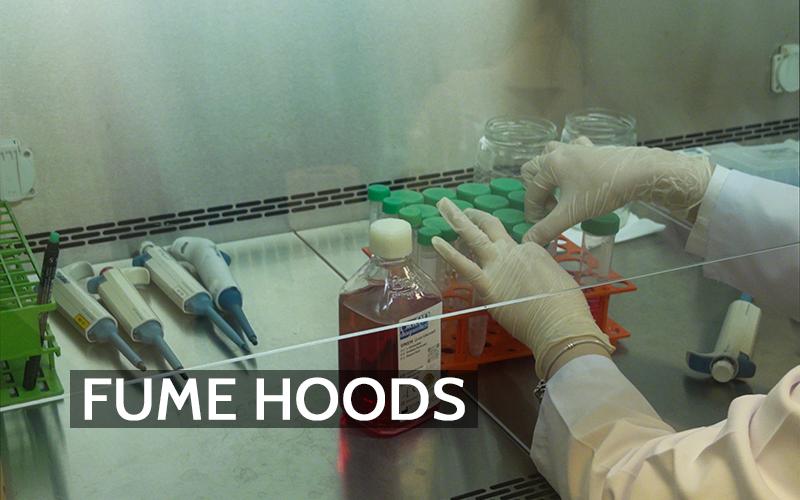
Laboratories often contain equipment designed to control hazards before they reach the person performing an experiment. Two of the most recognizable examples are chemical fume hoods and biosafety cabinets, which may look similar but are designed to solve very different air-quality problems.
A chemical fume hood primarily protects people from hazardous gases, vapors, and aerosols produced during chemical work. A biosafety cabinet is designed around biological materials and uses carefully controlled airflow and filtration to protect workers, samples, and the surrounding laboratory.
Fume Hoods Capture Chemical Emissions
A laboratory fume hood is an enclosed workspace connected to an exhaust system. Room air enters through the open front of the hood, passes across the work area, and carries chemical contaminants into ductwork that normally exhausts the air outside the building.
This directional airflow helps keep vapors from solvents, acids, and other hazardous chemicals away from the worker’s breathing zone. OSHA considers fume hoods an important engineering control in laboratories and requires protective equipment used for hazardous chemical work to function properly.
The adjustable glass panel on the front of the hood is called the sash. Keeping it at the recommended operating height helps maintain the airflow pattern while also providing a physical barrier between the worker and the experiment.
Airflow Can Be Easily Disturbed
A fume hood does not create an invisible wall between the experiment and the laboratory. Air currents from doors, supply vents, people walking past, or objects placed near the hood opening can interfere with its ability to capture contaminants.
Equipment placed deep inside the hood generally interferes less with incoming airflow than equipment positioned directly at the opening. Workers should also avoid placing their heads inside the hood because doing so places their breathing zone inside the area intended to contain contamination.
Many modern hoods include airflow monitors that warn users when ventilation drops below acceptable conditions. Regular inspection and testing are important because a fan or duct problem may not be obvious simply by looking at the hood.
Biosafety Cabinets Control Biological Aerosols
A biosafety cabinet, or BSC, is designed for work that may generate aerosols or droplets containing microorganisms or other biological material. Class II cabinets are especially common in research, clinical, and teaching laboratories.
Air is pulled inward through the front opening to help protect the worker, while filtered air flows downward across the work surface. Air leaving the cabinet passes through high-efficiency particulate air, or HEPA, filters that remove extremely small particles containing bacteria, viruses, fungal spores, and other biological material.
This airflow also helps protect the experiment itself from contamination. That makes a Class II BSC different from a typical chemical fume hood, which protects the worker but does not normally provide a clean, HEPA-filtered environment for the material being handled.
HEPA Filters Do Not Remove Chemical Vapors
One of the most important differences between these devices involves what their filters can capture. HEPA filters are highly effective at removing particles, but they do not generally remove gases or chemical vapors.
Many Class II biosafety cabinets recirculate some filtered air back through the cabinet or into the laboratory. Using volatile solvents or other hazardous chemicals inside the wrong type of BSC can therefore allow chemical vapors to build up or return to the room even though biological particles are being removed.
Specialized biosafety cabinets can be connected to outdoor exhaust systems when certain biological and chemical hazards must be controlled together. CDC guidance recommends evaluating the chemicals being used before selecting the cabinet because the correct equipment depends on both biological and chemical risks.
Movement Can Affect a Biosafety Cabinet
Biosafety cabinets depend on carefully balanced airflow at the front opening. Rapid arm movements, people walking directly behind the operator, open doors, nearby ventilation diffusers, or clutter inside the cabinet can disturb that airflow.
The front and rear ventilation grilles should remain unobstructed because blocking them changes how air moves through the cabinet. Materials should also be arranged to minimize unnecessary movement in and out of the work area once a procedure begins.
This is why biosafety cabinets are normally installed away from doors, frequently traveled areas, and other strong air currents. The air barrier protecting the worker may only be a controlled pattern of moving air, so seemingly small disturbances can affect performance.
Certification and Testing Matter
A cabinet or hood can look perfectly normal while its airflow is no longer providing adequate protection. Fans can fail, filters can load with particles, ducts can become damaged, and building ventilation changes can alter how equipment performs.
CDC biosafety guidance recommends that biosafety cabinets be certified at least annually and after certain events such as relocation or major maintenance. Certification checks airflow and filtration performance to confirm that the cabinet continues to operate as designed.
Chemical fume hoods also require regular evaluation and maintenance. OSHA laboratory requirements specifically call for measures to ensure that fume hoods and other protective equipment are functioning properly when they are used to control hazardous chemicals.
The Right Cabinet for the Right Hazard
Fume hoods and biosafety cabinets demonstrate an important principle of laboratory air quality: different contaminants require different engineering controls. Chemical vapors behave differently from biological particles, so equipment designed to capture one hazard cannot automatically be expected to control the other.
A fume hood moves chemical contamination away from the worker and out of the laboratory. A biosafety cabinet uses controlled airflow and HEPA filtration to contain biological aerosols while often protecting the material being studied at the same time.
Both systems depend on airflow that is largely invisible to the person using them. Proper equipment selection, good work practices, regular testing, and an understanding of where the air is actually going are what turn that airflow into a reliable layer of protection.
References
- OSHA, Occupational Exposure to Hazardous Chemicals in Laboratories. OSHA Laboratory Standard
- OSHA, Laboratory Safety: Chemical Fume Hoods. OSHA Chemical Fume Hood Guidance
- CDC and NIH, Biosafety in Microbiological and Biomedical Laboratories, Sixth Edition. CDC BMBL
- CDC, Recognize the Four Biosafety Levels. CDC Biosafety Guidance
- NIH, Class II Type B2 Biological Safety Cabinet Specifications. NIH Biosafety Cabinet Guidance