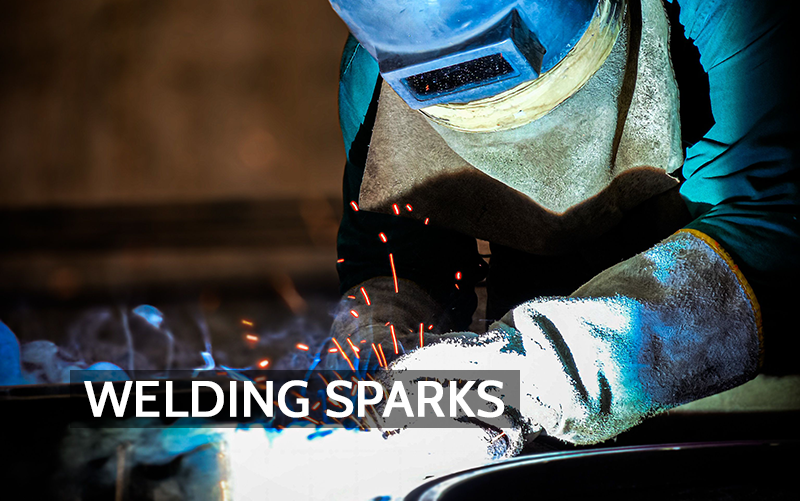
Welding joins metal by creating enough heat to melt or soften materials at the point where they meet. That intense heat can also vaporize small amounts of metal, electrode material, coatings, and flux, which cool into extremely fine particles known as welding fume. Because these particles form directly beside the welder’s face, controlling them before they reach the breathing zone is an important part of workplace air quality.
Welding fumes are not all the same. Their composition depends on the welding process, filler material, base metal, surface coatings, and other materials exposed to the heat. Effective control therefore begins by understanding both how much fume is being produced and what that fume contains.
Welding Creates Extremely Small Particles
Welding fume forms when heated material becomes a vapor and then rapidly cools in the surrounding air. The vapor condenses into very small particles containing metals and metal oxides that can remain suspended and be inhaled.
These particles are different from the larger sparks and pieces of metal visible during welding. Many are small enough to travel deep into the respiratory system, which means the brightest and most obvious parts of the welding process are not necessarily the greatest air-quality concern.
Some welding methods produce more fume than others. Welding current, electrode type, shielding gas, metal composition, and technique can all influence how much material enters the air.
The Metal Changes What Is in the Fume
Mild steel welding commonly produces fumes containing iron and manganese. NIOSH notes that most welding fumes contain some manganese, and prolonged exposure to high airborne concentrations can affect the nervous system.
Stainless steel creates a different concern because it contains chromium and nickel. Welding stainless steel can produce hexavalent chromium, a form of chromium associated with respiratory problems and increased cancer risk, along with nickel-containing particles.
Coatings can change the mixture again. Welding galvanized steel can release zinc-containing fumes, while older paints or specialized coatings may contain lead, cadmium, or other hazardous materials that become airborne when heated.
The Fume Plume Often Rises Toward the Welder
Hot gases produced by welding naturally rise, carrying particles with them. Unfortunately, a welder often bends over the workpiece, placing the head directly above the plume as it moves upward.
Changing work position can sometimes reduce exposure without altering the welding process itself. Keeping the head out of the rising plume and positioning the work so fumes move away from the breathing zone can reduce how much contamination reaches the worker.
Natural air movement can help, but it is unreliable as the main control. Fans or drafts can move fumes unpredictably and may even interfere with shielding gases required for a good weld.
Local Exhaust Captures Fume Near the Arc
Local exhaust ventilation is one of the most effective ways to control welding fume because it removes contamination close to where it is produced. A movable exhaust hood can be placed near the weld so the rising plume is pulled into ductwork instead of passing the worker’s face.
Distance matters greatly. The farther the hood is from the welding arc, the more airflow is needed to capture the same plume, which is why OSHA guidance calls for movable hoods to be positioned as close as practical to the work.
The hood must also be repositioned as the welder moves along a large part. An exhaust arm that worked well at the beginning of a weld may provide little protection if the worker moves several feet away and leaves it behind.
Fume Extraction Guns Move the Exhaust Closer
Some welding systems build fume extraction directly into the welding gun. Small openings near the nozzle pull contaminated air away almost immediately after the fume forms.
NIOSH research has shown that properly operated fume extraction guns can reduce welding fume exposure. Because the collection point moves with the welder, these systems can be useful for jobs where constantly repositioning a separate exhaust hood would be difficult.
Extraction still has to be balanced with the welding process. Excessive suction near the arc can disturb shielding gas, so equipment must be designed and adjusted to capture fume without reducing weld quality.
General Ventilation Has a Different Job
General building ventilation can dilute fumes that escape local collection systems and prevent pollution from gradually building throughout a welding shop. It is particularly important when many welders are operating in the same building at the same time.
General ventilation is less effective at protecting someone standing directly above a welding plume. By the time the room ventilation system captures those particles, they may already have passed through the worker’s breathing zone.
This is why source capture and general ventilation often work together. Local exhaust controls the concentrated plume while building ventilation manages pollutants that escape into the larger space.
Confined Spaces Increase the Challenge
Welding inside tanks, pipes, vessels, and other restricted spaces can produce much higher exposures because fumes have less room to disperse. Welding may also consume oxygen or introduce gases that create additional hazards in a poorly ventilated space.
OSHA requires adequate ventilation for welding and cutting in confined spaces. When ventilation cannot adequately control the atmosphere, appropriate supplied-air respiratory protection may be necessary.
Nearby employees must also be considered because welding fumes do not affect only the person holding the torch. Helpers and other workers inside or near the space can breathe the same contaminated air.
Respirators Add Another Layer of Protection
Respiratory protection may be needed when engineering controls cannot reduce exposure enough or when particularly hazardous materials are involved. The correct respirator depends on the contaminants, their concentrations, and the conditions under which welding is performed.
Respirators should not automatically replace effective ventilation. Capturing fume at its source reduces contamination for everyone in the area, while a respirator primarily protects the individual wearing it.
Air monitoring can help determine whether controls are working and whether additional protection is required. Because welding particles are often too small to see, the appearance of the shop cannot reliably show how much fume workers are breathing.
Controlling the Plume Before It Spreads
Welding fume control begins close to the arc, where metals and other materials are transformed into airborne particles. Work positioning, lower-fume processes, local exhaust, extraction guns, general ventilation, respiratory protection, and air monitoring can all contribute to reducing exposure.
The most effective approach is usually to prevent the plume from reaching the worker in the first place. Welding may create intense light and visible sparks, but from an air-quality perspective, the nearly invisible particles rising from the weld can be the more important hazard.
References
- NIOSH, Welding Fumes and Manganese
- NIOSH, Welding Operations: Local Exhaust Ventilation Systems
- NIOSH, Welding Fumes and Fume Extraction Guns
- NIOSH, Pocket Guide to Chemical Hazards: Welding Fumes
- NIOSH, Control of Hexavalent Chromium Exposures
- OSHA, Welding, Cutting, and Brazing General Requirements