Nail salons often have a distinctive smell that comes from polishes, removers, adhesives, acrylic products, and other chemicals used throughout the day. Those odors are only part of the air-quality picture because filing, buffing, artificial nail application, and cleaning can also release dust and vapors into a relatively small indoor space. For nail technicians who work long shifts, repeated exposure can add up over time even when individual services last only a few minutes.
The challenge is made greater by the number of products used at the same time. Several technicians may be performing manicures, pedicures, acrylic applications, and polish removal side by side, creating overlapping sources of airborne chemicals throughout the salon.
Nail Products Release VOCs
Many nail products contain volatile organic compounds, or VOCs, that evaporate readily at room temperature. Common ingredients can include acetone, ethyl acetate, methacrylate compounds, toluene, and other solvents that help products spread, dry, dissolve coatings, or form artificial nails.
Once a bottle is opened, some of these chemicals begin entering the surrounding air. Repeated product use across multiple workstations can increase indoor concentrations, particularly when ventilation is poor or containers are left open longer than necessary.
Exposure to salon chemicals can cause eye, nose, and throat irritation, headaches, dizziness, skin problems, or other symptoms depending on the chemical and amount involved. Some products can also contribute to asthma or allergic reactions after repeated occupational exposure.
Artificial Nails Create Their Own Chemical Mixture
Artificial nail systems often use liquid and powdered ingredients that react together to form a hard polymer. Methacrylate compounds are commonly involved in these products and can become airborne as vapors while technicians mix and shape artificial nails.
Application takes place only a short distance from the technician’s face, which means the source is directly inside the breathing zone. Even a salon with good general ventilation may benefit from additional controls positioned at the manicure table itself.
Keeping product containers closed when they are not being used can reduce unnecessary evaporation. Pressure-sensitive dispensers and other containers with small openings can also limit how much solvent is exposed to room air.
Filing and Buffing Add Dust
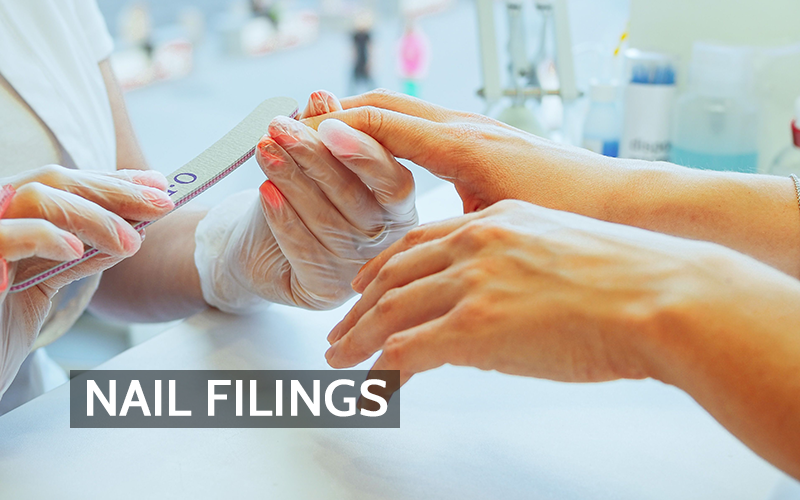
Chemical vapors are not the only airborne material inside a nail salon. Filing and buffing natural or artificial nails can produce very fine dust containing pieces of nail, hardened acrylic or gel products, and other materials.
Electric nail files can generate dust quickly because they remove material at high speed. Some of the particles settle onto tables and equipment, while smaller particles may remain suspended and enter the technician’s breathing zone.
Dust collection close to the work surface can reduce how much material spreads into the room. N95 respirators can filter particles when their use is appropriate, but they do not protect against solvent vapors and other gases.
Local Exhaust Works Close to the Hands
One of the most useful air-quality controls in a nail salon is local exhaust ventilation. Instead of waiting for chemicals to spread throughout the room, local exhaust pulls contaminated air away near the point where the service is being performed.
Ventilated manicure tables use suction openings near the client’s hands to capture vapors and dust. NIOSH testing has shown that well-designed local exhaust systems can greatly reduce exposure to methacrylate vapors during artificial nail application.
The location and strength of the airflow matter. A small desktop fan may move odors around the room without actually removing them, while a properly designed exhaust system captures contamination and either filters it effectively or sends it outdoors.
General Ventilation Still Matters
Local exhaust controls pollutants at individual workstations, but the entire salon also needs clean air. Heating, ventilation, and air-conditioning systems can bring in outdoor air and dilute chemicals that escape capture systems.
Ventilation becomes especially important during busy periods when many technicians and customers are inside at once. Research in nail salons has found that VOC concentrations can increase with salon activity, occupancy, and the number of services being performed.
Doors or windows can sometimes provide additional fresh air when outdoor conditions are good, but natural ventilation is not always reliable. Weather, temperature, outdoor pollution, and building design can all affect how much useful airflow actually enters the space.
Waste Can Keep Releasing Vapors
A cotton pad soaked with polish remover does not stop releasing chemicals when the manicure ends. Used wipes, cotton balls, and other materials can continue evaporating solvents while sitting in an open trash container.
OSHA recommends placing chemical-soaked waste into covered containers or sealed bags to reduce evaporation into salon air. Keeping chemical bottles tightly closed when they are not being used provides the same benefit at the source.
These practices may seem small, but they matter because salon workers can spend many hours in the same room. Reducing continuous low-level emissions helps keep the ventilation system from having to manage avoidable pollution.
Smell Does Not Measure Safety
Strong odors can warn that volatile chemicals are present, but smell is not an accurate exposure meter. Some chemicals can be detected by smell at low concentrations, while people can also become less aware of familiar odors after working around them for long periods.
A salon that smells strongly is a good reason to examine ventilation and work practices, but a weak smell does not automatically mean the air is free of chemical exposure. Air sampling and ventilation measurements can provide a more reliable picture when occupational exposure is a concern.
This is especially important for workers because they may spend far more time inside the salon than customers. An exposure that seems brief to someone receiving a manicure can be repeated throughout an entire workday for the technician providing it.
Clearing the Air at the Manicure Table
Nail salons combine many small pollution sources inside a compact workplace. Solvent vapors, artificial nail chemicals, filing dust, cleaning products, and contaminated waste can all contribute to the air workers and customers breathe.
Good air quality depends on controlling those sources before they spread. Local exhaust at workstations, effective building ventilation, closed chemical containers, covered waste, careful product handling, and regular ventilation maintenance can all reduce exposure.
The goal is not to remove every familiar salon smell. It is to make sure that the chemicals and particles behind those smells are kept as far as practical from the people who spend their working day only inches away from them.
References
- CDC/NIOSH, Nail Technicians: Workplace Safety and Health
- OSHA, Health Hazards in Nail Salons
- OSHA, Chemical Hazards in Nail Salons
- OSHA, Stay Healthy and Safe While Giving Manicures and Pedicures
- NIOSH, Nail Salons: Control of Ethyl Methacrylate Exposures During Artificial Nail Application
- NIOSH, Evaluation of Ergonomics, Chemical Exposures, and Ventilation at Four Nail Salons