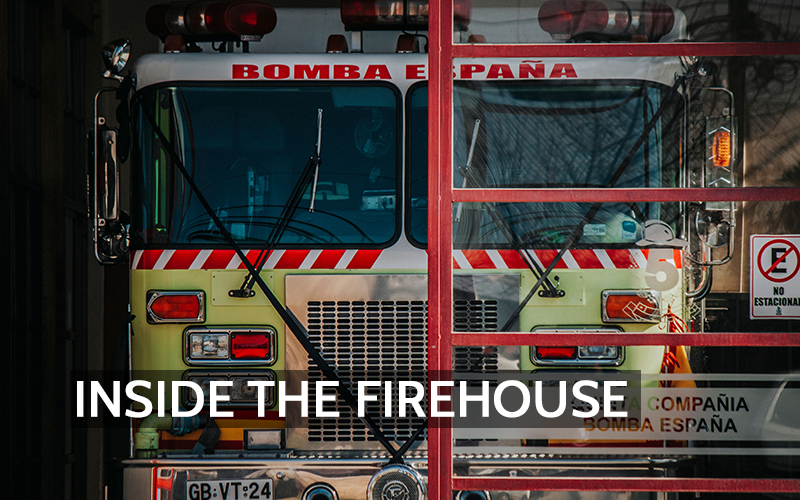
A fire station is supposed to be the place firefighters return to after leaving smoke behind.
Unfortunately, some of the fire can come home with them.
Soot clings to boots and equipment. Combustion products remain on turnout gear. Diesel engines operate inside apparatus bays. Contaminated clothing may release vapors after the emergency is over, while cleaning and decontamination introduce another set of chemicals into the building.
For firefighters who may live, eat, exercise, and sleep inside the station for extended shifts, controlling that indoor environment becomes an important occupational air-quality problem.
The Apparatus Bay Is an Indoor Garage
Fire engines and ambulances are often housed only a few feet from occupied portions of the station.
When diesel-powered apparatus starts inside the bay, exhaust can contain ultrafine particles, nitrogen oxides, carbon monoxide, and other combustion products.
Modern diesel engines are much cleaner than older equipment, but starting and idling can still produce short-lived pollution peaks.
Recent NIOSH evaluations of U.S. fire stations measured spikes in ultrafine particles when apparatus engines started, even at stations where average concentrations remained relatively low.
The challenge is preventing those emissions from traveling into kitchens, offices, dormitories, and recreation areas.
Exhaust Capture Stops Pollution at the Tailpipe
One of the most effective controls is to capture diesel exhaust before it spreads.
Some fire stations use flexible hoses that attach directly to vehicle exhaust pipes. The hose removes emissions while the apparatus is running and can automatically disconnect as the vehicle leaves the station.
Other facilities use onboard filtration or high-capacity general exhaust systems.
Source capture has an important advantage over simply opening a bay door.
Once exhaust has mixed throughout the building, much more ventilation is needed to remove it.
Capturing the plume directly at the tailpipe prevents much of that contamination from entering the station atmosphere in the first place.
The Fireground Returns on the Gear
Vehicle exhaust is only one source.
Turnout gear can carry a complicated mixture of combustion products back from a fire.
Smoke deposits soot, polycyclic aromatic hydrocarbons, volatile and semi-volatile organic compounds, metals, and other materials onto protective clothing.
Some contaminants remain attached to the fabric.
Others can slowly off-gas, meaning they evaporate back into the surrounding air after the firefighter returns to the station.
NIOSH recommends preliminary decontamination at the fire scene, careful removal of protective equipment, bagging contaminated gear during transport, and laundering exposed gear as soon as practical.
These actions are intended not only to protect the firefighter’s skin but also to prevent the station from becoming a secondary contamination site.
PFAS Add Another Gear-Related Question
Turnout gear itself can also contain chemicals unrelated to the fire.
Historically, some protective textiles have used fluorinated chemistry to provide water, oil, and chemical resistance.
A 2026 study examined indoor air at 11 North Carolina fire stations and a turnout-gear supply facility.
Researchers measured volatile PFAS and more than 100 other semi-volatile organic compounds.
PFAS, combustion byproducts, and phthalates were among the compounds frequently detected.
Importantly, total concentrations were highest in some enclosed turnout-gear storage rooms, where volatile PFAS levels exceeded those measured in day rooms.
The findings suggest that gear storage is not merely an organizational decision.
It can influence the chemical environment inside a station.
Soot Can Travel on Boots and Equipment
Not everything returns as a vapor.
Firefighters can also carry particulate contamination on boots, gloves, helmets, tools, hoses, and equipment.
If contaminated items are carried through kitchens, hallways, sleeping quarters, or offices, soot and dust can move with them.
Once deposited on indoor surfaces, particles can become airborne again through foot traffic, cleaning, or normal activity.
This is one reason modern station design increasingly emphasizes separating contaminated work areas from living spaces.
The goal is to stop pollutants from migrating deeper into the building.
Hot, Warm, and Cold Zones
A growing design strategy divides the station into contamination zones.
The hot zone includes the apparatus bay, equipment-return areas, decontamination spaces, and locations where contaminated turnout gear is handled.
The warm zone serves as a transition area.
Firefighters may remove contaminated clothing, shower, wash equipment, or pass through spaces designed specifically to prevent contamination from moving farther into the station.
The cold zone contains kitchens, sleeping quarters, offices, exercise rooms, and other areas intended to remain comparatively clean.
The idea resembles contamination control in laboratories and industrial facilities.
Instead of relying entirely on cleaning after contaminants spread, the building is designed to control where they are allowed to travel.
Air Pressure Can Protect Living Spaces
Walls and doors help separate zones, but airflow matters too.
If an apparatus bay is at higher pressure than the living quarters, contaminated air can move through door gaps and openings every time someone enters the building.
A better design reverses that relationship.
Living and sleeping areas can be maintained at slightly higher air pressure than the apparatus bay.
When a door opens, air moves from the clean space toward the contaminated space rather than allowing diesel exhaust and other pollutants to move inward.
The apparatus bay and turnout-gear rooms can simultaneously be maintained under negative pressure and exhausted directly outdoors.
This creates an invisible air barrier reinforcing the physical walls.
Gear Rooms Need Their Own Ventilation
Turnout gear should ideally have a dedicated storage environment.
Keeping gear in the apparatus bay can expose it to diesel particles.
Keeping it in living quarters can allow contaminants on the gear to enter spaces where firefighters spend much of their shift.
NIOSH recommends dedicated gear-storage areas with exhaust ventilation that discharges outdoors.
The 2026 PFAS study complicates the picture slightly because enclosed gear rooms showed higher concentrations of some volatile compounds than more open storage spaces.
That does not necessarily mean gear should be left in the apparatus bay.
Instead, it reinforces the importance of actively ventilating enclosed storage rooms so off-gassed contaminants do not accumulate.
Cleaning Removes Pollution but Can Add Chemistry
Fire stations require frequent cleaning.
Apparatus floors, equipment, turnout gear, showers, kitchens, and living areas all need regular sanitation.
Detergents are valuable because research shows that properly washing contaminated gear removes more fireground material than rinsing with water alone.
However, cleaning products can themselves release VOCs or aerosols.
Ventilation therefore remains important in wash rooms and decontamination areas, particularly when concentrated cleaners or disinfectants are used.
The objective is not simply to make contaminated material disappear from sight.
It is to remove it without transferring the exposure into another part of the building.
The Station Itself Is Part of Firefighter Exposure
A 2025 study of a fire station measured benzene, toluene, ethylbenzene, xylenes, formaldehyde, PAH-containing PM2.5, and metals inside the building.
It was only one station, so its results should not be assumed to represent every firehouse.
But it highlights an important shift in occupational-health research.
Firefighter exposure does not stop when the truck leaves the emergency scene.
The apparatus, protective gear, tools, storage rooms, ventilation system, and station layout can all influence what firefighters continue breathing after they return.
Keeping the Emergency Outside
A modern fire station has two very different functions.
It houses contaminated equipment returning from emergencies, but it is also a workplace and temporary home where firefighters eat, sleep, exercise, and recover.
Those functions should not share the same atmosphere.
Tailpipe capture can keep diesel exhaust from entering the building.
Decontamination can remove fireground residues before they spread.
Dedicated gear rooms can isolate protective clothing.
Pressure differences and separate HVAC systems can keep contaminated air moving away from living spaces.
The goal is simple even if the engineering is not:
When firefighters return from an emergency, the smoke, soot, and chemical contamination should remain on the dirty side of the station.
References
- https://www.cdc.gov/niosh/bulletin/2026/contaminated-ff-gear.html
- https://www.cdc.gov/niosh/bulletin/2026/laundering-ff-gear.html
- https://stacks.cdc.gov/view/cdc/258741
- https://stacks.cdc.gov/view/cdc/258737
- https://stacks.cdc.gov/view/cdc/259326
- https://www.usfa.fema.gov/downloads/pdf/publications/design_of_fire_ems_stations.pdf
- https://www.mass.gov/doc/diesel-exhaust-in-fire-stations-recommendations/download
- https://journals.sagepub.com/doi/10.1177/1420326X251363948
- https://pubs.rsc.org/en/content/articlehtml/2026/em/d6em00069j
- https://pubmed.ncbi.nlm.nih.gov/41972993/