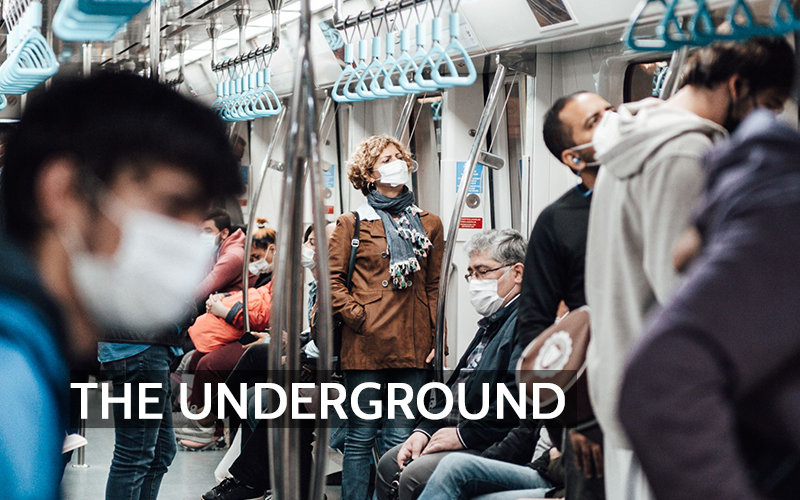
A subway train has no tailpipe.
Most modern subway systems run on electricity, which means passengers standing on an underground platform are not surrounded by gasoline or diesel exhaust from the trains themselves.
Yet underground stations can contain surprisingly high concentrations of particulate matter.
The reason is mechanical.
Steel wheels grind against steel rails. Brakes wear during every stop. Electrical contact equipment creates additional particles. Trains disturb dust already deposited inside tunnels and push it through stations.
The result is an atmosphere chemically different from the traffic pollution found on the street above.
Subway Dust Contains a Lot of Metal
Particulate matter is defined largely by particle size rather than chemical composition.
PM2.5 includes particles with aerodynamic diameters of 2.5 micrometers or smaller, whether those particles consist of soot, mineral dust, organic material, salt, or metal.
In subways, metals can dominate.
A large study of New York City’s subway system found that iron represented approximately 43 percent of the PM2.5 mass collected on underground platforms.
Other subway studies have identified manganese, copper, chromium, barium, zinc, nickel, and other metals.
These elements provide clues about where the particles originated.
Wheels and Rails Create Iron-Rich Dust
Subway trains repeatedly accelerate, turn, and brake while steel wheels remain in contact with steel rails.
Neither surface is perfectly smooth.
Microscopic quantities of material are removed through friction and wear.
Those particles can contain large amounts of iron along with manganese, chromium, and other components of steel.
Curves can increase wheel-and-rail wear because the wheel does not travel perfectly straight along the track.
Grinding and maintenance operations can produce additional metal particles.
Unlike outdoor dust that may be washed away by rainfall, subway particles can remain inside tunnels until ventilation, cleaning, or train movement transports them elsewhere.
Brakes Add Another Particle Source
Braking creates another form of mechanical wear.
Traditional friction brakes slow a train by pressing braking material against a wheel or disc, converting motion into heat.
Some of that material becomes airborne.
Researchers examining subway particulate matter have associated brake wear with elements including copper, barium, zinc, antimony, and other metals depending on the braking system.
The contribution can vary substantially between subway lines.
A 2024 study of Toronto’s subway system estimated that brake pads contributed only about 8 percent of PM2.5 on one line but approximately 45 percent on another.
The difference was strongly connected to how the trains slowed.
Regenerative Braking Changes the Equation
Modern electric trains can recover energy while braking.
Instead of relying entirely on friction brakes, regenerative braking reverses the electric motors so they act as generators.
The train slows while electrical energy is returned to the power system.
Friction brakes are still necessary, particularly at low speeds, during emergencies, or when additional stopping power is needed.
But they are used less.
Researchers studying Toronto found that brake-pad contributions to PM2.5 could fall below 10 percent when regenerative braking was used extensively.
Electrification therefore does not automatically eliminate subway particulate pollution, but the way an electric train is operated can substantially change what it produces.
Trains Behave Like Pistons
A train moving through a narrow tunnel pushes a large volume of air ahead of it.
Engineers call this the piston effect.
When a train approaches a station, the moving air can push tunnel dust toward the platform.
After the train passes, pressure changes pull air in other directions.
Measurements in subway systems have shown particulate concentrations rising on platforms as trains approach.
This can also move pollution into passenger cars when doors open.
The piston effect provides useful natural ventilation, but it can simultaneously transport metal-rich tunnel particles into places where passengers are waiting.
Deeper Stations Can Have More Pollution
Station design matters.
A shallow underground station with multiple entrances may exchange air relatively easily with the outdoor atmosphere.
A station located far below the surface has a much longer path to fresh outdoor air.
Studies have found higher particulate concentrations at some deeper stations, although depth is only one factor.
Train frequency, tunnel design, passenger numbers, ventilation, station age, platform configuration, outdoor pollution, and the type of rolling stock all influence conditions.
Two stations on the same subway system can therefore have very different air.
Mechanical Ventilation Can Dilute the Dust
Subway systems use large ventilation fans to move air through stations and tunnels.
Some systems continuously supply or exhaust air.
Others adjust ventilation based on temperature, train operations, or environmental conditions.
Experiments in the Barcelona Metro found that changing tunnel ventilation could reduce platform particulate concentrations by more than half under some conditions.
Ventilation does not destroy particles.
It moves and dilutes them.
If contaminated tunnel air is simply pushed toward a platform, an improperly configured system can actually worsen local concentrations.
Effective ventilation therefore depends on controlling the direction of airflow as well as its volume.
Platform Screen Doors Can Separate Two Atmospheres
Some modern subway stations physically separate the platform from the tracks using platform screen doors.
The doors remain closed while trains approach and open only after the train stops.
They improve passenger safety and can also reduce the movement of tunnel dust onto platforms.
Studies in Seoul and other systems have found reductions in particulate concentrations following installation.
Their effectiveness depends on station ventilation and how completely the barrier separates the tunnel from the passenger area.
A screen door system without appropriate ventilation can simply trap pollution on one side rather than remove it.
Cleaning Matters Because Dust Can Return to the Air
Particles eventually settle onto tracks, walls, equipment, and other tunnel surfaces.
But settled dust is not necessarily permanently removed.
Passing trains can resuspend it.
Subway operators therefore use specialized vacuum trains, track washing, station cleaning, and other methods to physically remove accumulated material.
Reducing the amount deposited inside a tunnel reduces the reservoir available for later resuspension.
This is another major difference from outdoor roads, where rain and weather regularly move or wash away surface material.
Workers Receive a Different Exposure Than Commuters
Most passengers spend a limited amount of time underground.
Subway employees may remain in stations, tunnels, or trains for an entire shift.
That makes occupational exposure particularly important.
Studies have found substantially greater cumulative exposure to iron and other subway-associated metals among workers compared with people who spend only brief periods inside the system.
Researchers are still investigating what long-term health effects may result from repeated exposure to metal-rich subway PM.
Importantly, ordinary outdoor PM2.5 health relationships cannot necessarily be applied directly to subway particles because their chemistry and physical properties can differ substantially.
Electric Trains Do Not Mean Particle-Free Transit
Subways demonstrate an important lesson about transportation air quality.
Removing an exhaust pipe removes a major pollution source, but it does not eliminate every form of pollution produced by movement.
Wheels still touch rails.
Brakes still wear.
Electrical contacts experience friction.
Dust still settles and becomes airborne again.
Modern subway systems can reduce those emissions through regenerative braking, improved materials, better ventilation, platform barriers, filtration, and aggressive cleaning.
But the air beneath a city will never behave exactly like the air above it.
Every arriving train creates wind, friction, heat, and particles—and in the enclosed world of a subway tunnel, those materials have nowhere to go until engineers give them a way out.
References
- https://www.sciencedirect.com/science/article/pii/S1309104223001216
- https://www.sciencedirect.com/science/article/pii/S0304389426012896
- https://www.sciencedirect.com/science/article/pii/S1361920924001214
- https://www.sciencedirect.com/science/article/pii/S0304389419306351
- https://www.sciencedirect.com/science/article/pii/S1361920918308678
- https://www.sciencedirect.com/science/article/pii/S0048969717302449
- https://www.sciencedirect.com/science/article/pii/S1352231011012453
- https://www.sciencedirect.com/science/article/pii/S0886779824000804
- https://www.sciencedirect.com/science/article/pii/S1361920915300237
- https://www.sciencedirect.com/science/article/pii/S0013935109001960