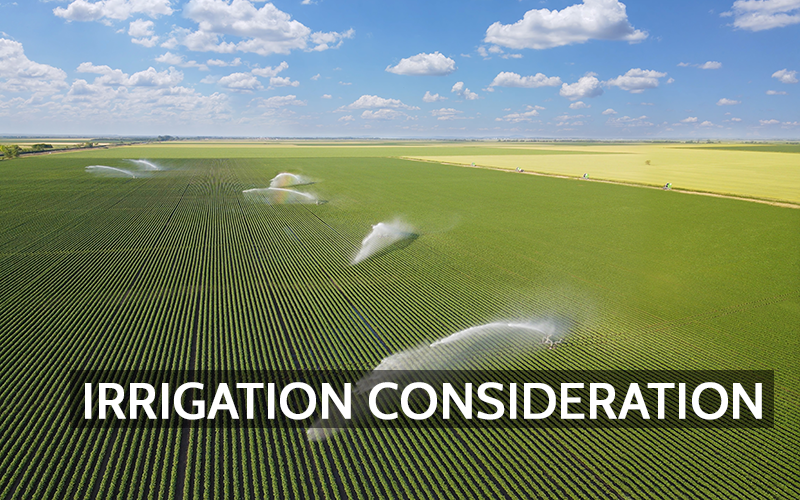
Large-scale irrigation makes farming possible in many dry regions and helps stabilize food production during periods of low rainfall. Center-pivot sprinklers, flood-irrigated fields, canals, pumps, and drip systems move enormous amounts of water across agricultural landscapes. Although irrigation is mainly discussed as a water-management issue, it can also influence the air above farms and in nearby communities.
Some of irrigation’s effects are beneficial. Dry, loose soil is easily lifted by wind or disturbed by tractors and harvesting equipment. Adding water increases soil moisture, helps particles stick together, and can temporarily reduce windblown dust. This is especially important in desert and semi-desert farming regions, where exposed soil may produce high levels of PM10, a category of inhalable particles small enough to enter the respiratory system.
Growing crops also protect the ground. A healthy crop canopy slows wind near the soil surface, while roots and plant residue reduce erosion. In this way, irrigation can indirectly improve air quality by supporting vegetation on land that might otherwise remain dry and dusty.
However, the relationship between irrigation and clean air is not always simple.
Large Sprinklers and Center-Pivot Systems
Center-pivot and other large sprinkler systems spray water through the air before it reaches the crop. Under hot, dry, or windy conditions, some droplets evaporate or drift away from the target area. This reduces irrigation efficiency and can carry very small droplets beyond the field.
If irrigation water contains high concentrations of dissolved minerals, evaporation may leave tiny mineral residues in the air. This does not mean every sprinkler system creates harmful pollution, but water quality, droplet size, wind speed, and operating pressure all affect the possibility of airborne salt or mineral particles. Sprinklers that apply recycled wastewater can require additional controls because drifting droplets may also carry odors or biological material.
Irrigation can also change local weather conditions. Evaporation cools the land surface and adds moisture to the lower atmosphere. This may reduce daytime temperatures and sometimes lower ground-level ozone formation. At the same time, cooler and more humid air can favor the formation of certain fine particles when ammonia from fertilizer mixes with nitrogen oxides from engines, traffic, or other sources. The overall effect depends on local pollution levels and weather patterns.
Flood Irrigation and Soil Salinity
Flood irrigation moves water across the soil surface through channels, furrows, or shallow sheets. While a field remains wet, dust emissions are usually reduced. Problems can develop when irrigation water evaporates and leaves salts behind.
All natural water contains some dissolved material. In well-drained soil, part of that salt can be carried below the crop root zone. In poorly drained fields, especially in hot desert climates, repeated irrigation and evaporation may concentrate salts near the surface. When the soil later dries, farming activity or strong winds can break the salty crust into airborne dust.
Flood irrigation can also leave parts of a field excessively wet while other areas remain dry. Improving field leveling, drainage, and irrigation timing helps prevent both water waste and the development of easily eroded surfaces.
Irrigation in Desert Regions
Desert agriculture can create large areas of productive vegetation that reduce local dust, but it may also shift air-quality risks elsewhere. Water diversions for farming can reduce flows into lakes, wetlands, and natural floodplains. As these water bodies shrink, previously submerged lakebed, often called playa, may become exposed.
Dry playa can be a serious dust source because its fine sediments may contain salts and other accumulated materials. The Salton Sea in California is a well-known example. Agricultural drainage has historically provided much of the lake’s inflow, while changing water use and conservation practices have contributed to concerns about declining water levels and exposed shoreline.
California is now using several methods to manage these conditions. Projects around the Salton Sea include shallow-water habitat, vegetation establishment, surface roughening, and other techniques designed to slow wind near the ground and reduce dust from exposed lakebed.
Energy Use and Irrigation Pumps
Moving water across large farms requires energy. Water may need to be pumped from underground wells, canals, rivers, or storage reservoirs. Older diesel-powered irrigation pumps can release nitrogen oxides and fine particulate matter. Nitrogen oxides also contribute to the formation of ground-level ozone and secondary particle pollution.
Replacing older diesel engines with electric motors can nearly eliminate emissions at the pump itself. When electrical connections are unavailable, newer low-emission diesel engines, properly maintained equipment, solar-powered pumps, and more efficient irrigation systems can reduce fuel use and pollution.
Managing Irrigation-Related Air Pollution
Farmers and water agencies can reduce these impacts through careful system design and operation. Sprinklers can be run during lower-wind periods or at night, when evaporation and human exposure may be lower. Low-pressure nozzles and drop hoses place water closer to the crop and reduce drift. Drip and subsurface irrigation deliver water directly to the root zone, minimizing airborne spray and often reducing energy use.
Regular soil and water testing helps identify salinity before it becomes severe. Adequate drainage, precise irrigation scheduling, cover crops, crop residue, windbreaks, and reduced tillage protect soil from wind erosion. Farmers can also avoid leaving large fields bare after harvest, particularly during dry and windy seasons.
In areas near shrinking lakes or abandoned farmland, air-quality management may require regional action. Dust-monitoring stations, exposed-soil mapping, community reporting, vegetation projects, wetland construction, and emergency dust controls can protect communities beyond individual farm boundaries.
Irrigation is neither automatically good nor bad for air quality. It can suppress dust, cool the landscape, and support protective vegetation, but inefficient systems can waste water, spread spray, increase energy-related emissions, or contribute to long-term salinity and exposed lakebeds. The best results come from treating water, soil, energy, and air as connected parts of the same agricultural system.
References
- https://www.nrcs.usda.gov/sites/default/files/2024-10/449_NHCP_CPS_Irrigation_Water_Management_2024_0.pdf
- https://www.nrcs.usda.gov/sites/default/files/2023-01/7385.pdf
- https://www.nrcs.usda.gov/programs-initiatives/eqip-air-quality-initiative/california/air-quality-initiative-california
- https://www.nrcs.usda.gov/conservation-basics/climate/climate-smart-mitigation-activities
- https://www.nrcs.usda.gov/resources/tech-tools/wind-erosion-prediction-system
- https://pubs.usgs.gov/publication/ofr20131133
- https://saltonsea.ca.gov/program/
- https://saltonsea.ca.gov/projects/
- https://acp.copernicus.org/articles/25/4211/2025/