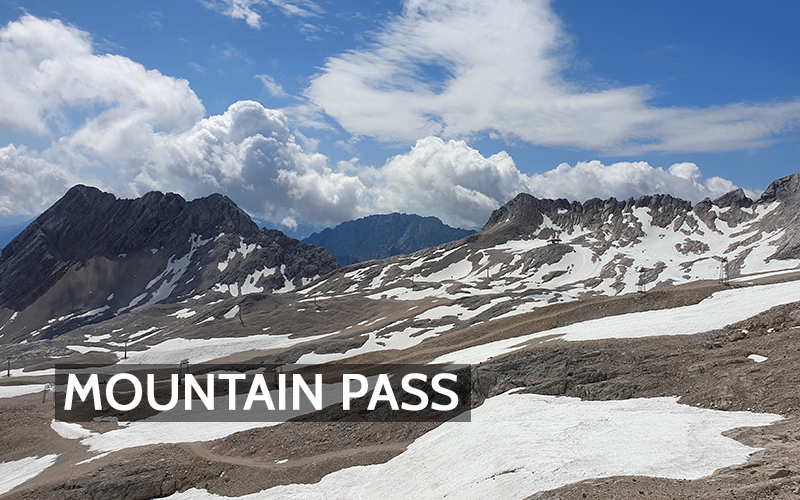
Mountains shape far more than scenery. By blocking winds, redirecting air currents, forcing air upward, and creating sheltered valleys, mountain ranges can strongly influence where pollution travels and how long it remains near the ground.
In some regions, mountains act like walls around cities and communities. Exhaust, smoke, industrial emissions, and other pollutants may accumulate inside the surrounding basin. In other situations, mountain winds can move pollution away from populated areas or carry it into remote high-elevation environments.
The result depends on the shape of the terrain, the season, the weather, and the location of pollution sources.
Valleys and Basins Can Trap Pollution
Air pollution usually becomes less concentrated when it mixes with cleaner air. Strong winds and rising warm air help carry pollutants away from roads, buildings, and industrial areas.
Mountain valleys can restrict this movement. Ridges may block horizontal winds, while the narrow shape of a valley limits the directions in which air can travel. If local winds are weak, emissions from vehicles, wood stoves, factories, construction equipment, and other sources may remain concentrated near the community that produced them.
Large basins surrounded by mountains can experience a similar problem. A city may release pollution throughout the day, but the surrounding terrain prevents the atmosphere from replacing that air efficiently.
This does not mean every mountain valley has poor air quality. Open valleys with frequent winds may disperse pollution effectively. Problems become more likely when mountain terrain combines with calm and stable weather.
Temperature Inversions Create a Lid
Normally, air near the ground warms during the day and begins to rise. As it rises, it carries pollutants upward and encourages atmospheric mixing.
During a temperature inversion, this pattern is reversed. A layer of warm air sits above colder air near the surface. Because the cold air is dense and cannot rise through the warmer layer, the atmosphere becomes stable.
The warm layer acts like a lid. Vehicle exhaust, wood smoke, industrial emissions, and fine particles remain trapped below it.
Mountain valleys are especially vulnerable because cold air naturally flows downhill and collects in low areas. On clear winter nights, the ground loses heat rapidly. Air touching the cold surface cools, becomes heavier, and drains down mountain slopes into the valley.
If calm high-pressure weather continues, the cold-air pool may remain for several days. Each morning commute, fireplace, furnace, and industrial operation adds more pollution beneath the inversion.
Fine particulate matter can become a major concern during these events. Nitrogen oxides, volatile organic compounds, ammonia, and other gases may also react in the trapped air and form additional particles. A valley may therefore experience worsening pollution even when emissions remain relatively constant.
Wildfire Smoke Settles Into Low Areas
Wildfire smoke follows the same terrain that controls ordinary air pollution.
During the day, heating may cause smoke to rise and mix through a deeper section of the atmosphere. At night, cooling air can carry smoke downhill into valleys, canyons, and river corridors. Residents may wake to worse conditions even when the fire itself is located at a higher elevation.
Fine smoke particles can remain suspended for long periods and travel far from the original fire. Once smoke enters a mountain valley, weak winds and an inversion may prevent it from leaving.
This makes monitoring difficult. A sensor on a mountain ridge may report relatively clean air while the town below experiences unhealthy particle levels. Air-quality agencies and fire managers therefore use combinations of permanent stations, portable monitors, satellite images, weather forecasts, and observations from different elevations.
Mountains Redirect Pollution
Mountain ranges do not always stop pollution. They can also guide it.
During sunny days, mountain slopes warm more quickly than the air above them. Warm air begins moving uphill, producing an upslope or valley breeze. These winds can carry vehicle emissions and urban pollution from low-elevation cities toward forests, parks, and mountain communities.
At night, the slopes cool and the direction may reverse. Denser air flows downhill and returns toward the valley. In some regions, this daily circulation can move pollution back and forth rather than allowing it to leave the area completely.
Strong regional winds may carry pollution through mountain passes or over ridges. As the daytime atmosphere becomes deeper and more turbulent, polluted air from a nearby metropolitan area can reach surprisingly high elevations.
This matters because remote mountain environments are not necessarily protected from urban emissions. Ozone, nitrogen compounds, smoke, and fine particles can damage vegetation, reduce visibility, and change soil and water chemistry far from the original source.
Rainfall Can Clean the Air
Mountains can also improve air quality by forcing moving air upward. As air rises, it expands, cools, and may form clouds. Rain or snow can then remove particles and soluble gases from the atmosphere.
This process, called wet deposition, can temporarily produce cleaner air on the windward side of a range. However, the pollutants do not simply disappear. They are transferred to soil, lakes, streams, snowpack, and vegetation.
The opposite side of the mountain may remain much drier. This is known as a rain shadow. Dry soil and sparse vegetation can become sources of windblown dust, particularly when drought, grazing, construction, or land disturbance leaves the surface exposed.
Mountains can therefore encourage cleaner air on one side while contributing to dusty conditions on the other.
Elevation Changes the Pollution Mixture
Air quality may differ sharply between a valley floor and a nearby summit.
Valleys often experience higher levels of pollutants released close to the ground, especially during inversions. Mountain peaks are usually better exposed to regional winds and may sit above the trapped layer.
High elevations can still receive pollution transported over long distances. Ozone concentrations may sometimes remain elevated because there are fewer fresh vehicle emissions available to react with and remove it. Smoke and dust transported across continents may also pass through mountain air.
Occasionally, ozone-rich air from the upper atmosphere can descend toward high terrain. This means an elevated ozone reading does not always come entirely from nearby human activity.
Managing Air Quality in Mountain Regions
Communities surrounded by mountains must combine emission controls with careful weather forecasting. Agencies may issue air-stagnation advisories when inversions and calm winds are expected. Residents may be asked to limit wood burning, unnecessary driving, outdoor burning, and other activities that release particles.
Cities can reduce routine emissions through cleaner vehicles, industrial controls, improved public transportation, restrictions on high-polluting heating systems, and better management of construction dust.
Monitoring stations should represent different elevations and parts of the valley. A single monitor may miss pollution that collects in a canyon, settles near the valley floor, or moves upslope during the afternoon.
Mountains do not create most urban air pollution, but they determine what happens after it is released. By trapping, lifting, redirecting, or washing pollutants from the atmosphere, terrain helps decide which communities breathe clean air, and which remain beneath a layer of haze.
References
- https://www.epa.gov/pmcourse/clinical-scenario-2-particle-pollution
- https://www.epa.gov/air-quality/wildland-fires-and-smoke
- https://www.epa.gov/cmaq/wildland-fires-cmaq
- https://scied.ucar.edu/learning-zone/air-quality/how-weather-affects-air-quality
- https://scied.ucar.edu/image/temperature-inversion
- https://scied.ucar.edu/learning-zone/air-quality/what-is-air-quality
- https://scied.ucar.edu/learning-zone/clouds/clouds-form-mountains
- https://csl.noaa.gov/news/2021/315_0519.html
- https://psl.noaa.gov/news/2021/051921.html
- https://csl.noaa.gov/groups/csl7/measurements/2017uwfps/
- https://www.nps.gov/yose/learn/nature/aqmonitoring.htm
- https://www.nps.gov/articles/airprofiles-yose.htm
- https://www.nps.gov/articles/airprofiles-yell.htm