Concrete covers enormous portions of modern cities.
Buildings, bridges, retaining walls, parking structures, and noise barriers create durable infrastructure, but they also replace vegetation with hard surfaces that absorb heat, shed rainwater, and provide little habitat.
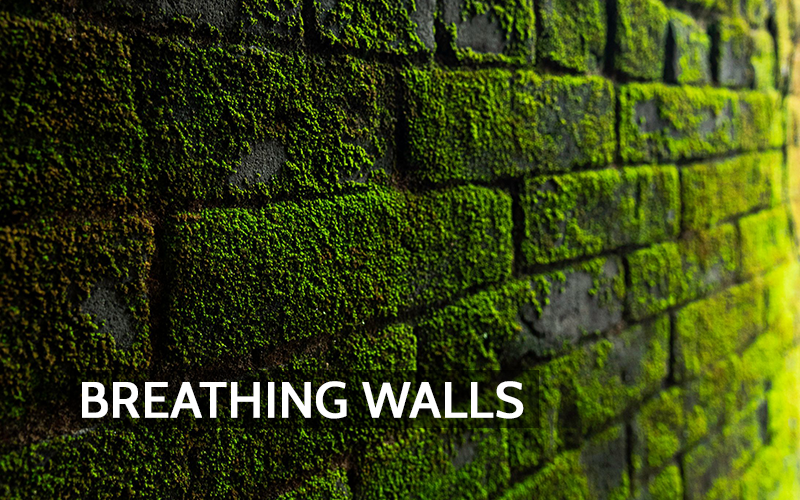
A Dutch company called Respyre is experimenting with a different approach: making concrete deliberately hospitable to moss.
Its technology, called Mosscrete, is designed to turn otherwise bare walls into living surfaces without the soil beds, irrigation pipes, and structural systems commonly associated with traditional green walls.
For air-quality researchers, the concept raises an interesting question.
What happens when millions of square feet of passive urban surfaces become biologically active?
Ordinary Concrete Is Not Friendly to Moss
Moss readily colonizes old stones and walls in nature, but modern concrete is not necessarily an ideal habitat.
Fresh concrete is highly alkaline, dries quickly, and may provide few suitable places for moss to establish itself.
Respyre’s approach is based on bioreceptive concrete.
Instead of treating biological growth as deterioration that should be prevented, the surface is engineered to encourage it.
The composition, porosity, surface texture, and chemistry of the material are modified to create conditions in which moss can attach and survive.
Moss does not have roots like a tree or flowering plant. It anchors itself using tiny structures called rhizoids, which means it can grow on relatively thin surfaces without requiring deep soil.
How Mosscrete Works
Respyre grew out of research associated with Delft University of Technology in the Netherlands.
Earlier versions of the system used a porous concrete layer followed by a sprayed biological mixture containing fragments of moss. The surface was watered while the moss established itself.
The company’s current Mosscrete system is designed so that, once established under suitable conditions, the moss can rely largely on rainfall and atmospheric humidity rather than a complicated permanent irrigation network.
Respyre has developed versions for new construction as well as coatings and façade systems that can be applied during renovation.
Projects have now included apartment buildings, industrial structures, bridge surfaces, and a roughly 300-square-meter noise barrier in the Netherlands.
Moss Can Intercept Airborne Particles
One of the most interesting potential benefits involves particulate matter.
Moss creates a dense, irregular surface containing leaves, stems, moisture, and microscopic structures.
Particles carried by moving air can collide with this surface and become trapped rather than continuing through the atmosphere.
The principle is similar to particulate deposition onto tree leaves, grass, and other vegetation.
Respyre lists fine-particle capture as one of the environmental functions of Mosscrete, and scientific reviews of moss-covered bioreceptive concrete identify particulate interception as a promising ecosystem service.
However, an important distinction remains.
Showing that moss collects particles on its surface is much easier than demonstrating that covering a building with moss produces a measurable reduction in neighborhood PM2.5 concentrations.
Urban air is constantly moving and receiving new pollution from traffic, industry, heating, construction, and regional sources.
The ability of moss façades to meaningfully change citywide air pollution therefore still requires considerably more field measurement.
What About NOx and Carbon Dioxide?
Respyre also promotes its moss systems as capable of taking up carbon dioxide and interacting with nitrogen pollution.
The basic biology is sound.
Moss performs photosynthesis, using carbon dioxide to build new tissue, and mosses can absorb nitrogen compounds from their surroundings. Moss has long been used by scientists as a biomonitor because pollutants and metals accumulate within its tissues.
Scale again matters.
A thin layer of moss growing on a building contains far less biomass than a mature forest. Its carbon storage should therefore not be interpreted as a major method of atmospheric carbon sequestration.
Its value may instead come from combining numerous smaller functions across surfaces that currently provide almost no biological activity.
A wall can potentially capture some particles, take up some carbon, retain water, provide habitat, and alter its thermal behavior simultaneously.
Can Moss Cool Buildings?
Urban cooling is another major part of the Mosscrete concept.
Concrete absorbs solar energy during the day and later releases heat, contributing to the urban heat island effect.
Living vegetation can alter that energy balance through shading, insulation, water retention, and evaporation.
Recent TU Delft research shows that moss makes this relationship more complicated than simply saying that a green wall is always cooler.
When moss was dry and exposed to direct sunlight, researchers measured surface temperatures several degrees warmer than bare mortar in some experiments because the darker moss absorbed more sunlight.
When the moss contained water, evaporation produced a cooling effect.
Researchers observed measurable cooling for several hours after watering, while the moss layer also reduced heat transfer into the material underneath.
This suggests that climate, shade, rainfall, wall orientation, and moisture availability will strongly affect how well a moss façade performs as a cooling system.
Rainwater Becomes Part of the Design
Moss can absorb surprisingly large quantities of water relative to its size.
Instead of rain immediately striking an impermeable wall and becoming runoff, part of that water can temporarily remain within the moss and porous surface.
It can later evaporate or drain more gradually.
For cities facing intense rainfall, large areas of vegetated surfaces could potentially complement other stormwater strategies such as green roofs, rain gardens, and permeable pavement.
The moss also benefits from the same water it intercepts.
This creates a system in which rainfall supports the biological surface while the biological surface changes how rainfall leaves the building.
Living Walls Without Traditional Green-Wall Infrastructure
Conventional vertical gardens can be impressive, but they often require planters, structural supports, irrigation, pumps, fertilizer, replacement plants, and regular maintenance.
Moss offers a different model.
It remains extremely small, does not require deep soil, and many species can tolerate drying before becoming metabolically active again when water returns.
That potentially makes moss suitable for structures where a conventional planted wall would be impractical.
Respyre is already experimenting with noise barriers, bridges, industrial buildings, and residential façades rather than limiting the technology to decorative installations.
A Promising Idea That Still Needs Measurement
Mosscrete should not be treated as a device capable of cleaning an entire city’s atmosphere.
Current scientific reviews of bioreceptive concrete repeatedly identify the same limitation: many proposed ecosystem benefits are plausible, but researchers still lack enough quantitative real-world data to determine their magnitude at scale.
That is not unusual for a developing green technology.
The interesting part of Respyre’s experiment is the surface being reconsidered.
Cities contain enormous quantities of concrete that currently perform only structural or architectural functions.
If even some of those surfaces can also support living organisms, retain rainwater, intercept airborne particles, provide habitat, and influence building temperatures, the wall itself begins performing ecological work.
The future of urban greening may therefore involve more than planting trees and building parks.
Some of it may grow directly on the concrete already surrounding us.
References
- Respyre — Mosscrete
- Respyre — About the Company
- Respyre — Mosscrete FAQ
- Respyre — Hoofddorp Noise Barrier Project
- Respyre — Purmerend Social Housing Project
- TU Delft — Bioreceptive Concrete: State of the Art and Potential Benefits
- TU Delft — Growing Moss on Bioreceptive Concrete Using a Novel Two-Step Approach
- TU Delft — Irrigation of Urban Moss Surfaces
- TU Delft — Evaporative Cooling of a Bioreceptive Concrete Facade
- TU Delft — How Moss Affects Urban Temperatures