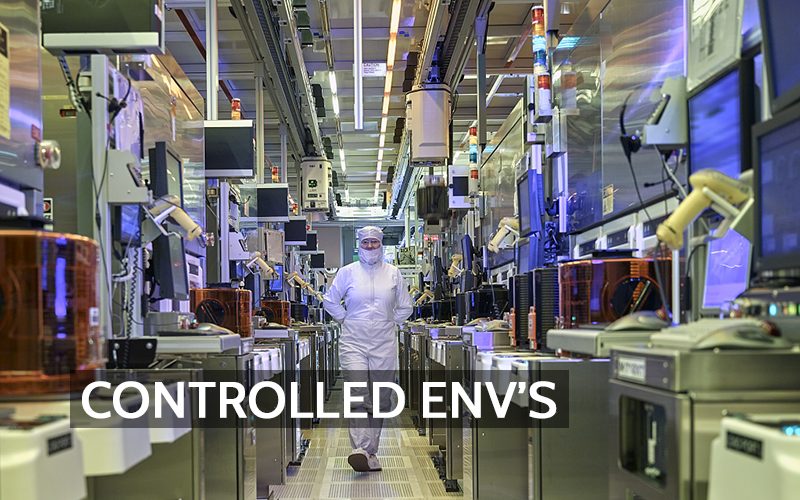
A room can look spotless while still containing millions of invisible particles. Dust, skin cells, clothing fibers, microorganisms, chemical vapors, and tiny droplets continuously enter ordinary indoor air. In most buildings, these materials create few immediate problems. In certain manufacturing environments, however, a single particle or microorganism may damage a product, interrupt a process, or place a patient at risk.
Cleanrooms are specially designed spaces that control airborne contamination. They are used in pharmaceutical production, biotechnology, medical-device manufacturing, semiconductor fabrication, optics, aerospace, and other industries where ordinary indoor air is not clean enough.
What Makes a Cleanroom Different?
A cleanroom is not simply a room that receives frequent cleaning. Its walls, ceilings, ventilation system, equipment, clothing procedures, and work practices are all designed to limit the introduction, production, and accumulation of contamination.
Cleanrooms are commonly classified according to the number and size of airborne particles found in a measured volume of air. ISO 14644-1 establishes internationally recognized cleanliness classes. A lower ISO class represents a cleaner environment with fewer permitted particles.
The required cleanliness depends on the process. A room used to assemble large mechanical components may not need the same level of control as an area where open sterile medicine is being filled into vials. The cleanest conditions are usually placed directly around the most sensitive product or operation.
Why Is the Air Controlled?
Different industries control air for different reasons.
In sterile pharmaceutical manufacturing, bacteria, fungi, and other microorganisms could contaminate an injectable drug. Because the product may be introduced directly into the body, contamination could cause infection or serious illness. Particles may also interfere with product quality even when they are not alive.
In semiconductor manufacturing, an extremely small particle can settle onto a circuit pattern and block or alter a feature. As electronic components become smaller, particles that once seemed insignificant can damage a chip or reduce production yield.
Medical devices, optical equipment, spacecraft components, and precision instruments may also fail if dust, oils, fibers, or chemical residues reach sensitive surfaces. Cleanroom air control therefore protects both safety and manufacturing consistency.
Filtering and Replacing the Air
The cleanroom ventilation system is one of its most important controls. Incoming air passes through high-efficiency filters, commonly HEPA filters, before entering the room. More demanding applications may use ULPA filters, which are designed to capture even smaller particles at very high efficiencies.
Cleanrooms also recirculate and filter large volumes of indoor air. Contaminants released inside the room are carried back toward filters instead of being allowed to accumulate. The amount of air moved can be much greater than in an ordinary office or home.
There is no single correct number of air changes for every cleanroom. The required airflow depends on room size, cleanliness classification, process risk, equipment heat, occupancy, and the amount of contamination generated during work.
Filters mainly control particles. They do not automatically remove every gas or chemical vapor. Processes that release solvents, acids, or other chemicals may require activated-carbon filtration, local exhaust, scrubbers, or specialized air-handling systems.
Controlling the Direction of Airflow
Cleanroom air must move in a predictable direction. In many rooms, filtered air mixes throughout the space before returning through low-wall or ceiling vents. Highly critical areas may use unidirectional airflow, sometimes called laminar airflow, which moves filtered air in a consistent path across exposed products and work surfaces.
Airflow visualization tests use visible fog or smoke-like material to demonstrate how air moves around workers, equipment, and open products. These studies can reveal turbulence, stagnant areas, or air moving from a contaminated surface toward a critical operation.
Cleanrooms are also commonly maintained at a higher air pressure than surrounding spaces. When a door opens, air flows outward from the cleaner room, helping prevent unfiltered air from entering. A series of rooms may form a pressure cascade, with the cleanest room having the highest pressure.
The direction may be reversed when hazardous materials must be contained. Rooms handling potent drugs, infectious agents, or toxic powders may operate under negative pressure so contaminated air does not escape into adjoining areas.
People Are a Major Contamination Source
Even healthy people continuously release skin cells, hair, respiratory droplets, and microorganisms. Clothing produces fibers, while walking and reaching create air currents that move particles around the room.
Workers therefore enter through controlled changing areas or airlocks and wear garments selected for the cleanliness level. These may include coveralls, hoods, masks, gloves, goggles, and dedicated footwear.
Cleanroom clothing does not make a person sterile. It creates a barrier that reduces the amount of material released into the environment. Careful gowning, slow movement, proper glove disinfection, and restrictions on unnecessary activity are essential parts of contamination control.
Materials entering the room may also be cleaned, disinfected, unwrapped in stages, or transferred through pass-through chambers. Cardboard, ordinary paper, pencils, cosmetics, food, and other particle-generating materials are frequently restricted.
Cleaning and Monitoring the Environment
Cleanroom surfaces are normally smooth, sealed, and easy to disinfect. Shelves, ledges, cracks, and rough materials are minimized because they collect particles and are difficult to clean.
Specialized procedures define which cleaning agents are used, how frequently areas are cleaned, and the direction in which workers wipe surfaces. Pharmaceutical cleanrooms may rotate disinfectants and use sporicidal agents to control resistant microbial spores.
Monitoring confirms whether the controls continue to work. Airborne particle counters measure nonliving particles, while active air samplers, settle plates, and surface-contact plates are used to evaluate microorganisms. Facilities may also monitor temperature, humidity, room pressure, airflow velocity, and filter condition.
Alert and action limits help identify unusual results. A single high reading may trigger an investigation, while gradual changes over time can reveal a weakening filter, poor cleaning practice, damaged room seal, or change in worker behavior.
Testing alone cannot create a clean environment. Monitoring shows whether the facility design, procedures, maintenance, and employee practices are working together as intended.
Cleanroom air quality is controlled because invisible contamination can have visible consequences: rejected products, damaged electronics, production delays, regulatory action, or harm to patients. By combining filtered air, controlled airflow, pressure differences, careful gowning, cleaning, and continuous monitoring, cleanrooms create environments where sensitive manufacturing can be performed reliably.
References
- https://www.iso.org/standard/53394.html
- https://www.iso.org/standard/53393.html
- https://www.iso.org/news/2016/01/Ref2041.html
- https://www.fda.gov/regulatory-information/search-fda-guidance-documents/sterile-drug-products-produced-aseptic-processing-current-good-manufacturing-practice
- https://www.fda.gov/media/71026/download
- https://health.ec.europa.eu/medicinal-products/eudralex/eudralex-volume-4_en
- https://health.ec.europa.eu/system/files/2022-08/20220825_gmp-an1_en_0.pdf
- https://www.nist.gov/news-events/news/2004/06/nist-launches-advanced-measurement-laboratory