Air pollution is often associated with smokestacks, vehicle exhaust and wildfires. However, some of the particles suspended in the atmosphere begin with a much older process: the gradual breakdown of the Earth’s surface.
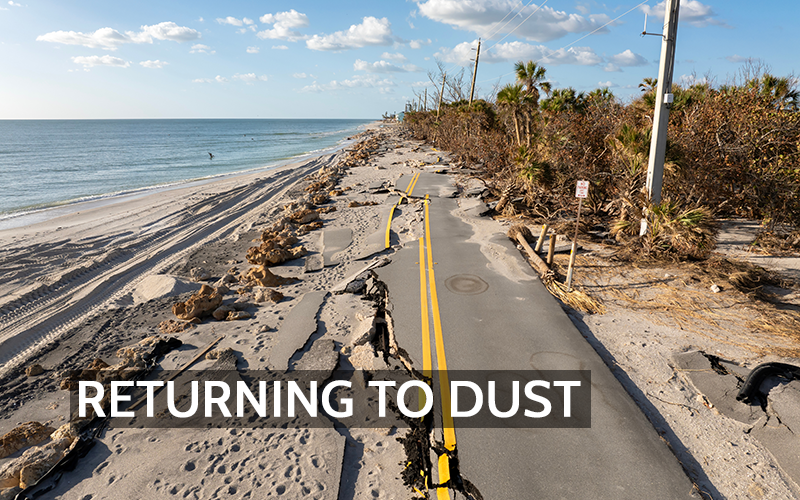
Wind, rain, flowing water, ice, temperature changes and coastal waves continually wear away rock and soil. These geological processes produce loose fragments that range from large boulders to microscopic mineral particles. When the smallest particles become dry and exposed, wind can lift them into the atmosphere as dust.
The effect on air quality depends on several connected factors. The original rock determines what the particles contain, the type of erosion influences their size and shape, and the climate controls how easily they become airborne. As a result, dust from a limestone plain may behave differently from dust produced by volcanic ash, desert sandstone or a drying lakebed.
From Solid Rock to Airborne Dust
Weathering and erosion are closely connected but slightly different processes. Weathering breaks rock apart or changes it chemically, while erosion removes and transports the resulting material.
Physical weathering can occur when water freezes inside cracks, expanding and gradually splitting the rock. Large temperature changes can also stress exposed surfaces, while plant roots and salt crystals can widen existing fractures. Chemical weathering changes minerals through reactions with water, oxygen and weak natural acids.
These processes eventually create gravel, sand, silt and clay. Sand grains are generally too large to remain suspended in the air for long, although strong winds can make them bounce across the ground. This movement, known as saltation, causes grains to strike the surface and knock finer particles loose.
Silt, clay and other microscopic fragments can rise much higher and travel much farther. Some become part of PM10, the category of inhalable particles measuring 10 micrometers or smaller. The finest material can enter the PM2.5 range and remain suspended for extended periods.
Wind Erosion in Arid and Semi-Arid Climates
Drylands are among the world’s largest natural sources of mineral dust. Rainfall is limited, vegetation is often sparse and exposed sediment can remain dry for months. When strong winds pass across these surfaces, loose particles are swept into the atmosphere.
Deserts are not simply endless fields of loose sand. Many contain dry river channels, clay-rich depressions, exposed lake sediments and areas of weathered rock. These finer materials can contribute more heavily to airborne particulate pollution than large dune sand.
Soil moisture is particularly important. Even a small amount of water can help bind particles together. During droughts, this binding effect disappears, vegetation declines and the land becomes more vulnerable to wind erosion.
Dust storms can therefore become especially severe when prolonged dryness is followed by strong winds. These events can raise particulate matter concentrations across entire regions and carry mineral dust hundreds or even thousands of miles from its source.
Quartz-Rich Sandstone and Granite
Sandstone and granite commonly contain quartz, one of the most abundant minerals in the Earth’s crust. Quartz is resistant to chemical weathering, which allows it to remain after less durable minerals have broken down.
Much of the quartz released from these rocks remains in relatively large sand grains. However, repeated grinding, crushing and abrasion can also produce much smaller fragments. Natural erosion, road traffic, construction and land disturbance can all contribute to the release of this finer material.
The presence of quartz matters because very small particles of crystalline silica can damage lung tissue when exposure is sufficiently intense and prolonged. The greatest risks are generally associated with occupations such as mining, stone cutting and construction, where mechanical processes generate concentrated silica dust. Natural dust normally occurs at lower and more variable concentrations, but its mineral composition can still influence the potential health effects of a dust event.
Clay, Shale and Loess
Clay-rich soils and weathered shale can generate extremely fine particles. Individual clay minerals are much smaller than typical sand grains and can remain airborne for long periods once separated from the soil surface.
However, clay does not always release dust easily. When moist, its particles stick together strongly. Even when dry, clay can form hard crusts or stable aggregates that resist moderate winds. Dust emissions rise when these crusts are broken by drought, grazing, vehicle traffic, cultivation or repeated wetting and drying.
Loess deposits are another important source. Loess consists largely of wind-deposited silt that accumulated during earlier geological periods. These deposits can form deep, fertile soils, but they are also highly erodible when vegetation is removed. In dry agricultural regions, exposed loess can produce large amounts of airborne PM10 during strong wind events.
The mineral mixture within clay and loess commonly includes quartz, feldspar, mica, iron oxides and aluminosilicate minerals. This composition gives dust from each region its own chemical signature.
Limestone and Carbonate-Rich Landscapes
Limestone is primarily composed of calcium carbonate, while dolostone contains additional magnesium. These rocks are easily weathered by slightly acidic rainwater, producing caves, sinkholes and other features associated with karst landscapes.
Chemical weathering often removes carbonate rock in dissolved form rather than producing large quantities of airborne dust. Physical erosion, however, can generate pale, alkaline particles from exposed limestone, dried sediments, unpaved roads and disturbed soils.
Carbonate-rich dust is often dominated by coarse particles that settle relatively close to their source, although smaller fractions can travel farther. These particles may irritate the eyes, nose and respiratory tract when concentrations become high.
Mineral dust can also interact with other substances in the atmosphere. Carbonate particles are alkaline and may partially neutralize acidic compounds carried in polluted air. This does not make the dust harmless, but it demonstrates how geology can influence atmospheric chemistry as well as particle concentration.
Volcanic Ash and Eroding Volcanic Terrain
Volcanic eruptions can inject ash directly into the atmosphere, but the air-quality problem does not necessarily end when the eruption stops.
Volcanic ash consists of sharp fragments of volcanic glass, minerals and pulverized rock. Once deposited, it can cover roads, fields, rooftops and bare ground. In dry or windy climates, the ash may be repeatedly lifted back into the air for weeks, months or even years.
The composition of volcanic ash depends on the volcano and the type of magma involved. Some ash contains respirable crystalline silica, particularly material associated with silica-rich magma or collapsing lava domes. Other volcanic deposits may contain lower silica concentrations but still irritate the respiratory system because of their fine size and abrasive shape.
Rain can temporarily improve conditions by washing ash from the air and binding it to the surface. When the deposits dry, however, vehicles, machinery and wind can resuspend them again.
Dry Lakebeds and Exposed Salts
Lakes in closed desert basins collect fine sediment, salts and minerals carried by surrounding rivers and runoff. When the water evaporates naturally, or disappears because of drought and water diversion, the exposed lakebed can become a major dust source.
These dry lakebeds, often called playas, contain extremely fine clay, silt and evaporated salts. Depending on the region’s geology and history, the sediment may also contain arsenic, selenium or other trace elements.
Owens Lake in California became one of North America’s most famous examples after water diversion exposed much of its lakebed. Strong winds carried alkaline and saline dust into surrounding communities, creating a severe regional air-quality problem.
Similar concerns surround other shrinking lakes. Their air-quality effects are shaped not only by climate but also by geology, hydrology and human water use.
Glacial Erosion and Cold-Climate Dust
Glaciers act like enormous grinding machines. Rocks frozen into the base of moving ice scrape across the landscape, producing fine sediment commonly called rock flour.
While a glacier remains present, much of this material is trapped beneath ice or carried away by meltwater. As glaciers retreat, however, newly exposed floodplains, outwash deposits and former lakebeds may become sources of dust.
Cold regions can therefore experience seasonal dust events, particularly during spring and summer when snow cover disappears and sediments dry. Strong winds flowing from glaciers and mountain valleys can lift fine material from these deposits.
Freeze-and-thaw cycles also break exposed rock into smaller fragments. The underlying geology determines whether the resulting dust is rich in basalt, granite, shale or other rock types.
Water Erosion in Humid Climates
Rainfall usually suppresses airborne dust by wetting the ground and removing particles from the atmosphere. Dense vegetation also shields soil from wind. Humid regions therefore tend to produce less persistent mineral dust than deserts.
Water erosion can still influence future air quality. Heavy rain, flooding and landslides move enormous quantities of sediment. Rivers grind, sort and redeposit this material across floodplains, deltas and lake margins.
If these deposits later dry during a drought, they can become vulnerable to wind erosion. A flood may therefore prepare a fresh supply of fine sediment, while a later dry period provides the conditions needed to lift it into the air.
This connection explains why erosion by water and erosion by wind should not always be viewed separately. One process frequently creates, sorts or exposes the material used by the other.
A Changing Relationship Between Land and Air
Geological erosion is natural, but human activity can greatly increase the amount of dust entering the atmosphere. Removing vegetation, draining lakes, disturbing fragile soil crusts and driving across exposed land all make surfaces more vulnerable.
Changes in climate can further alter this relationship. Longer droughts may dry soils and reduce protective vegetation, while intense rainfall may produce new deposits that later become dust sources. Retreating glaciers and shrinking inland lakes can expose additional sediment.
The result is an air-quality issue controlled by both ancient geology and modern environmental conditions. Every dust cloud carries a sample of the landscape from which it came. Its particles reveal the minerals beneath the soil, the forces that broke them apart and the climate that allowed them to enter the sky.
Understanding those differences helps scientists identify dust sources, predict high-particle events and evaluate their possible effects on nearby communities. It also reminds us that the air above a landscape is closely connected to the ground below it.
References
- https://www.epa.gov/pm-pollution/particulate-matter-pm-basics
- https://www.epa.gov/cmaq/air-surface-exchange-process-overview
- https://www.who.int/news-room/fact-sheets/detail/sand-and-dust-storms
- https://www.who.int/publications/i/item/B09453
- https://www.usgs.gov/publications/monitoring-dust-storms-and-mapping-landscape-vulnerability-wind-erosion-using
- https://www.ars.usda.gov/research/publications/publication/?seqNo115=285629
- https://www.ars.usda.gov/ARSUserFiles/24758/3.%20PM2.5%20and%20PM10%20emissions%20by%20breakage%20during%20saltation%20of%20agricultural%20soils.pdf
- https://pubs.usgs.gov/bul/2149/report.pdf
- https://www.ivhhn.org/information/health-impacts-volcanic-ash
- https://www.ivhhn.org/uploads/ALG_Health_and_safety_in_volcanic_environments_2024.pdf
- https://oceanservice.noaa.gov/facts/sand.html