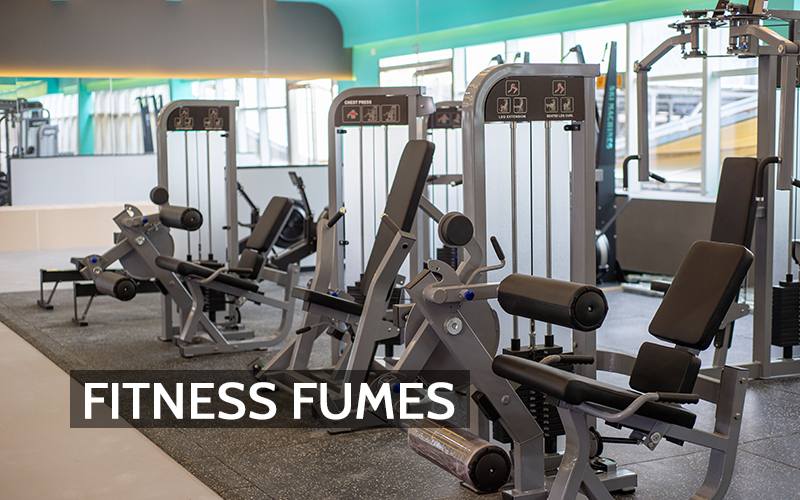
A busy gym brings together people, moving equipment, cleaning products, and materials that can release particles or gases. Exercise adds heat and moisture while lifting settled dust into the air. At the same time, people working out breathe much more heavily than people sitting still. These changes make indoor air quality an important part of the exercise environment.
More Breathing Means More Exposure
During intense exercise, the volume of air moving through the lungs each minute can increase more than tenfold above resting levels. At the same pollutant concentration, breathing more air means inhaling more material over the same period. For particles, the amount that settles in the airways and lungs also depends on size and breathing patterns. A concentration that seems modest therefore deserves attention when people are exercising hard.
CO₂ and Humidity Build With Activity
Exercising muscles produce more carbon dioxide, or CO₂, which leaves the body through breathing. In a crowded studio, CO₂ can build up when outdoor-air ventilation does not keep pace with occupancy and activity. Measuring it can help assess how effectively ventilation dilutes exhaled air. However, CO₂ readings cannot establish the levels of chalk dust, chemical vapors, or infectious particles. An air-conditioned room can feel cool while receiving too little outdoor air.
Breathing and evaporating sweat also add water vapor to the room. High humidity makes sweat evaporate less effectively, which can make exercise feel hotter. Persistent dampness or condensation can support mold growth on building materials. Moisture removal, ventilation, and maintenance therefore matter alongside temperature control.
People Release Bioaerosols
Exhaled droplets are bioaerosols, meaning airborne particles of biological origin. Controlled studies have found that respiratory particle emissions rise sharply during strenuous exercise. If someone has a respiratory infection, some exhaled particles may carry infectious material. Measuring particle emissions alone does not reveal whether those particles contain a pathogen or how likely transmission is.
Floor Dust and Chalk Become Airborne
Running, jumping, and other movement can lift settled floor dust back into the air, a process called resuspension. That dust can contain tracked-in soil, skin flakes, textile fibers, and other accumulated material. Where lifting or climbing chalk is used, magnesium carbonate powder adds another particle source. Applying chalk, brushing surfaces, and disturbing deposited powder can expose both the user and nearby occupants.
Dust control involves reducing both fresh releases and the material available for resuspension. Managing chalk use and cleaning floors and equipment help limit these reservoirs. Cleaning methods that capture dust are preferable to methods that scatter it into the room. Ventilation and particle filtration then help remove the fraction that remains airborne.
Cleaning Products and Gym Materials
Cleaning shared equipment is important, but the products and application methods also affect the air. Sprays can create inhalable droplets, while volatile ingredients enter the air as gases. Research in a university weight room also found that cleaning chemicals could react with substances released by people to form additional airborne compounds. Product selection, application methods, and ventilation during cleaning all influence exposure.
Rubber flooring, foam padding, and installation adhesives can contribute chemical emissions. Some emissions are volatile organic compounds, or VOCs, which evaporate into indoor air. The types and amounts vary with the material, its formulation, age, and surrounding conditions. Materials with documented low emissions and adequate ventilation after installation can help reduce this contribution.
Matching Air Controls to the Workout
Outdoor-air ventilation needs to reflect how many people occupy a space and how intensely they exercise. Effective particle filtration can reduce airborne dust and respiratory aerosols. Particle filters do not remove CO₂, and ordinary particle filtration also does not control gaseous VOCs. Fans can improve air movement, but air circulation alone does not supply fresh outdoor air. Source control, ventilation, filtration, and humidity management address different parts of the problem.
Monitoring during busy classes can reveal conditions that an empty-room inspection misses. CO₂, humidity, temperature, and particle measurements each provide useful information. Their patterns can help identify overcrowding, dust-producing activities, or ventilation problems. Interpreting these measurements together gives a more complete picture of the air people breathe during a workout.
References
- Mutsch and Colleagues: Aerosol Particle Emission During Increasing Exercise Intensity
- Peixoto and Colleagues: Indoor Air Quality in Health Clubs
- Weinbruch and Colleagues: Dust Exposure in Indoor Climbing Halls
- Finewax and Colleagues: Exercise, Cleaning Products, and Airborne Chemicals in an Athletic Center
- CalRecycle: Rubber Flooring Chemical Emissions Study
- CDC: Ventilation Frequently Asked Questions
- EPA: Moisture and Mold Prevention